
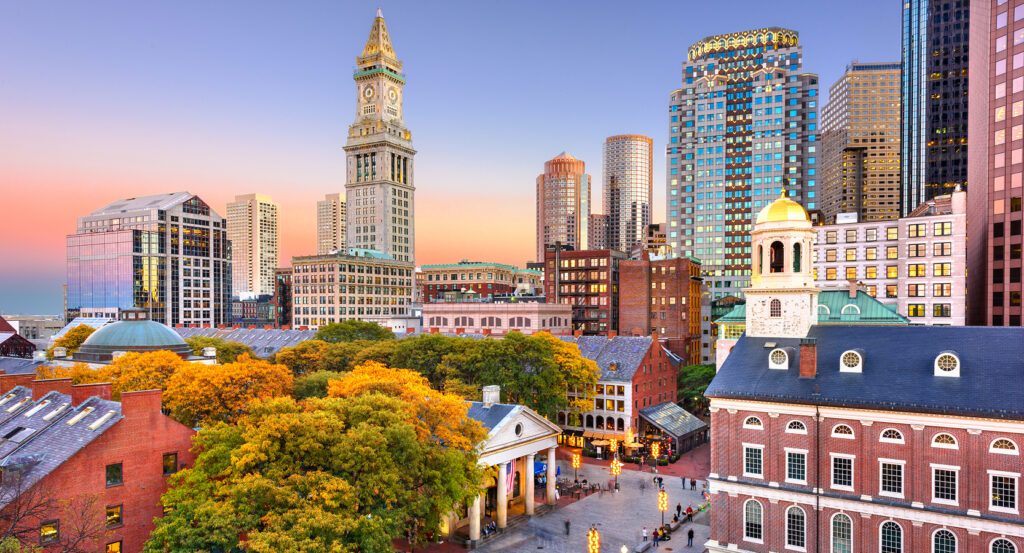
Why North Market Building matters.
North Market Building is a distinguished historic marketplace where the Financial District's mercantile legacy, granite architecture, waterfront commerce, and urban revitalization create one of Boston's most enduring commercial landmarks.
Set along the northern edge of Quincy Market between Clinton Street and Blackstone Street near Faneuil Hall and just steps from Quincy Market, this beautifully preserved granite arcade welcomes visitors into an elegant nineteenth-century marketplace filled with specialty retailers, restaurants, artisan shops, and lively pedestrian corridors. Rhythmic colonnades, historic storefronts, and thriving public spaces create an atmosphere where nearly two centuries of commercial history remain vibrantly alive. Every visit reflects the remarkable continuity of Boston's marketplace tradition. The result is an experience defined by architectural preservation, commercial heritage, and one of the city's finest historic market buildings.
What defines North Market Building.
North Market Building is best known for opening in 1826 as one of the three principal buildings comprising Quincy Market, the ambitious commercial expansion commissioned by Mayor Josiah Quincy Jr. to relieve overcrowding around Faneuil Hall while establishing Boston as one of America's leading nineteenth-century trading centers. Designed by prominent architect Alexander Parris, the granite structure formed the northern anchor of the new marketplace opposite South Market Building, extending the commercial district through rows of merchant spaces, food vendors, wholesale businesses, storage facilities, and specialty retailers serving Boston's rapidly expanding waterfront economy. Throughout the nineteenth century the building accommodated fishmongers, butchers, grocers, produce dealers, dry goods merchants, and importers supplying both local residents and ships arriving from ports around the world. After periods of economic decline during the mid-twentieth century, North Market Building became a centerpiece of the internationally influential Faneuil Hall Marketplace redevelopment, completed in 1976 under developer James Rouse and architect Benjamin C. Thompson, whose adaptive reuse preserved the building's historic granite exterior while introducing energetic retail, dining, and public gathering spaces that helped redefine historic preservation in American cities. As an integral component of the National Historic Landmark-designated Quincy Market complex, the building also received recognition through the 2024 Boston Landmark designation, affirming its importance as one of the city's finest surviving examples of early nineteenth-century commercial architecture.
Beyond its architectural significance, North Market Building demonstrates the enduring success of preserving historic commercial infrastructure while adapting it for contemporary urban life. The building's long granite arcades, generous storefronts, and pedestrian-oriented layout continue supporting the marketplace tradition envisioned nearly two centuries ago, welcoming millions of visitors annually within a remarkably authentic historic setting. Its direct relationship with Quincy Market, Faneuil Hall, and the Blackstone Block reinforces the district's importance as the birthplace of Boston's commercial identity. Historic preservation, adaptive reuse, waterfront commerce, and thoughtful urban planning combine to create one of New England's most influential marketplace buildings.
How North Market Building fits.
North Market Building works as the historic commercial centerpiece of an exploration through Faneuil Hall Marketplace.
Begin at Quincy Market, where Boston's celebrated food hall introduces the remarkable marketplace surrounding North Market Building. Continue to Faneuil Hall, whose revolutionary history complements the district's commercial legacy. Conclude at the Blackstone Block Historic District, where Boston's oldest surviving commercial streets provide a memorable finale celebrating the remarkable relationship between commerce, preservation, and urban development that defines Downtown. The progression moves naturally from historic marketplace to preserved commercial arcade before concluding through two defining historic landmarks, revealing why North Market Building remains one of Boston's essential historic experiences.
Where your story begins.
Foresyte Travel reveals places that feel extraordinary long before you arrive.
Enjoy editorial crafted for luxury travelers.
Foresyte may earn a commission when you book.







































































































