
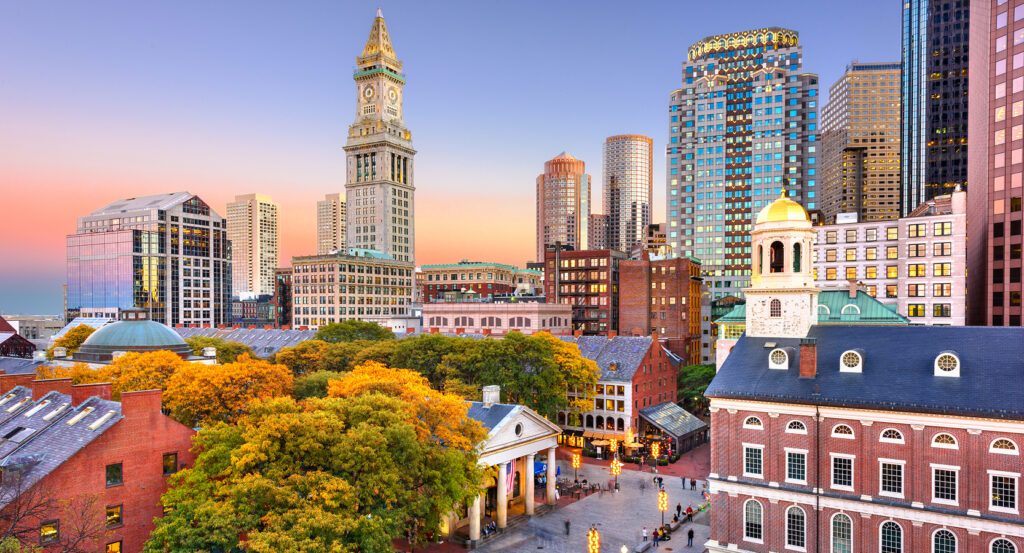
Why Faneuil Hall matters.
Faneuil Hall in Boston is a living stage where centuries of history, commerce, and community converge beneath brick arcades and open skies.
Known affectionately as “The Cradle of Liberty,” Faneuil Hall has been at the heart of Boston's character since 1742, when merchant Peter Faneuil gifted the building to the city as a public meeting hall and market. What began as a trading hub for merchants and fishermen soon became the epicenter of revolutionary thought, echoing with fiery speeches by Samuel Adams and other patriots who rallied for independence from British rule. Today, that same space hums with a different kind of energy, one driven by the rhythm of street performers, the aroma of clam chowder, and the chatter of visitors from around the world. The red-brick promenades of Faneuil Hall, which includes Quincy Market, North Market, and South Market, are alive with activity from dawn to dusk. Whether it's a violinist playing beneath the arches, the clang of a food vendor's spatula, or the laughter of families gathered on the cobblestones, every corner feels alive with the spirit of Boston, bold, bustling, and unshakably proud.
What defines Faneuil Hall.
Behind its lively atmosphere, Faneuil Hall carries layers of history that reveal how Boston has evolved, from colonial outpost to modern metropolis.
The original Faneuil Hall was designed by artist-architect John Smibert and built in the Georgian style, its stately façade marked by tall windows and a crowning cupola. The hall quickly became the city's political heartbeat, hosting speeches that fueled the American Revolution and later serving as the site of abolitionist gatherings and women's suffrage meetings. Quincy Market, added in 1826, expanded the complex under Mayor Josiah Quincy's vision of creating a “market for the people.” Its granite colonnades and domed rotunda became architectural icons in their own right, setting the tone for civic design in the 19th century. By the mid-1900s, however, the area had fallen into decline, a shadow of its revolutionary past, until a landmark urban renewal project in the 1970s reimagined it as one of the world's first festival marketplaces. That revitalization, led by architect Benjamin Thompson, pioneered the concept of blending retail, dining, and entertainment within historic architecture, influencing city developments across the globe. Today, Faneuil Hall welcomes over 20 million visitors annually, balancing preservation with modern vibrancy. Few realize that the weather vane atop Faneuil Hall, shaped like a golden grasshopper, has been there since 1742, a whimsical symbol of vigilance and Boston's mercantile past. Beneath the lively surface lies deep continuity: a place where the right to speak freely, buy freely, and live freely has been exercised for nearly three centuries.
How Faneuil Hall fits.
To truly experience Faneuil Hall is to let yourself flow with its rhythm, equal parts history lesson, physical adventure, and civic heartbeat.
Start inside the Great Hall, where portraits of revolutionary figures watch from above and exhibits recount the building's role in shaping America's founding ideals. Step outside into the marketplace's cobbled plaza, where street performers turn the air electric and the smell of roasted nuts, chowder, and lobster rolls drifts from Quincy Market's colonnade. Grab a bowl from Boston Chowda Co. or a lobster roll from Wicked Good Lobster and find a seat beneath the rotunda to people-watch, the same gathering spirit that once fueled debates now fuels delight. Browse the boutique shops and artisan stalls across North and South Market, where everything from handmade jewelry to Red Sox memorabilia captures Boston's blend of grit and pride. For a taste of the city's soul, time your visit for late afternoon, when golden light spills across the brick facades and buskers play to crowds leaning against the railings with coffee in hand. From here, it's easy to continue your journey, the Freedom Trail runs directly through the marketplace, connecting it to historic landmarks like the Old State House and Paul Revere House. Stay a while into evening, when string lights glow above the plaza and live music filters through the air, turning history into celebration. Faneuil Hall isn't just where Boston began, it's where the city keeps beginning, day after day, with the same irrepressible spark that lit a revolution.
Where your story begins.
Foresyte Travel reveals places that feel extraordinary long before you arrive.
Enjoy editorial crafted for luxury travelers.
Foresyte may earn a commission when you book.







































































































