
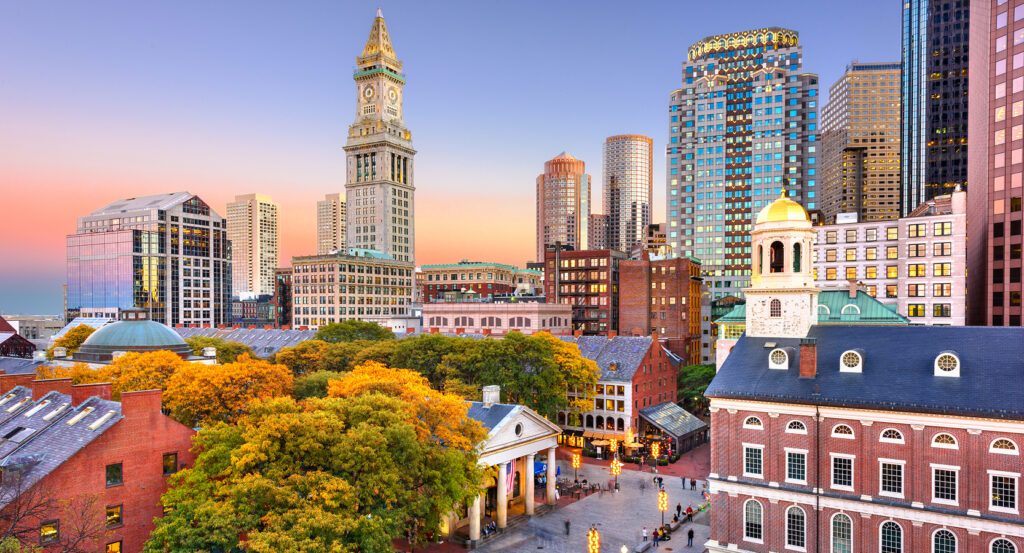
Why Quincy Market matters.
Quincy Market is a historic marketplace where Downtown's commercial heritage, Federal architecture, culinary traditions, and civic life create one of America's most celebrated public gathering places.
Set along South Market Street between Faneuil Hall and the North Market near Congress Street and just steps from Faneuil Hall, this grand granite marketplace welcomes visitors into a lively promenade filled with regional food vendors, artisan retailers, street performers, and historic architecture that has animated the heart of Boston for nearly two centuries. Expansive colonnades, thriving food halls, and energetic public plazas create an atmosphere where commerce, history, and culture seamlessly converge. Every visit reflects the enduring spirit of one of the nation's oldest marketplaces. The result is an experience defined by architectural distinction, culinary diversity, and one of Boston's most iconic destinations.
What defines Quincy Market.
Quincy Market is best known for opening in 1826 as Boston's first purpose-built central marketplace, constructed under the leadership of Mayor Josiah Quincy III, whose ambitious expansion of the city's commercial district gave the landmark its name. Designed by architect Alexander Parris in the Greek Revival style, the expansive granite building stretches 535 feet (163 meters) in length and was erected on nearly seven acres of newly created land reclaimed from Boston Harbor, dramatically expanding the city's waterfront. The marketplace quickly replaced overcrowded street vending with an organized public market containing produce stalls, butcher shops, fishmongers, and specialty merchants while establishing a new commercial center anchored by Faneuil Hall, North Market, and South Market. During the nineteenth century, Quincy Market became one of New England's busiest trading centers, reflecting Boston's emergence as one of America's leading commercial ports. Following decades of decline after World War II, the building became the centerpiece of architect Benjamin C. Thompson's internationally influential 1976 adaptive reuse of Faneuil Hall Marketplace, transforming the historic structure into one of the world's earliest and most successful festival marketplaces. Today, Quincy Market welcomes 18 million visitors annually, houses more than 50 food vendors within its famous central colonnade, and remains a designated National Historic Landmark within Boston's historic marketplace district.
Beyond its remarkable architectural history, Quincy Market fundamentally changed the international approach to urban revitalization by demonstrating how historic commercial buildings could be preserved through adaptive reuse. The success of the Faneuil Hall Marketplace redevelopment inspired similar waterfront and downtown revitalization projects in cities including Baltimore, New York, London, Sydney, and Toronto, establishing Quincy Market as a global model for heritage-led economic development. Daily performances by licensed street entertainers, seasonal festivals, public art, and a constantly evolving mix of New England seafood, international cuisine, and regional specialties reinforce the marketplace's role as Boston's civic living room nearly two centuries after its opening. Architectural preservation, entrepreneurial innovation, public-private collaboration, and energetic cultural programming combine to create one of America's most influential historic marketplaces.
How Quincy Market fits.
Quincy Market works as the historic centerpiece of an exploration through Downtown.
Begin at Faneuil Hall, where revolutionary history introduces the remarkable civic heritage surrounding Quincy Market. Continue to the New England Aquarium, whose waterfront location extends the experience toward Boston Harbor. Conclude at the Paul Revere House, where one of the city's oldest surviving homes provides a memorable finale celebrating the remarkable relationship between commerce, colonial history, and architectural preservation that defines Boston. The progression moves naturally from historic meeting hall to celebrated marketplace before concluding through two defining Boston landmarks, revealing why Quincy Market remains one of America's essential public spaces.
Where your story begins.
Foresyte Travel reveals places that feel extraordinary long before you arrive.
Enjoy editorial crafted for luxury travelers.
Foresyte may earn a commission when you book.







































































































