
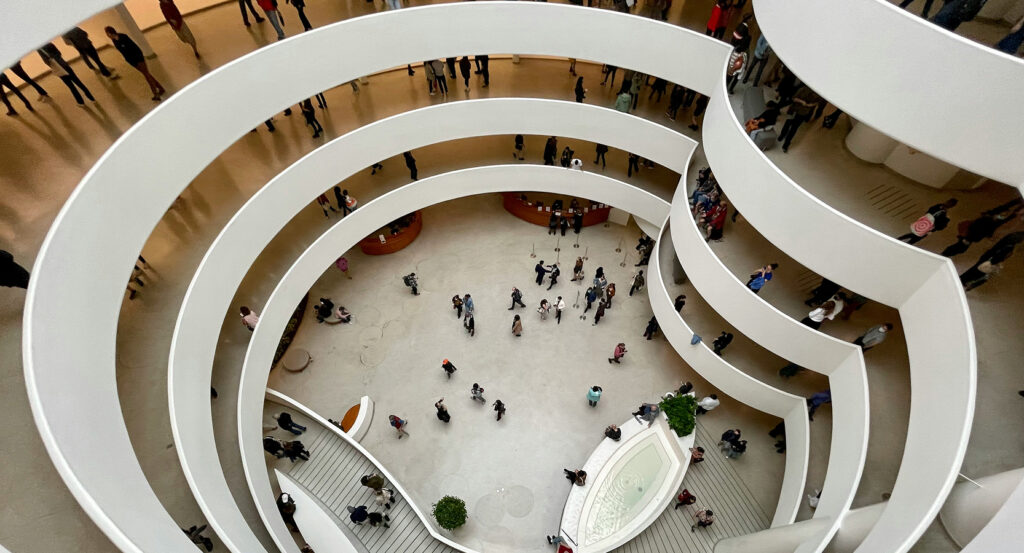
Why you should experience The Guggenheim Atrium in New York, NY.
Step inside the The Guggenheim Atrium, and the world seems to inhale. Designed by Santiago Calatrava as both a transportation hub and a work of art, it is less a building and more a celestial gesture, white steel ribs stretching skyward like wings mid-flight. The space hums with kinetic poetry, its symmetry and light shifting throughout the day in response to New York's rhythm. From the upper balconies, you don't just see the structure; you feel it, as the arches cradle your line of sight and pull it toward the heavens. The effect is disarmingly intimate for such a grand space, each perspective revealing new alignments between form and purpose.
Visiting the atrium isn't just about marveling at architecture; it's about stepping into a moment of reprieve within the chaos of Downtown Manhattan. As commuters stream beneath, you'll notice how silence folds into motion, how light becomes architecture's most fluid material. The Oculus reminds us that function and beauty need not compete, they can soar together, elegantly, impossibly.
What you should know about The Guggenheim Atrium.
What few visitors know is that the Oculus's alignment with sunlight was engineered with almost spiritual precision. Each year on September 11th, at exactly the same time the Twin Towers fell, the atrium's skylight opens to allow a single beam of light to cascade through the space. It's a silent memorial, among the city's most quietly powerful, designed to transform architecture into remembrance. Calatrava's intent was to evoke a “bird released from a child's hand,” a symbol of freedom emerging from loss. Yet beyond the poetry lies astonishing technical mastery: every curve and connection calculated to support not just structure, but emotion.
The rib-like columns are each unique in dimension, none interchangeable, making the Oculus one of the most complex pieces of steelwork ever assembled in modern architecture. It stands as both a triumph of human ingenuity and a requiem for fragility, proof that even in the shadows of tragedy, design can teach us how to rise again.
How to fold The Guggenheim Atrium into your trip.
Fold the Oculus view atrium into your New York journey as a moment of quiet awe amid the city's intensity. Visit in the late morning, when sunlight cuts through the skylight like a blade, and linger on the mezzanine to take in how people and geometry merge into a kind of living artwork.
Afterward, step outside to explore the surrounding World Trade Center complex, the 9/11 Memorial pools, the reflecting glass of One World Observatory, and the rejuvenated energy of the Financial District. End with coffee at one of the atrium's sleek cafés, where the sound of espresso machines mingles with footsteps echoing beneath the ribs. The Oculus invites you not to rush through, but to look up, and to remember that the city's pulse is strongest where art and resilience intersect.
Where your story begins.
Foresyte Travel reveals places that feel extraordinary long before you arrive.
Experience premium editorial crafted for luxury travelers.







































































































