
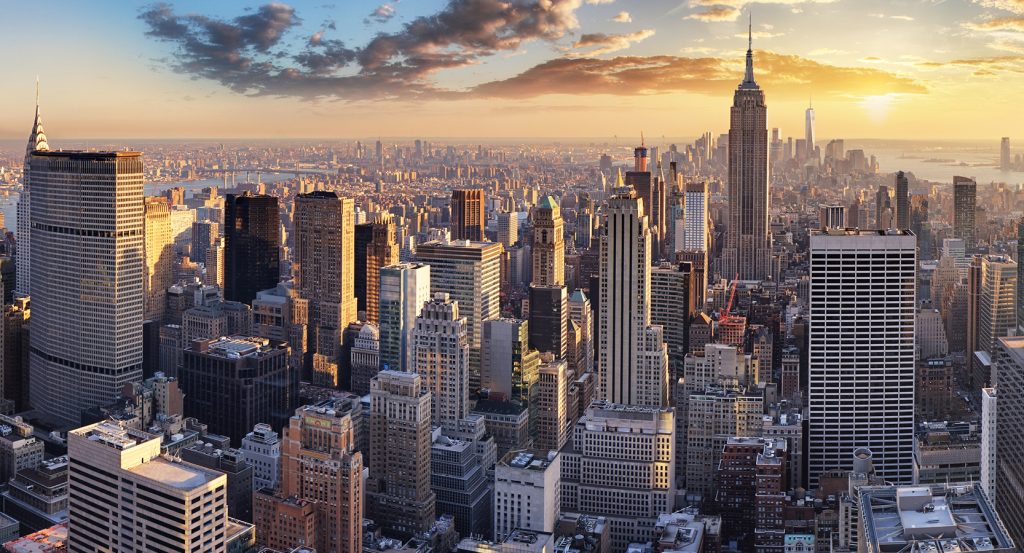
Why World Trade Center matters.
World Trade Center is a consequential Lower Manhattan campus where the Financial District's vertical skyline meets architecture, public space, regional transportation and a site carrying profound significance in modern American history.
Set across 16 acres between West Street and Church Street near Vesey Street and just steps from Brookfield Place, World Trade Center occupies a large urban precinct connecting the Hudson River edge with the dense street fabric of Lower Manhattan. The rebuilt campus combines multiple towers with broad pedestrian spaces, an elevated park and below-grade connections, distributing substantial building mass around open areas at the center of the site. One World Trade Center rises at the northwest corner, with 3 World Trade Center and 4 World Trade Center defining the eastern edge and 7 World Trade Center standing north of Vesey Street. Pedestrian routes extend through and beneath the campus toward surrounding subway lines, PATH rail service and the West Concourse, making movement between architecture and public space a fundamental physical characteristic of the precinct. The result is a 16-acre ensemble whose towers, open spaces, transportation infrastructure and Hudson River connections have reconstructed a major portion of Lower Manhattan through an unusually concentrated architectural undertaking.
What defines World Trade Center.
World Trade Center is best known for the Twin Towers that transformed Lower Manhattan during the 1970s and for the destruction of the complex in the terrorist attacks of September 11, 2001, followed by one of the largest rebuilding campaigns in New York history. New York State created the World Trade Corporation in 1946, and David Rockefeller advanced another major proposal for Lower Manhattan in 1958 before the Port Authority assumed responsibility for development. The agency selected the present site in 1962 and commissioned Minoru Yamasaki, who worked through more than 100 concepts before the $525 million plan was unveiled in 1964. Thirteen city blocks were cleared beginning in 1966, and construction demanded foundations reaching bedrock 70 feet below street level due to the landfill beneath the site. Excavation removed more than one million cubic yards of soil and rock, much of which contributed to the creation of Battery Park City along the Hudson River. Engineers enclosed the excavation with a vast slurry wall using a technique pioneered in Italy, spending 12 months creating the watertight structure later known as the Bathtub before anchoring it to bedrock with steel tiebacks. The 110-story North and South Towers reached 1,368 and 1,362 feet, using closely spaced exterior steel columns, floor trusses, sky lobbies and high-speed elevators to support an immense office program. The ceremonial opening on April 4, 1973 marked the completion of a complex containing the towers, four smaller buildings, a hotel, an underground retail center and transportation infrastructure used by tens of thousands of workers and commuters. Minoru Yamasaki centered the ensemble on a five-acre pedestrian plaza, and the Port Authority's 1969 Percent for Art program brought seven commissioned works to the site through 1995, including Fritz Koenig's 25-foot bronze The Sphere, assembled from 64 cast segments and installed above a fountain in 1971. A terrorist bombing beneath the North Tower on February 26, 1993 killed six people, injured more than 1,000 and opened a 150-foot-wide crater through several underground levels, leading to extensive changes in emergency planning and security. Eight years later, the September 11 attacks destroyed the World Trade Center and killed thousands of people in New York, at the Pentagon and aboard four hijacked aircraft.
Reconstruction began through a planning process that reshaped the architecture and organization of the entire site. The Lower Manhattan Development Corporation was created in November 2001 to coordinate long-term rebuilding and administer $10 billion in federal funds, and an international competition subsequently drew 2,000 proposals for the broader site. Daniel Libeskind's scheme was selected in 2003, arranging a descending spiral of skyscrapers around the ground reserved for commemoration. Michael Arad and Peter Walker won the separate international competition for Reflecting Absence after more than 5,000 submissions, establishing the two recessed pools within the footprints of the destroyed towers as the organizing center of the memorial landscape. The first completed office building of the reconstruction was 7 World Trade Center, opened in 2006 as a 52-story tower with a reinforced-concrete core, steel superstructure and enhanced safety systems. Fumihiko Maki's 4 World Trade Center followed in November 2013, rising 977 feet through a restrained glass composition with column-free corners and 80-foot spans between perimeter columns. One World Trade Center reached completion in 2014, carrying David Childs and Skidmore, Owings & Merrill's skyscraper to the symbolic elevation of 1,776 feet. Richard Rogers and Rogers Stirk Harbour + Partners added the 1,079-foot 3 World Trade Center in 2018, bringing another 2.5 million square feet into the eastern tower group. Santiago Calatrava's transportation complex, the memorial precinct and subsequent cultural construction expanded the rebuilt site beyond an office-tower program, creating a campus organized around commemoration, architecture, transportation and public institutions.
How World Trade Center fits.
World Trade Center works as the anchor for a Lower Manhattan outing connecting the nineteenth-century maritime economy, the creation of the constitutional federal government and the recovery of African New York beneath the modern city.
Begin at Wavertree, the wrought-iron cargo ship built by Oswald, Mordaunt and Company at Southampton in 1885 and acquired two years later by R. W. Leyland & Company, which gave the vessel its present name. The ship initially carried jute between South Asia and Scotland before entering global tramp trade, transporting grain, nitrate, lumber and other bulk cargoes during a 24-year sailing career that included three or more circumnavigations. A Cape Horn storm destroyed major sections of the rig in 1910, ending active cargo sailing; ship preservationist Karl Kortum rediscovered the surviving hull in South America decades later, and the The Seaport Museum purchased it for scrap value in 1968 before its ceremonial New York arrival in 1970. Continue to Federal Hall National Memorial, occupying the Wall Street site where New York's colonial City Hall became the seat of government under the newly ratified Constitution. George Washington took the presidential oath from its second-floor balcony on April 30, 1789, and the building housed the first Congress, Supreme Court and executive offices of the new government. The original structure disappeared in 1812; the present building opened in 1842 as the United States Custom House, became a U.S. Sub-Treasury in 1862 and received John Quincy Adams Ward's bronze Washington on its steps in 1882. Conclude at African Burial Ground National Monument, where preparation for a federal office building in 1991 uncovered a cemetery used by free and enslaved Africans during the seventeenth and eighteenth centuries. Excavation recovered 419 individuals from a burial ground extending far beyond the construction parcel, prompting sustained community action and congressional intervention that altered the federal project. Howard University scholars undertook years of study before the ancestral remains returned to Lower Manhattan in 2003 inside hand-carved Ghanaian coffins, and the site became a national monument in 2006. Architect Rodney Leon's memorial was dedicated in 2007, giving permanent architectural form to one of the most consequential archaeological discoveries associated with African life in colonial New York. The progression moves from Wavertree's global cargo routes through the Wall Street site where the new constitutional government began and culminates at a recovered burial ground that restored thousands of African New Yorkers to the historical understanding of the colonial city.
Where your story begins.
Foresyte Travel reveals places that feel extraordinary long before you arrive.
Enjoy editorial crafted for luxury travelers.
Foresyte may earn a commission when you book.







































































































