
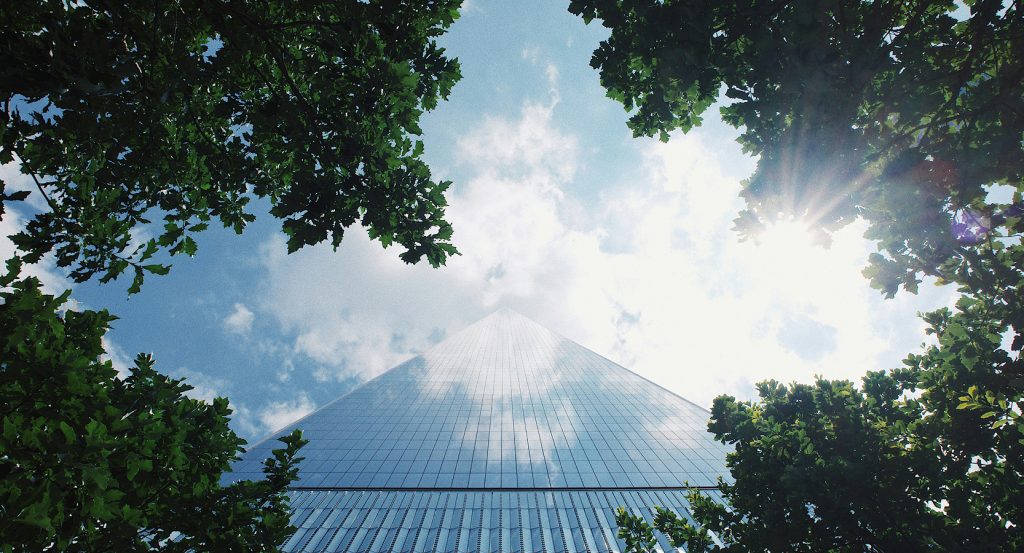
Why One World Observatory matters.
One World Observatory is a panoramic observation complex where the World Trade Center's rebuilt civic core meets three elevated levels, floor-to-ceiling glazing and sweeping views from 1,250 feet above Lower Manhattan.
Set across floors 100 through 102 of One World Trade Center near West Street and just steps from Brookfield Place, the observatory occupies more than 125,000 square feet near the summit of the 1,776-foot tower. Floor-to-ceiling windows wrap the principal viewing level, opening 360-degree sightlines across Manhattan, New York Harbor, Brooklyn, New Jersey and the surrounding waterways from a position far above the neighboring skyline. The 100th floor concentrates the principal viewing areas around the tower perimeter, placing the city directly beyond the glass as circulation follows the faceted exterior geometry. Upper levels add elevated interior platforms and broad window walls, extending the visual field across successive heights within the crown. The result is a vertically organized observatory whose three floors, continuous glazing, immense elevation and commanding harbor outlook make the geography of New York the dominant physical presence.
What defines One World Observatory.
One World Observatory is best known for returning a public observation destination to the World Trade Center through an attraction developed by Legends and The Hettema Group inside the uppermost occupied floors of One World Trade Center. Legends secured the operating role during the tower's construction and established administrative offices inside the building as work advanced on a 120,000-square-foot attraction planned for floors 100 through 102. Phil Hettema and The Hettema Group led concept, design and production, working with Legends on a sequence built around New York's history, the construction workforce and the significance of the rebuilt site. More than 100 people involved in erecting the tower, including ironworkers, pipe setters, architects and custodial workers, were interviewed for media incorporated into the attraction. Five dedicated SkyPod elevators became one of its principal technical achievements, traveling at 2,000 feet per minute as synchronized interior media depicts Manhattan developing across centuries during the ascent. The trip reaches the upper floors in 47 seconds, compressing a climb of more than 1,200 feet into less than a minute. One World Observatory opened to the public on May 29, 2015, following preview days reserved for local schoolchildren, World Trade Center construction workers and the general public. The Hettema Group and Legends subsequently received a 2015 Thea Award for Outstanding Achievement, and the SkyPod installation took first place in the new-construction elevator category of Elevator World's 2016 Project of the Year competition.
Digital media forms a separate technical chapter extending from the underground arrival sequence through the upper observation floors. The Global Welcome Center uses a curved multiprojector wall to register the international origins of arriving groups, with six Panasonic short-throw projectors and four additional Panasonic units driven by 7thSense media servers. The Horizon Grid follows with multimedia devoted to New York and the people involved in constructing the tower before the ascent begins. A two-minute presentation on the 102nd floor uses 28 Christie projectors and seven 7thSense servers to map moving imagery across relief panels that physically lift at the conclusion, exposing the northern Manhattan skyline beyond them. Electrosonic supplied projection, video displays, program audio and show-control systems for The Hettema Group, joining multiple media technologies across the attraction. Local Projects developed City Pulse as a 14-foot circular digital installation controlled through a presenter's gestures, allowing live ambassadors to call up geographic and historical information tied to places visible beyond the windows. The SkyPod display, See Forever Theater and City Pulse Ring later received separate United States patents, giving three prominent components of the attraction formal technical protection. One World Observatory's multimedia program extends far past the view itself, joining projection engineering, responsive displays, elevator media and live interpretation across a coordinated sequence from ground level to the tower crown.
How One World Observatory fits.
One World Observatory works as the anchor for a Lower Manhattan outing connecting nineteenth-century immigration, Revolutionary New York and the creation of the first federal government under the Constitution.
Begin at Castle Clinton National Monument, constructed between 1808 and 1811 as Southwest Battery on rocks offshore from Manhattan and armed with 28 cannons for harbor defense. Military use ended during the 1820s, and the circular fort became Castle Garden, an entertainment venue where Samuel F. B. Morse demonstrated the telegraph in 1842 and Jenny Lind made her American debut in 1850 under P. T. Barnum's management. A new chapter began on August 3, 1855 when Castle Garden became an immigrant landing depot; 8,280,917 immigrants passed through between its opening and the end of 1889 before federal processing shifted toward Ellis Island. Continue to Fraunces Tavern Museum, occupying a building constructed by merchant Stephen De Lancey in 1719 and purchased by Samuel Fraunces in 1762. The tavern became a center of Revolutionary activity, and George Washington gathered officers in its Long Room for his farewell on December 4, 1783. Fires and nineteenth-century alterations profoundly changed the structure before the Sons of the Revolution purchased it in 1904 and hired William H. Mersereau for an extensive restoration completed in 1907. The organization retained surviving eighteenth-century fabric as it removed later additions, making the project an early major undertaking in American architectural preservation. Conclude at Federal Hall National Memorial, where New York's colonial City Hall became the national capitol after Pierre L'Enfant remodeled it for the new federal government in 1788. George Washington took the presidential oath on its second-floor balcony on April 30, 1789, and the First Congress created executive departments, organized the federal judiciary and proposed twelve constitutional amendments, ten of which became the Bill of Rights. The original structure disappeared in 1812; the present Greek Revival building opened as the United States Custom House in 1842 and became the U.S. Sub-Treasury in 1862, storing millions of dollars in gold and silver within its basement vaults. The progression moves from Castle Clinton's evolution through defense, entertainment and immigration through Fraunces Tavern's Revolutionary history and preservation and culminates at the site where Washington assumed the presidency and the First Congress constructed central institutions of the new federal government.
Where your story begins.
Foresyte Travel reveals places that feel extraordinary long before you arrive.
Enjoy editorial crafted for luxury travelers.
Foresyte may earn a commission when you book.







































































































