
Why Castle Clinton National Monument matters.
Castle Clinton National Monument is a storied harbor fort where The Battery's maritime character meets circular brownstone architecture, two centuries of changing public uses and the surviving fabric of Manhattan's early coastal defenses.
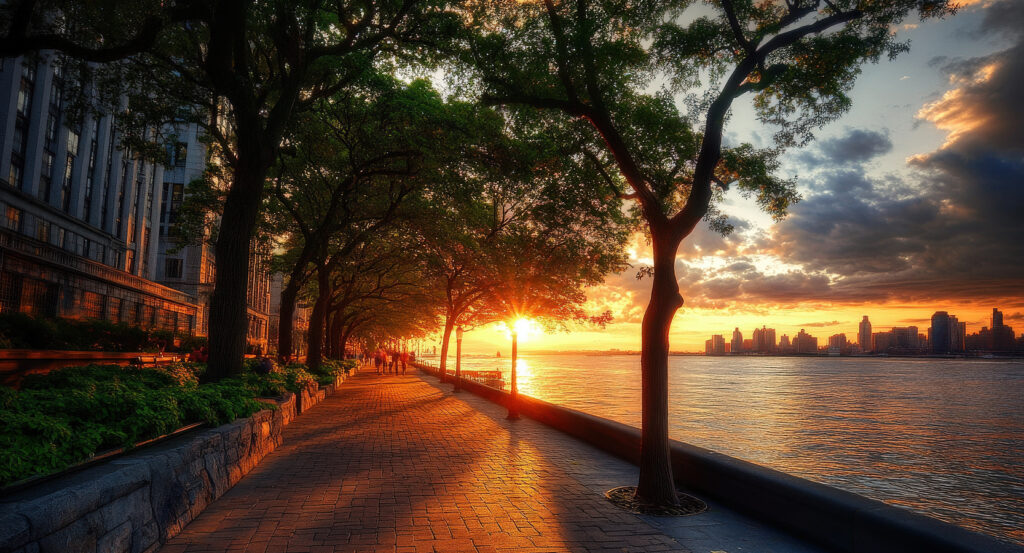
Set within The Battery near State Street and just steps from the East Coast Memorial, the fort occupies the southern tip of Manhattan on ground that has advanced considerably into New York Harbor since its original construction offshore. Lieutenant Colonel Jonathan Williams and architect John McComb Jr. shaped an almost circular, single-tiered battery with a flat landward edge, eight-foot-thick brownstone walls and an open central parade ground. Twenty-eight embrasures punctuated the perimeter, creating firing positions around a defensive structure originally connected to Manhattan by a 200-foot wooden causeway and drawbridge. Magazine chambers and officers' quarters occupied the landward corners, with an 11-foot sally port controlling passage into the enclosed interior and a hotshot furnace standing near its center. The result is a compact military structure whose curved stone perimeter, deep walls, surviving gun openings and unusual position within present-day parkland preserve the physical form of a fort once separated from Manhattan by harbor water.
What defines Castle Clinton National Monument.
Castle Clinton National Monument is best known for passing through radically different chapters as a coastal fortification, entertainment center, immigrant reception station and aquarium across more than two centuries at Manhattan's southern edge. Rising tensions with Great Britain prompted New York to strengthen its harbor defenses between 1807 and 1811 through a coordinated system that included Fort Gibson on Ellis Island, Fort Wood on Liberty Island and Castle Williams on Governors Island alongside the new Southwest Battery. Twenty-eight cannons armed the Manhattan fort with 32-pound shot capable of reaching 1.5 miles across the harbor, yet the battery never fired against British forces during the War of 1812. The structure received the Castle Clinton name after the war in honor of DeWitt Clinton and continued under military use until the federal government transferred it to New York City in 1823. Castle Garden opened the following summer as an amphitheater under lessees Francis B. Fitch, Arthur Roorbach and Jonathan Rathbone, beginning three decades of concerts, exhibitions, fireworks and public spectacles. Marquis de Lafayette appeared there during his celebrated 1824 return to the United States, and Charles Durant later launched balloon ascensions above crowds gathered around the harbor. Samuel F. B. Morse demonstrated telegraph technology at the venue in 1842, and the building was converted into a European-style opera house during the same decade. Swedish soprano Jenny Lind made her American debut there on September 11, 1850 under P. T. Barnum's promotion, generating $26,238 in receipts and placing the former military battery within one of nineteenth-century New York's major musical events.
New York State opened Castle Garden Emigrant Depot on August 3, 1855 as the nation's first facility devoted entirely to receiving and assisting immigrants, beginning another consequential period in the building's history. Between that opening and the end of 1889, 8,280,917 of the 10,956,910 immigrants entering the United States passed through Castle Garden, with Germans forming the largest national group followed by Irish and English arrivals. The institution combined entry processing with practical services including railroad-ticket sales, currency exchange, family contact and baggage storage, giving newcomers assistance before dispersal across New York and the country. A major 1876 fire gutted the former opera-house interior, yet sailor John Lucy of the USS Minnesota entered the smoke-filled building and guided hundreds of immigrants outside, an act for which he received the Medal of Honor. Immigration operations ended in 1890, and the structure reopened on December 10, 1896 as the New York Aquarium, drawing more than 30,000 people on its first day. The New York Zoological Society assumed management in 1902 under director Charles H. Townsend, who improved water systems, ventilation, lighting, laboratories and aquatic research programs; McKim, Mead & White later enlarged the aquarium between 1922 and 1926 with two additional stories. More than 84 million people passed through the building during the Zoological Society's 39 years of management before Robert Moses closed the aquarium in 1941 amid plans for a Brooklyn connection that threatened the surviving fort. Public opposition helped secure federal protection in 1946, the National Park Service received the property in 1950 and a three-year restoration returned Castle Clinton to an interpretation of its early military form before reopening in 1975.
How Castle Clinton National Monument fits.
Castle Clinton National Monument works as the anchor for a Lower Manhattan outing connecting Revolutionary politics, federal architecture and the preservation of New York's nineteenth-century seaport.
Begin at Fraunces Tavern Museum, occupying a Pearl Street building erected for the De Lancey family in 1719 and purchased by Samuel Fraunces in 1762. Revolutionary activity repeatedly converged there: the New York Provincial Congress met inside during 1776, the Birch Trials concerning Black Loyalists took place there in 1783 and George Washington bade farewell to his officers in the Long Room on December 4 of that year. Departments of Foreign Affairs and War subsequently occupied the building alongside offices of the Board of Treasury between 1785 and 1788, giving the former tavern a role in the national government before ratification of the Constitution. The Sons of the Revolution acquired the property in 1904 and hired William H. Mersereau for the restoration that preceded its 1907 opening as a museum. Continue to National Museum of the American Indian, housed inside Cass Gilbert's Alexander Hamilton U.S. Custom House at Bowling Green. Gilbert won a 20-firm federal competition in 1899 and developed a steel-framed Beaux-Arts building completed between 1900 and 1907, with Daniel Chester French creating four entrance sculptures representing America, Asia, Europe and Africa. Raphael Guastavino engineered the tile-and-plaster dome above the 135-by-85-foot rotunda, and Reginald Marsh later painted its cycle of harbor murals. The Customs Service departed in 1971, and a federal rehabilitation beginning in 1983 preceded the Smithsonian museum's arrival in 1994, joining Native American collections with one of the great surviving federal interiors of the port era. Conclude at The Seaport Museum, founded in 1967 as demolition threatened the mercantile buildings of the East River waterfront. Its founders acquired endangered structures, advocated for historic-district protection and pursued an ambitious plan to repopulate South Street with historic vessels recalling the port that drove New York's commercial expansion. The museum purchased the 1885 iron-hulled sailing ship Wavertree for scrap value in 1968 after maritime preservationist Karl Kortum found her serving as a sand barge in Argentina; fireboats, tugs and ferries accompanied the ship into New York on August 11, 1970. The surviving windjammer had previously carried jute, nitrate, grain and other cargo across global routes before a 1910 Cape Horn storm ended her sailing career, giving the museum a physical survivor from the commercial maritime world that once filled the neighboring East River piers. The progression moves from Fraunces Tavern's Revolutionary and early governmental chapters through Gilbert's architecture for the federal customs system and culminates in the Seaport Museum's preservation of ships and buildings from New York's mercantile waterfront, tracing political independence, international commerce and maritime preservation around the island's southern tip.
Where your story begins.
Foresyte Travel reveals places that feel extraordinary long before you arrive.
Enjoy editorial crafted for luxury travelers.
Foresyte may earn a commission when you book.







































































































