
Why Ellis Island National Museum of Immigration matters.
Ellis Island National Museum of Immigration is a consequential historical museum where Ellis Island's immigration heritage meets Beaux-Arts architecture, preserved personal objects and galleries spanning centuries of migration to the United States.
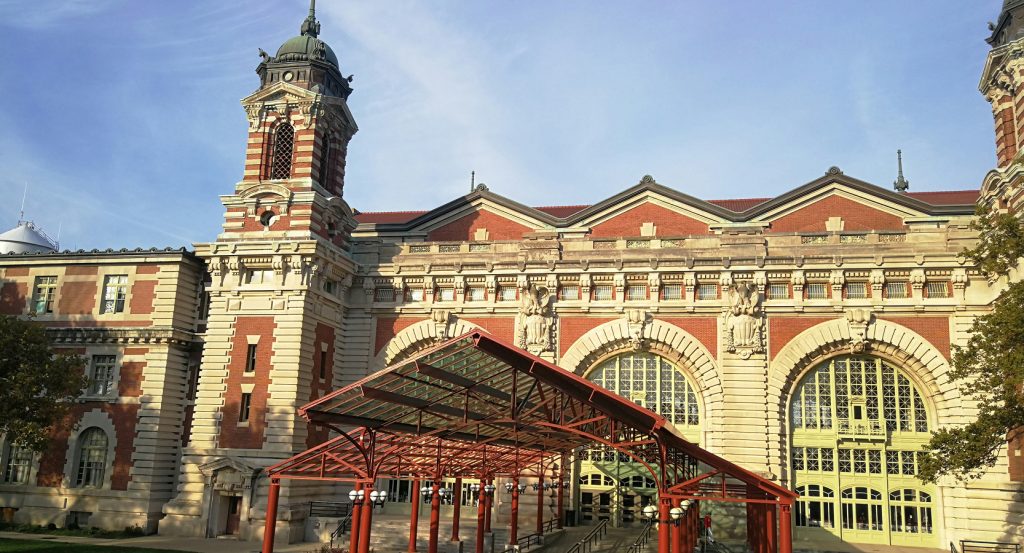
Set within the Main Immigration Building on the northern side of Ellis Island near its ferry basin and just across the harbor from Liberty Island, the museum occupies the principal structure of a federal complex spread between the original island and later land extensions. Boring & Tilton gave the building four ornate corner towers, copper domes, limestone quoins and immense arched windows, creating a formal Beaux-Arts composition intended to command attention from approaching ships. The three public floors retain spaces ranging from the Baggage Room to former dormitories, placing museum galleries within rooms originally constructed for arrival, inspection and detention functions. Third-floor displays incorporate personal possessions carried across the Atlantic, including prayer books, linens, crockery and family objects donated by immigrants and their descendants. The result is a museum whose harbor position, copper-crowned architecture, surviving institutional rooms and immigrant possessions preserve the physical setting through which millions entered the United States.
What defines Ellis Island National Museum of Immigration.
Ellis Island National Museum of Immigration is best known for occupying the principal building of the federal station that processed 12 million immigrants between 1892 and 1954, making the island central to one of the largest migration periods in United States history. Federal control of immigration expanded through the Immigration Act of 1891, which established the Office of Immigration and assigned immigrant health examinations to the Marine Hospital Service. Ellis Island's first station opened on January 1, 1892 in a Georgia-pine complex after landfill had doubled the island's size. Fire destroyed the wooden station on June 15, 1897 without killing any of the 140 immigrants or employees present, prompting an immediate decision to rebuild in fireproof construction. Boring & Tilton won the federal architectural competition for the replacement, and the new Main Immigration Building opened on December 17, 1900. A Main Hospital followed in March 1902 with capacity for 125 patients, then expanded through additional wards and a separate contagious-disease complex as medical screening became a substantial part of the federal operation. Immigration restrictions enacted during the 1920s sharply reduced processing on the island, and changing federal procedures further diminished its original function before the Immigration and Naturalization Service closed the facility in November 1954. President Lyndon B. Johnson incorporated Ellis Island into Statue of Liberty National Monument in 1965, transferring the abandoned federal complex to National Park Service stewardship.
A vast rehabilitation campaign during the 1980s converted the deteriorated Main Immigration Building into a museum after three decades of abandonment. The National Park Service and Statue of Liberty-Ellis Island Foundation led the undertaking, with the 1986 Statue of Liberty centennial helping propel work that returned principal interiors to their 1918-1924 appearance. The restoration cost $156 million between 1986 and 1990, and the Ellis Island Immigration Museum opened in September 1990. Former immigrants and their descendants contributed textiles, luggage and personal possessions to the developing collection, allowing individual objects carried into the country to become part of the institution's historical interpretation. The American Family Immigration History Center followed in 2001, placing passenger-arrival information into a searchable genealogical resource that later expanded to 65 million entries covering arrivals through the Port of New York between 1820 and 1957. The Peopling of America Center broadened the museum beyond the years of Ellis Island processing: galleries devoted to arrivals before 1890 opened in 2011, followed by a 2015 wing addressing immigration from 1954 forward. That expansion transformed the institution into the Ellis Island National Museum of Immigration in 2015, shifting its chronological scope from the federal station alone toward the longer history of migration to the United States. Hurricane Sandy had forced about half of the museum collection, including more than one million archival items and thousands of objects, into off-island storage; a $39.4 million infrastructure project subsequently moved critical mechanical and electrical systems above flood elevations before the collection returned in 2015.
How Ellis Island National Museum of Immigration fits.
Ellis Island National Museum of Immigration works as the anchor for a harbor outing connecting New York's predecessor immigration depot, the rail terminal that dispersed new arrivals across the country and New Jersey's memorial to lives lost on September 11.
Begin at Castle Clinton National Monument, constructed as Southwest Battery between 1808 and 1811 on rocks beyond Manhattan's shoreline, armed with 28 cannons and converted after military use into Castle Garden. The structure became an entertainment center in 1824 and later an opera house before another decisive conversion on August 3, 1855 created New York's immigrant landing depot. More than eight million people entered through Castle Garden during the following 34 years, making the circular fort the direct institutional predecessor to federal processing on Ellis Island. The immigration operation closed on April 18, 1890, and the building entered another chapter as the New York City Aquarium in 1896 before receiving National Monument status in 1946. Continue to Central Railroad of New Jersey Terminal, completed in 1889 on the Jersey City waterfront and developed into a major interchange between ferries and rail lines reaching inland destinations. The terminal became a crucial second stage for immigrants leaving Ellis Island, with New Jersey estimating that two-thirds of the millions passing through the federal station continued their new lives aboard trains departing from the complex. Daily traffic reached as many as 50,000 ferry and rail passengers, and the terminal's peak year of 1929 brought 21 million people through the facility. Rail service ended in 1967, and the preserved terminal became a cornerstone of Liberty State Park after the park's 1976 dedication. Conclude at Empty Sky Memorial, where architects Jessica Jamroz and Frederic Schwartz created New Jersey's official memorial to residents and people with state ties who died in the September 11 attacks. Dedicated on September 11, 2011, the composition uses two parallel brushed-stainless-steel walls measuring 210 feet long and 30 feet high, dimensions tied to the width of the former World Trade Center towers. A 12-foot bluestone passage runs between the walls toward the Lower Manhattan skyline, with individual names cut deeply enough into the steel for hand rubbings. The progression moves from Castle Garden's nineteenth-century reception of new arrivals through the Jersey City rail network that carried Ellis Island immigrants inland and culminates at Jamroz and Schwartz's harbor-facing memorial, linking migration, onward movement and national memory across the waterfront.
Where your story begins.
Foresyte Travel reveals places that feel extraordinary long before you arrive.
Enjoy editorial crafted for luxury travelers.
Foresyte may earn a commission when you book.







































































































