
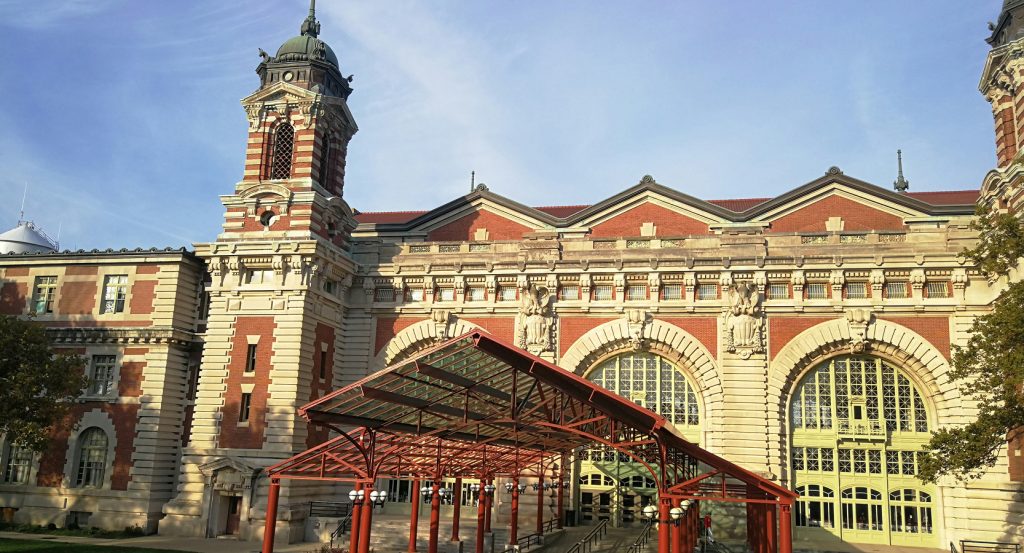
Why Ellis Island matters.
Ellis Island is a consequential harbor site where New York Harbor's maritime geography meets federal immigration history, an extensive institutional complex and the physical threshold crossed by more than 12 million immigrants.
Set in Upper New York Bay near Liberty Island and just offshore from Jersey City, the island occupies a 27.5-acre footprint surrounded by seawalls and open water between Manhattan and the New Jersey shoreline. The present landmass consists of three interconnected sections created through successive landfill campaigns that expanded an original natural island measuring only 3.3 acres. Island 1 contains the principal arrival buildings, with Islands 2 and 3 extending south through a dense ensemble of former medical structures, service buildings, connecting corridors and enclosed courtyards. Ferry approaches place the copper-domed Main Immigration Building at the center of the composition, its symmetrical Beaux-Arts mass rising above the lower structures distributed across the shoreline. The result is a layered harbor complex whose expanded terrain, institutional architecture, medical campus and physical isolation preserve the scale of the federal operation once concentrated on Ellis Island.
What defines Ellis Island.
Ellis Island is best known for serving as the preeminent federal immigration station in the United States from 1892 to 1954, processing more than 12 million people during an era of enormous demographic change. The Immigration Act of 1891 transferred immigration regulation from individual states to the federal government, created the Office of Immigration and assigned medical examinations to the Marine Hospital Service, establishing the administrative system that shaped the new station. The first immigration complex opened on January 1, 1892, with 17-year-old Annie Moore of County Cork becoming the first immigrant processed there; more than 400,000 people passed through during the fiscal year. Fire destroyed the original Georgia-pine complex in 1897 without killing the 140 immigrants and numerous employees present, forcing operations temporarily to Manhattan's Barge Office and prompting a competition for a fireproof replacement. Edward Lippincott Tilton and William A. Boring, both École des Beaux-Arts alumni, won the federal commission, and their new Main Immigration Building opened on December 17, 1900 with 2,251 people examined that day. Expansion followed rapidly: a Kitchen and Laundry Building and Power House arrived in 1901, the Main Hospital opened in 1902 with capacity for 125 patients, and further hospital additions responded to trachoma, favus and other illnesses that immigration law treated as grounds for exclusion. Additional landfill supported a contagious-disease hospital and isolation wards, turning medical inspection and treatment into a substantial institutional operation beside immigration processing. The station reached its peak in 1907 when 1.2 million people were examined, demonstrating the extraordinary scale attained within fifteen years of the federal depot's opening.
Federal policy radically altered the island's function during the following decades. The Emergency Quota Act of 1921 imposed nationality quotas tied to the 1910 census, and the Immigration Act of 1924 tightened those limits and shifted significant inspection overseas through American consulates, sharply reducing the volume of new arrivals requiring processing in New York Harbor. Detention and deportation assumed greater importance, and the Roosevelt administration later commissioned new facilities after Secretary of Labor Frances Perkins appointed a committee in 1933 to investigate conditions on the island. Military use expanded during World War II: the Coast Guard operated a training station from 1939 through 1946 that served 60,000 enlisted men and 3,000 officers, adapting numerous immigration buildings for drills, dormitories, storage and technical work. The Coast Guard returned in 1951 with a Port Security Unit, and the federal government closed Ellis Island in November 1954 after releasing its final detainee, Norwegian merchant seaman Arne Peterssen. President Lyndon B. Johnson incorporated the island into Statue of Liberty National Monument in 1965, followed by limited public access beginning in 1976 and a major rehabilitation campaign announced under President Ronald Reagan in 1982. The 1986-1990 restoration cost $156 million, and the Main Building reopened to the public on September 10, 1990 as the Ellis Island Immigration Museum. A 1998 Supreme Court decision divided sovereignty over the island, leaving the original 3.3 acres within New York and assigning the later man-made acreage to New Jersey, adding an unusual interstate legal geography to a site already shaped by immigration, medicine, military use and preservation.
How Ellis Island fits.
Ellis Island works as the anchor for a harbor outing connecting the immigration system that preceded it, Indigenous collections housed within New York's former customs headquarters and the railroad terminal that carried newly admitted immigrants into the United States.
Begin at Castle Clinton National Monument, where a harbor fort constructed between 1808 and 1811 underwent successive conversions before becoming Castle Garden, New York's immigrant landing depot, on August 3, 1855. The facility processed 8,280,917 immigrants through the end of 1889, representing 75 percent of all immigrants entering the United States during that span, and developed services for railroad tickets, currency exchange, family contact and baggage handling. Federal control of immigration ended Castle Garden's role in 1890, making its three decades of state administration the direct institutional predecessor to the system established on Ellis Island two years later. Continue to National Museum of the American Indian, New York, whose George Gustav Heye Center opened in 1994 inside Cass Gilbert's 1907 Alexander Hamilton U.S. Custom House at Bowling Green. George Gustav Heye founded the Museum of the American Indian, Heye Foundation in 1916 after assembling an immense collection of Indigenous objects; Congress created the Smithsonian's National Museum of the American Indian in 1989, incorporating Heye's institution and preserving a New York presence through the new center. Its holdings now form part of a collection approaching one million objects spanning Indigenous peoples throughout the Western Hemisphere, placing Native art and history inside the Beaux-Arts building once devoted to the customs revenues generated by New York's international trade. Conclude at Central Railroad of New Jersey Terminal, completed in Jersey City in 1889 and positioned across the harbor from the federal immigration station that followed three years later. Newly admitted immigrants purchased rail tickets after processing and traveled by ferry to terminals including this one, where trains dispersed families toward destinations throughout the United States. The terminal formed a critical next stage after federal admission, translating arrival in New York Harbor into onward movement through the national railroad network during the same decades that Ellis Island handled mass immigration. The progression moves from Castle Garden's state-operated immigrant reception through Heye's Indigenous collection within Gilbert's former customs headquarters and culminates at the railroad terminal that carried newly admitted immigrants beyond New York Harbor, connecting arrival, federal authority and continental movement across the port.
Where your story begins.
Foresyte Travel reveals places that feel extraordinary long before you arrive.
Enjoy editorial crafted for luxury travelers.
Foresyte may earn a commission when you book.







































































































