
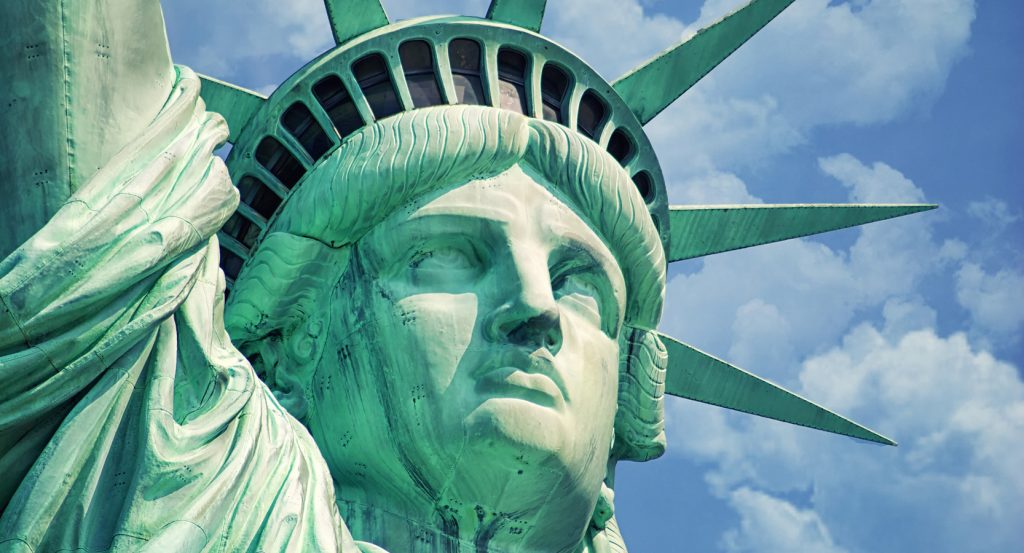
Why Liberty Island matters.
Liberty Island is a storied harbor island where New York Harbor's maritime geography meets a compact park landscape, preserved military fabric and one of the world's most consequential works of public sculpture.
Set in New York Harbor near Governors Island and just southwest of The Battery, the island occupies an exposed position between Lower Manhattan and the New Jersey waterfront with uninterrupted water surrounding its shoreline. The 15-acre landmass is edged by seawalls and organized around a compact central precinct whose low profile leaves the island's principal vertical structure visible across the harbor from numerous directions. Broad lawns open around the central masonry complex, giving the small island substantial horizontal space despite its confined offshore footprint. Ferry landings and waterfront paths place the harbor beside the principal circulation areas, allowing Manhattan, Brooklyn, Governors Island and New Jersey to remain visible across changing orientations around the shore. The result is a concentrated harbor landscape whose open ground, low shoreline and isolation from Manhattan give its historic structures an exceptional degree of visual separation within New York's dense metropolitan geography.
What defines Liberty Island.
Liberty Island is best known for a history extending centuries before its present name, beginning with Indigenous use of the Oyster Islands for fishing and shellfish harvesting before European colonization transformed New York Harbor. Isaac Bedloe acquired the island in 1667, and the property eventually became known as Bedloe's Island after passing through Dutch and English control. New York City took possession in 1738 and used the site for quarantine, a role revived during the smallpox outbreak of 1755-1757 and supported by construction of a hospital soon afterward. Loyalists found refuge there during the American Revolution before colonial forces attacked the island and burned its buildings in 1776. Federal appropriations for harbor defenses followed renewed tensions with European powers during the 1790s, and construction of the military work later called Fort Wood began in 1808. The eleven-point fort was completed in 1811 and received the Fort Wood name in 1814 for Eleazer D. Wood, an American officer killed at Fort Erie during the War of 1812. Artillery and infantry occupied the post through much of the nineteenth century, and the Civil War brought service as a recruiting station and ordnance depot. Congress accepted France's proposed Statue of Liberty in 1877, and President Ulysses S. Grant signed legislation designating Bedloe's Island as its site, beginning the transformation of a military harbor post into a place associated internationally with liberty.
Federal stewardship reshaped the island again during the twentieth century through a sustained campaign to unite its grounds with the national monument rising above Fort Wood. President Calvin Coolidge designated the statue and fort a national monument in 1924, and Franklin D. Roosevelt transferred administration to the National Park Service in 1933 before the War Department relinquished the remainder of Bedloe's Island four years later. Landscape architect Norman T. Newton developed a 1939 master plan organized around two intersecting axes, controlled views and formal plantings, with older Army buildings targeted for removal as the former military post became a park. Public Works Administration and Works Progress Administration funding supported early construction, including demolition, seawall work and grading, before World War II interrupted the undertaking. Congress supplied $110,000 in 1948 to restart improvements, leading to renewed planting, paving and removal of deteriorated military structures before work concluded in 1957. Congress renamed Bedloe's Island as Liberty Island in 1956 through legislation signed by President Dwight D. Eisenhower, placing the name already associated with the monument onto the surrounding land itself. President Lyndon B. Johnson returned to the island in 1965 to sign the Immigration and Nationality Act, legislation ending the national-origins quota system that had shaped American immigration policy for decades.
How Liberty Island fits.
Liberty Island works as the anchor for a harbor outing connecting the physical creation of the Statue of Liberty, the mass immigration era on neighboring Ellis Island and the shifting uses of Manhattan's oldest surviving harbor fort.
Begin at Statue of Liberty Museum, the 26,000-square-foot building designed by FXCollaborative and opened in May 2019 after the National Park Service and Statue of Liberty-Ellis Island Foundation sought a larger setting for the monument's history. ESI Design developed three principal exhibition galleries, and the collection places the statue's original torch inside a glass-walled gallery facing the monument itself. The torch had been replaced during the major 1980s restoration, making its surviving copper form a direct artifact of Frédéric Auguste Bartholdi's nineteenth-century work. Phelps Construction Group built the museum, whose roof rises into planted terraces that extend accessible outdoor space across the structure and preserve broad harbor views. Continue to Ellis Island National Museum of Immigration, housed in the Beaux-Arts Main Immigration Building designed by Boring & Tilton after fire destroyed the island's first wooden immigration station in 1897. The replacement opened in 1900, and Ellis Island processed more than 12 million immigrants during its federal immigration era from 1892 to 1954. The Registry Room on the second floor became the principal inspection chamber, where arrivals underwent medical and legal examination before admission. After three decades of abandonment, the Statue of Liberty-Ellis Island Foundation restored the Main Building with the National Park Service, reopening it as a museum in September 1990; its three floors now span immigration before, during and after the great Ellis Island processing era. Conclude at Castle Clinton National Monument, the circular sandstone fort constructed on rocks off Manhattan between 1807 and 1811 under military engineer Jonathan Williams. Originally called Southwest Battery, the fort formed part of the same harbor-defense network as Fort Wood and never fired on an enemy before the Army departed in 1821. New York City subsequently converted it into Castle Garden, where the structure passed through entertainment and opera uses before becoming the principal immigrant receiving station in 1855. More than eight million immigrants entered through Castle Garden before federal processing shifted away from the site in 1890, after which the building became the New York City Aquarium in 1896 and a national monument in 1946. The progression moves from the surviving torch and modern museum devoted to the Statue of Liberty through Ellis Island's immense federal immigration operation and culminates at the earlier Manhattan depot that processed millions of arrivals, binding sculpture, migration and harbor infrastructure across three successive chapters of New York history.
Where your story begins.
Foresyte Travel reveals places that feel extraordinary long before you arrive.
Enjoy editorial crafted for luxury travelers.
Foresyte may earn a commission when you book.







































































































