Why Palace of Fine Arts matters.
Palace of Fine Arts in San Francisco is where architecture, imagination, and nostalgia converge, a vision so ethereal it feels dreamt into existence.
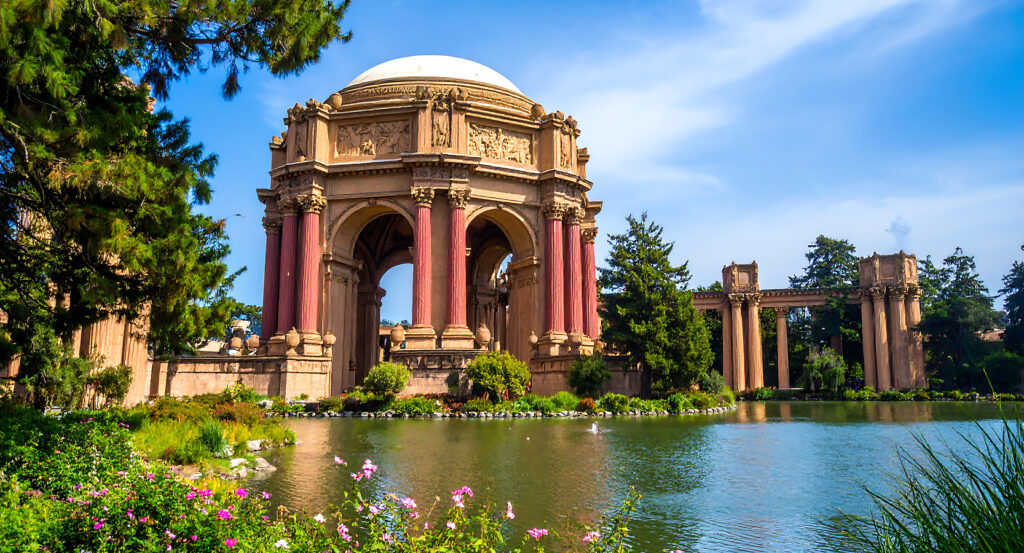
Originally built for the 1915 Panama-Pacific International Exposition, this expansive structure was conceived as a fleeting world's fair pavilion. Yet its beauty was so transcendent that the city refused to let it fade. The palace, with its Greco-Roman colonnades and domed rotunda reflected in a tranquil lagoon, evokes a sense of timeless melancholy, a ruin reborn, built not from decay but from longing. Designed by Bernard Maybeck, it was intended to symbolize the fleeting nature of art and human achievement. More than a century later, it remains one of San Francisco's most beloved icons, a space where architecture becomes poetry. As you walk beneath its soaring arches, you can feel the city's heartbeat slow, an oasis of silence amid the modern rush, where every ripple in the water seems to carry a whisper of the past.
What defines Palace of Fine Arts.
Despite its permanence today, Palace of Fine Arts was never meant to survive.
Constructed from temporary materials, wood, burlap, and plaster, it began deteriorating almost immediately after the exposition ended. Locals, however, fell in love with its haunting beauty and rallied to preserve it, seeing in its classical symmetry a spiritual counterpoint to the city's forward momentum. In the 1960s, the entire structure was painstakingly rebuilt in concrete, faithful to Maybeck's original vision but fortified for eternity. Its lagoon, once meant merely as an ornamental feature, evolved into a thriving ecosystem of swans, ducks, and herons, a living metaphor for San Francisco's capacity to transform fragility into endurance. Few realize that the rotunda's acoustics are so pure that even a whispered word can echo through the dome, or that the palace has starred in countless films, from Vertigo to The Room, each capturing its surreal blend of grandeur and solitude. Palace of Fine Arts is not just an architectural marvel, it's the city's collective memory carved into form, a monument to impermanence that refused to disappear.
How Palace of Fine Arts fits.
To truly experience Palace of Fine Arts is to let it unfold slowly, as both a destination and a feeling.
Arrive early, when the morning fog still clings to the lagoon and the columns seem to rise out of mist. Walk the circular path around the water, pausing often, from each angle, the palace reveals a new composition, as though Maybeck designed it to be rediscovered with every step. Bring a coffee from nearby Chestnut Street and settle on one of the benches facing the dome; it's one of the few places in San Francisco where time feels suspended. For photographers, the golden hour before sunset turns the entire rotunda into a glowing lantern, its reflection doubling the dreamscape. If you have the chance, step inside for an event at Palace of Fine Arts Theatre, the blend of neoclassical drama and modern acoustics is unforgettable. When you leave, cross the street to the Marina Green or stroll toward Crissy Field for sweeping views of the Golden Gate Bridge. Palace of Fine Arts isn't just a landmark, it's San Francisco's love letter to wonder itself, eternal proof that beauty, once imagined, can never truly fade.
Where your story begins.
Foresyte Travel reveals places that feel extraordinary long before you arrive.
Enjoy editorial crafted for luxury travelers.
Foresyte may earn a commission when you book.