
Why Sheep Meadow matters.
Sheep Meadow is a pastoral urban lawn where Central Park's landscape tradition meets 15 acres of open grass, deliberately engineered country scenery and a social history extending from grazing sheep to mass public gatherings.
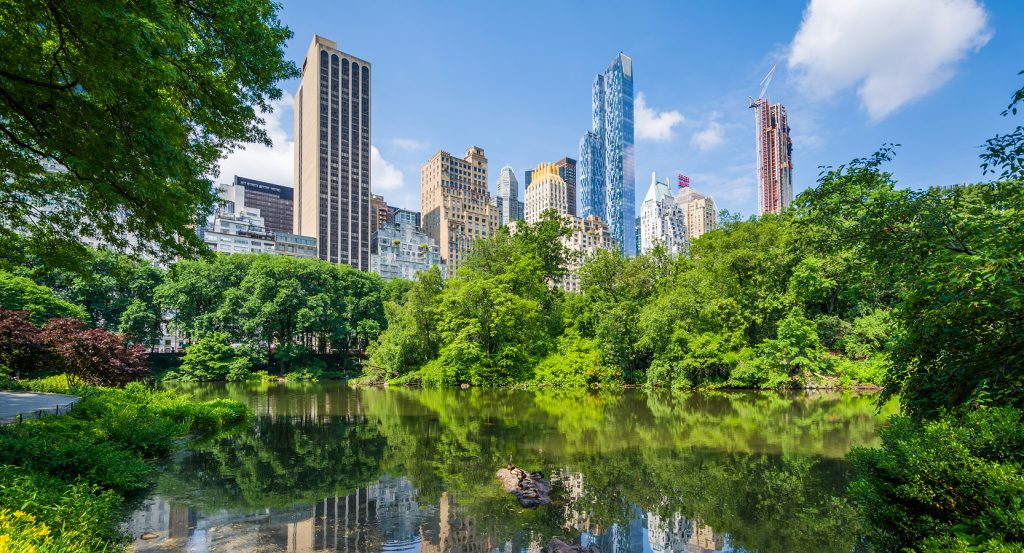
Set along the west side of Central Park between 66th and 69th Streets and just steps from Le Pain Quotidien at Mineral Springs, the meadow occupies a broad clearing framed by mature trees, winding paths and the Manhattan skyline rising beyond the park boundary. Frederick Law Olmsted and Calvert Vaux shaped the ground as an idealized pastoral landscape, requiring workers to blast substantial rock outcrops, level the terrain, add several feet of soil and establish the continuous grass surface. The broad central clearing preserves long uninterrupted views across the lawn, with perimeter trees functioning as a visual boundary between open grass and the surrounding circulation system. Manhattan towers now rise above that planted edge, placing an immense horizontal field against the vertical city beyond Central Park. The result is an engineered pastoral landscape whose scale, uninterrupted grass, tree-lined perimeter and skyline backdrop preserve one of Olmsted and Vaux's clearest demonstrations of open country scenery inside Manhattan.
What defines Sheep Meadow.
Sheep Meadow is best known for transforming a planned military parade ground into one of Frederick Law Olmsted and Calvert Vaux's principal pastoral landscapes, then evolving from scenery intended primarily for observation into a major gathering ground for twentieth-century New York. Early planning reserved the area for military exercises, an idea incompatible with the country scenery Olmsted and Vaux sought through their Greensward plan. Creation of the lawn became one of Central Park's most expensive construction undertakings as crews removed rock, regraded the site and imported deep layers of soil to create an open field from difficult Manhattan terrain. A flock arrived in 1864, giving the meadow a practical grazing system that simultaneously clipped the grass and reinforced the illusion of countryside within the growing metropolis. Park administrators constructed a dedicated Sheepfold in 1870 for the animals and their shepherd, with architect Jacob Wrey Mould contributing a structure tied to his broader work at Central Park features including Bethesda Terrace and Belvedere Castle. Twice daily, the shepherd stopped traffic along West Drive as the flock crossed between its quarters and the grass. Sheep remained part of the landscape for 70 years before Parks Commissioner Robert Moses relocated them to Prospect Park in 1934. The former Sheepfold then entered a radically different chapter when the Parks Department converted it into Tavern on the Green, preserving the physical building after its original agricultural purpose disappeared. Sheep Meadow's first seven decades joined landscape engineering, animal husbandry and Mould's architecture in an unusually literal realization of Olmsted and Vaux's country ideal.
Public use changed dramatically during the twentieth century as organized recreation and mass gatherings displaced the earlier principle that the lawn should primarily be viewed as scenery. Athletic events and school programs expanded the range of activity before the meadow emerged during the mid-1960s as a prominent gathering ground for concerts, demonstrations and large civic assemblies. Crowds eventually overwhelmed the turf, and by the 1970s severe erosion had reduced much of the once-continuous lawn to bare earth during a period of broader deterioration across Central Park. Elizabeth Barlow Rogers became Central Park Administrator in 1979 after leading the Central Park Task Force, placing a dedicated park advocate inside municipal management as New York confronted the accumulated physical decline. Existing advocacy groups joined in 1980 to form the Central Park Conservancy in partnership with the City, creating the organization that would drive a new era of restoration. Sheep Meadow became one of the Conservancy's earliest major projects, with damaged turf rebuilt and intensive landscape management returning the broad grass surface after decades of heavy use. Seasonal closure now protects that rehabilitation legacy during winter, preserving turf through a management practice directly tied to the lessons of the meadow's twentieth-century decline. The recovery of Sheep Meadow became an early demonstration of the Conservancy's ability to restore a heavily damaged historic landscape without abandoning the broad public use that had become fundamental to its modern role.
How Sheep Meadow fits.
Sheep Meadow works as the anchor for a daytime Central Park sequence connecting Victorian social reform, formal architectural artistry and a Swedish exhibition building repurposed through successive chapters of park history.
Begin at Dairy Visitor Center & Gift Shop, where Calvert Vaux designed a Victorian country cottage within Central Park's Children's District and construction between 1869 and 1871 created a dedicated place for children and caregivers to obtain fresh milk and refreshments. Families used its open-air loggia beside a rolling play lawn during an era when safe fresh milk remained difficult for many urban households to obtain, giving Vaux's scenic architecture a direct social purpose. The building deteriorated during the twentieth century and lost its loggia before becoming Central Park's first visitor center in 1979; the newly formed Central Park Conservancy reconstructed the missing porch during an early restoration campaign, then completed another comprehensive rehabilitation in 2021. Continue to Bethesda Terrace, where Vaux and Jacob Wrey Mould created Central Park's principal formal architectural ensemble as a counterpoint to the naturalistic scenery surrounding it. Two levels, broad stairways, carved balustrades and piers descend toward the Lake, with Mould's intricate ornament drawing plants, birds and seasonal imagery into the stonework. The Arcade beneath the upper roadway carries an elaborate ceiling of Minton encaustic tiles, extending decorative art into a circulation structure engineered to separate different forms of park movement. Bethesda Fountain anchors the lower level with Emma Stebbins's Angel of the Waters, dedicated in 1873 as the first public monument in New York City created by a woman artist. Conclude at Swedish Cottage (Marionette Theatre), constructed in Sweden as a model schoolhouse and sent across the Atlantic for Philadelphia's 1876 Centennial Exhibition, the first world's fair held in the United States. The timber building subsequently reached Central Park and passed through service as a tool house, restroom, entomological laboratory and World War II Civil Defense headquarters before NYC Parks assigned it to the traveling marionette theater in 1947. Puppet production eventually moved inside the building during the 1970s, giving a nineteenth-century Swedish exhibition structure a permanent theatrical purpose nearly a century after its transatlantic journey. The progression moves from Vaux's socially purposeful Children's District through the architectural artistry of Vaux, Mould and Stebbins into a Swedish exhibition building remade as a marionette theater, tracing three distinct ways Central Park architecture accumulated new public roles across successive generations.
Where your story begins.
Foresyte Travel reveals places that feel extraordinary long before you arrive.
Enjoy editorial crafted for luxury travelers.
Foresyte may earn a commission when you book.







































































































