
Why Sheridan Square matters.
Sheridan Square is an irregular civic crossroads where Greenwich Village's bohemian character meets layered street geometry, twentieth-century apartment architecture and a public triangle shaped by centuries of neighborhood change.
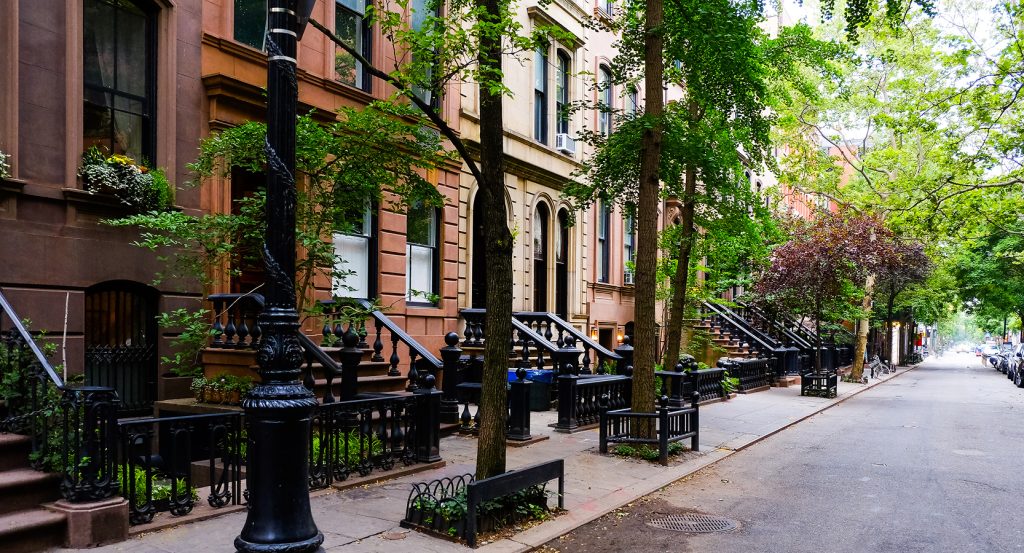
Set at the convergence of Washington Place, West 4th Street and Barrow Street near Seventh Avenue South and just steps from the Northern Dispensary, the square occupies one of Greenwich Village's characteristic breaks from Manhattan's rectilinear street plan. The 4,200-square-foot triangular plot is framed by streets arriving at different angles, producing long sightlines toward brick row houses and taller prewar apartment buildings across a compact piece of open ground. The Shenandoah at 10 Sheridan Square rises 14 stories above the junction, where Emery Roth's 1929 apartment building gave the low-rise surroundings a conspicuous vertical anchor. The viewing garden softens the paved convergence with planted beds and trees, preserving an open center within a district whose narrow streets repeatedly bend, terminate and intersect around it. The result is a small public square whose triangular garden, irregular approaches, prewar architecture and unusually layered streetscape concentrate Greenwich Village's physical development into a single intersection.
What defines Sheridan Square.
Sheridan Square is best known for occupying a Greenwich Village crossroads whose history extends from Indigenous activity through nineteenth-century public use, rapid-transit construction and the twentieth-century reshaping of the surrounding blocks. The triangular ground formed part of Sapokanican, an Indigenous settlement associated with Lenape people before European colonization transformed Lower Manhattan. The plot was paved as public roadway in 1830 and subsequently supported campaign speeches, community gatherings, military drilling, marching and children's recreation during the nineteenth century. Municipal officials named the ground for Union general Philip Henry Sheridan in 1896, eight years after his death, commemorating the Civil War commander whose Army of the Shenandoah campaigns formed a major part of his national reputation. The IRT opened Christopher Street-Sheridan Square station in 1918, attaching the name to a rapid-transit stop and strengthening the junction's role within the Village. Seventh Avenue South had recently cut through the neighborhood as part of subway construction, altering the older street pattern and producing new development sites around the square. Low brick and wood buildings still dominated much of the immediate setting during the 1910s, with an eight-story structure at Washington Place and West 4th Street standing above mostly three- and four-story neighbors. Apartment construction during the following decade radically changed that scale, culminating locally in Emery Roth's Shenandoah in 1929. Sheridan Square entered another preservation chapter when the surrounding Greenwich Village Historic District received municipal designation on April 29, 1969, protecting a district of more than 2,000 buildings across 65 blocks. The square compresses several stages of Greenwich Village's physical history into one junction, joining pre-grid geography, nineteenth-century public ground, subway-era street reconstruction and the apartment-building expansion of the 1920s.
A neighborhood archaeological campaign in 1982 opened an entirely different chapter beneath the triangular plot after the Sheridan Square Triangle Association persuaded the Parks Department to convert the paved traffic island into a viewing garden. Regina Kellerman, then executive director of the Greenwich Village Trust for Historic Preservation, recognized that the 4,200-square-foot parcel had escaped substantial modern development and proposed excavation before landscaping began. Rutgers University anthropologist Anne-Marie Cantwell directed the project with students and professional archaeologists, concentrating particular attention on evidence of Native American activity associated with the earlier settlement. Excavation during July and August uncovered numerous Indigenous objects, giving the garden project an archaeological dimension before the new landscape covered the ground again. The completed Sheridan Square Viewing Garden converted a site that had spent much of the twentieth century functioning as a traffic island into a planted neighborhood space maintained with local involvement. Another cultural institution had already attached Sheridan Square to postwar Village life: Dan Wolf, Edwin Fancher and Norman Mailer founded The Village Voice in 1955, with its earliest operation occupying a tiny space at the square before the newspaper became one of the country's most influential alternative weeklies. Wolf and Fancher had met at the New School, and Mailer supplied early financial backing as the founders built a publication around Village politics, arts and culture. The archaeological excavation and Village Voice origins give Sheridan Square two distinct forms of cultural depth, connecting physical evidence beneath the ground with a newspaper created to chronicle the unconventional community developing around it.
How Sheridan Square fits.
Sheridan Square works as the anchor for a daytime Greenwich Village sequence connecting experimental theater, the rescue of Victorian civic architecture and Gertrude Vanderbilt Whitney's creation of an institution devoted to American artists.
Begin at Provincetown Playhouse, whose theatrical ancestry reaches to the Provincetown Players founded in Massachusetts in 1915 by a group including George Cram Cook and Susan Glaspell before the company moved to Greenwich Village the following year. The Players initially occupied a parlor at 139 MacDougal Street, staging Floyd Dell's King Arthur's Socks, Louise Bryant's The Game and Eugene O'Neill's Bound East for Cardiff, then leased a former stable and bottling plant at 133 MacDougal Street for $400 a month when the first quarters proved too small. The larger playhouse opened on November 22, 1918 with one-act works by Edna St. Vincent Millay, Florence Kiper Frank and O'Neill, giving American experimental drama a permanent Village stage associated in later decades with playwrights extending through Edward Albee, John Guare and David Mamet. Continue to Jefferson Market Library, built from 1875 to 1877 as a Victorian Gothic courthouse by Frederick Clarke Withers and Calvert Vaux for $360,000. A civil court occupied the second floor, a police court occupied the first and prisoners waited in the brick-arched basement beneath a 100-foot fire-watch tower whose bell summoned volunteer firefighters; the building later drew national attention through Harry K. Thaw's 1906 trial for killing Stanford White and Mae West's prosecution following her play Sex. Court use ended in 1945, demolition threatened the empty structure by 1959 and preservation advocates including Margot Gayle, Philip Wittenberg, Lewis Mumford and E. E. Cummings secured its survival before Giorgio Cavaglieri converted it into the public library that opened in 1967. Conclude at New York Studio School, occupying the West 8th Street complex where Gertrude Vanderbilt Whitney built the institutional foundations of the Whitney Museum of American Art. Whitney acquired a MacDougal Alley carriage house in 1907 for her sculpture practice, established the Whitney Studio in 1914 and, with Juliana Force, developed the Whitney Studio Club into an exhibition, teaching and social center supporting American artists excluded from conservative institutions. Four townhouses and four stables had been consolidated by 1930, and the Whitney Museum opened there in 1931 after the Metropolitan Museum of Art declined Whitney's proposed gift of more than 500 works; Edward Hopper, Stuart Davis, John Sloan, Charles Demuth and Yasuo Kuniyoshi belonged to the artistic world nurtured through her patronage. The New York Studio School has occupied the complex since 1967, carrying studio education into buildings that once incubated a major American museum. The progression moves from the Provincetown Players' experimental stage through the community rescue of a Victorian courthouse into Whitney and Force's support of American artists, tracing the theatrical, preservationist and artistic institutions that made Greenwich Village an enduring center of cultural production.
Where your story begins.
Foresyte Travel reveals places that feel extraordinary long before you arrive.
Enjoy editorial crafted for luxury travelers.
Foresyte may earn a commission when you book.







































































































