Why Spacebase Gift Shop matters.
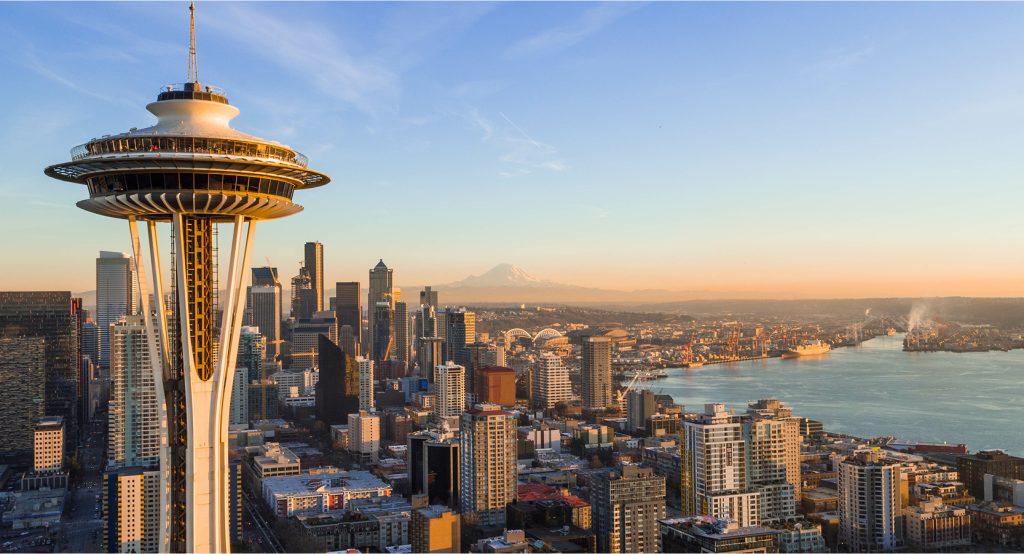
SpaceBase Gift Shop is a futuristic retail destination where Uptown's Space Age legacy meets Space Needle design, Pacific Northwest imagery and six decades of Seattle's most recognizable skyline symbol.
Set within the Space Needle complex near Broad Street and just steps from the tower's sweeping steel legs, the shop occupies the Pavilion Level between the open grounds of Seattle Center, the cultural buildings surrounding the former World's Fair campus and the dense city blocks extending south toward downtown. A broad retail floor spreads beneath the tower, giving the store a physical relationship with the structure that supplies nearly all of its visual language. Miniature Needles, architectural models, apparel and graphic objects repeat the tower's saucer-shaped silhouette across radically different scales. Seattle imagery expands that repertoire through orcas, salmon, octopuses, Bigfoot and other motifs associated with the Pacific Northwest. The result is a destination shop whose merchandise turns the architecture above it and the surrounding region into objects that can be carried away from Seattle Center.
What defines Spacebase Gift Shop.
SpaceBase Gift Shop is best known for emerging from the Space Needle's $20 million revitalization completed in 2000, nearly four decades after the tower transformed Seattle's skyline for the Century 21 Exposition. The project created a new Pavilion Level at the tower's base and installed SpaceBase as its dedicated retail operation, placing a permanent merchandise program inside the privately owned structure. That intervention followed an architectural history beginning with hotel executive Edward Carlson's 1959 sketch for a futuristic tower inspired by Stuttgart, Germany. Architect John Graham Jr. directed the final design and adapted revolving-restaurant technology he had previously employed in Honolulu, with Bagley Wright, Howard S. Wright, Ned Skinner, Norton Clapp and Graham forming the five-man investment group behind construction. Howard S. Wright Construction served as general contractor, and the tower was completed for $4.5 million in time for the 1962 World's Fair. The 2000 revitalization gave the aging structure a substantially expanded base program through the Pavilion, SpaceBase, restaurant improvements, observation-deck work and new exterior lighting. SpaceBase subsequently became the Space Needle's official store, converting the tower's architecture and the larger Seattle mythology surrounding it into a permanent retail collection. Its position beneath the Needle connects the store directly with a privately financed civic symbol whose commercial functions have remained integral to the building since its conception.
How Spacebase Gift Shop fits.
SpaceBase Gift Shop works as the retail anchor for an outing connecting an experimental rapid-transit system built for Century 21, a science pavilion by one of the twentieth century's most consequential American architects and a fountain conceived as an image of outer space.
Begin at Seattle Center Monorail, where West German company ALWEG began construction in April 1961 after agreeing to finance the system itself. The Blue and Red trains were built in West Germany, and the Blue Train made its first test run on March 3, 1962. Public service began on March 24, nearly a month before the fair opened, and more than eight million passengers rode during the six-month exposition. The original trains still travel on dedicated concrete beams supported by 68 Y-shaped columns, with 64 tires on each train carrying and guiding the vehicles along the elevated route. Continue to Pacific Science Center, created as the United States Science Pavilion for the same exposition after Seattle-born architect Minoru Yamasaki won the commission in 1960. A radio signal bounced off the moon from Washington, D.C. to Seattle during the February 1961 groundbreaking, connecting construction with the fair's scientific ambitions. Nearly seven million people entered the pavilion during Century 21, encountering Yamasaki's soaring white arches and fountain courts before the building reopened immediately after the fair as Pacific Science Center. The institution became the first American organization founded as a science and technology center, and Yamasaki appeared with the building on the cover of Time in 1963, the year he was selected to design New York's World Trade Center. Conclude at International Fountain, originally designed by Tokyo architects Hideki Shimizu and Kazuyuki Matsushita as another expression of the fair's fascination with space exploration. Its silver dome, projecting nozzles and jagged white rocks originally produced a lunar composition before a 1995 reconstruction by Kenichi Nakano & Associates and WET Design transformed the fountain into an accessible water landscape. The present 220-foot bowl surrounds a 27-foot-wide stainless-steel dome fitted with 137 mist nozzles, 77 fleur-de-lis jets, 56 microshooters and four Super Shooters capable of releasing 66 gallons apiece under 120 psi of air pressure. A 2021 renovation renewed jets, lighting and mechanical systems while preserving the 1995 configuration. The progression moves from ALWEG's full-scale vision of future transportation through Yamasaki's architecture for scientific discovery and culminates in a machine that translated the Space Age into moving water, connecting three surviving expressions of the technological optimism that remade Seattle Center in 1962.
Where your story begins.
Foresyte Travel reveals places that feel extraordinary long before you arrive.
Enjoy editorial crafted for luxury travelers.