
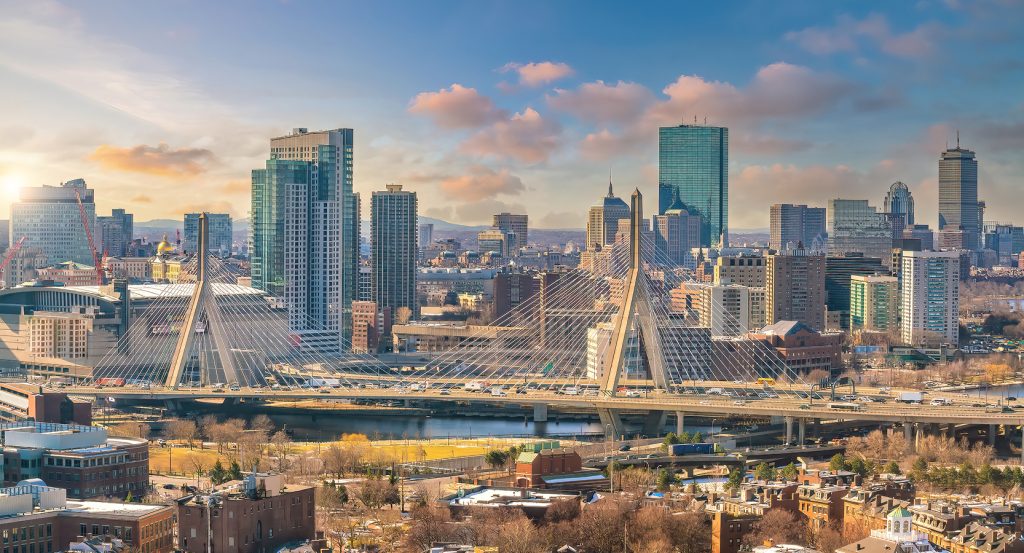
Why Thayer Street matters.
Thayer Street is a cultivated corridor where Mission Hill's academic energy, medical innovation, residential heritage, and neighborhood character converge into one of Boston's most engaging urban streets.
Running through Mission Hill between Fenway-Kenmore and Roxbury, the corridor links historic residential blocks, renowned medical institutions, higher education campuses, and tree-lined streets that reflect the neighborhood's distinctive balance of scholarship and community life. Each successive block heightens the experience as late nineteenth-century brick buildings, institutional architecture, landscaped campuses, and increasingly intimate streetscapes reveal the longstanding relationship between education, healthcare, and urban living. The corridor reaches its defining moment where architectural continuity, academic achievement, and neighborhood character combine into an unmistakably Boston experience shaped by generations of institutional and residential growth. The result is an experience defined by architectural character, academic vitality, and one of Mission Hill's most distinctive corridors.
What defines Thayer Street.
Thayer Street is best known for extending through Mission Hill, a neighborhood whose modern character emerged during Boston's rapid late nineteenth-century expansion as streetcar access encouraged substantial residential and institutional development. The corridor evolved alongside the growth of the Longwood Medical Area, whose internationally recognized hospitals and research institutions established the surrounding district as one of the world's foremost centers for medicine, biomedical research, and clinical innovation. Residential development introduced enduring collections of brick rowhouses, apartment buildings, and institutional architecture influenced by Romanesque Revival, Colonial Revival, and Classical Revival design traditions that continue defining the corridor's visual identity. Nearby expansion of Wentworth Institute of Technology, founded in 1904, reinforced Mission Hill's longstanding connection to technical education while complementing the area's broader academic landscape. Collectively, Mission Hill's streetcar-era growth, the emergence of the Longwood Medical Area, distinguished institutional architecture, and expanding higher education established Thayer Street as one of the neighborhood's defining corridors.
Bordering the corridor, Mission Hill Triangle Architectural Conservation District, established in 1985, preserves one of Boston's finest collections of late nineteenth-century residential architecture while reinforcing the area's historic streetscape through carefully protected brick rowhouses and masonry detailing. Nearby, Basilica and Shrine of Our Lady of Perpetual Help, dedicated in 1878 and designed principally by Franz Joseph Untersee, introduced a commanding Gothic Revival presence whose twin spires became enduring visual markers across Mission Hill. Throughout the surrounding neighborhood, original granite curbstones, ornamental iron fencing, mature street trees, and preserved residential façades continue expressing the craftsmanship that accompanied Mission Hill's transition into a prominent urban residential district. Together, these preservation efforts, ecclesiastical architecture, and intact residential streetscapes demonstrate how Thayer Street matured within one of Boston's most architecturally cohesive hillside neighborhoods.
How Thayer Street fits.
Thayer Street works as an exploration of Mission Hill's academic, cultural, and architectural heritage.
Begin at Museum of Fine Arts, Boston, where internationally celebrated collections establish the artistic foundation of the surrounding district before naturally leading toward Mission Hill. Continue to Isabella Stewart Gardner Museum, where intimate galleries and a distinctive personal collection deepen appreciation for Boston's cultural legacy while extending the experience through one of the city's most distinctive museums. Conclude at Kevin W. Fitzgerald Park, where elevated pathways and sweeping views provide a memorable finale that reveals the topography and neighborhood character defining Mission Hill. The progression moves naturally from world-renowned art to personal collecting before concluding with the landscape that best expresses Mission Hill's unique setting, revealing why Thayer Street remains central to the neighborhood's enduring identity.
Where your story begins.
Foresyte Travel reveals places that feel extraordinary long before you arrive.
Enjoy editorial crafted for luxury travelers.
Foresyte may earn a commission when you book.







































































































