
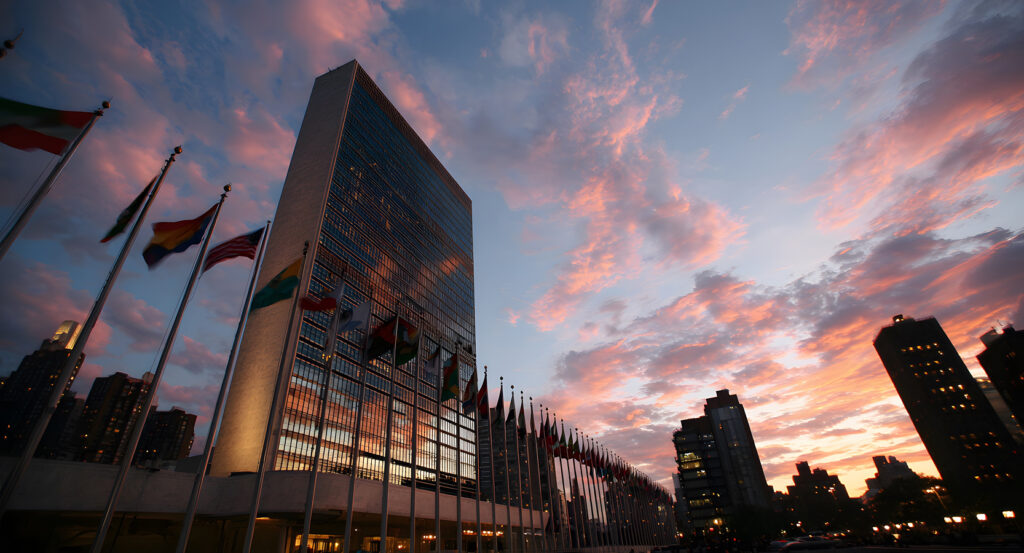
Why you should experience United Nations Secretariat Building in New York, NY.
The UN Secretariat Building is a vertical tribute to modernism, sleek, reflective, and quietly monumental. You should visit because it stands not just as an architectural triumph but as a symbol of a world striving for order in chaos.
Rising along Manhattan's East River, its glass façade captures the sky in ever-changing hues, serene in morning light, ethereal at sunset, a daily reminder that transparency was always part of its mission. Designed by an international team including Le Corbusier and Oscar Niemeyer, the Secretariat's minimalist aesthetic captures the spirit of collaboration it represents. Inside, corridors hum with the rhythm of global decision-making: policy papers, quiet conversations, translators' voices echoing through glass partitions. Visiting the building allows you to feel that rare mix of awe and calm, an awareness that the grand issues debated here ripple through every corner of the globe. It's one of those rare places where architecture and purpose align seamlessly, each reinforcing the other's quiet dignity.
What you should know about United Nations Secretariat Building.
Its layout, too, broke convention: rather than emphasizing hierarchy, the building's open-plan offices were designed to promote equality and fluid communication among international staff. Each of the 39 floors is a microcosm of the world, with translators, economists, and policy analysts from dozens of countries working side by side. The structure itself was built on land donated by John D. Rockefeller Jr., who saw the UN as a moral anchor for postwar civilization. Few visitors realize that beneath the building lies an intricate security system designed to protect sensitive diplomatic operations, or that the original air-conditioning and lighting systems were considered technological marvels of their time. Even the shade of blue used throughout the interior, now known as “UN blue”, was meticulously chosen to represent peace and neutrality. Every pane of glass reflects not only the skyline but the shared ideals of 193 nations.
How to fold United Nations Secretariat Building into your trip.
To fold the UN Secretariat Building into your trip, consider pairing your visit with a broader exploration of the East River corridor.
Begin your morning on the nearby riverside promenade, where you can take in sweeping views of the building's mirrored surface catching the dawn. Then, join a guided UN campus tour that grants access to the Secretariat's interior art collection, a global gallery featuring gifts from every continent, from mosaics and sculptures to the haunting “Non-Violence” gun sculpture on the grounds. Afterward, take a short walk to Dag Hammarskjöld Plaza, named after the visionary UN Secretary-General, where world citizens often gather in peaceful protest or solidarity. If you time your visit right, you might witness diplomats emerging for lunch or journalists huddled over breaking stories, quiet moments that remind you the world's pulse beats strongest here, not in performance but in the steady pursuit of peace.
Where your story begins.
Foresyte Travel reveals places that feel extraordinary long before you arrive.
Experience premium editorial crafted for luxury travelers.







































































































