Why The White House South Lawn matters.
The White House South Lawn is a ceremonial landscape where Downtown Washington's federal character meets presidential arrivals, public traditions and a park-like composition shaped around the southern face of the Executive Mansion.
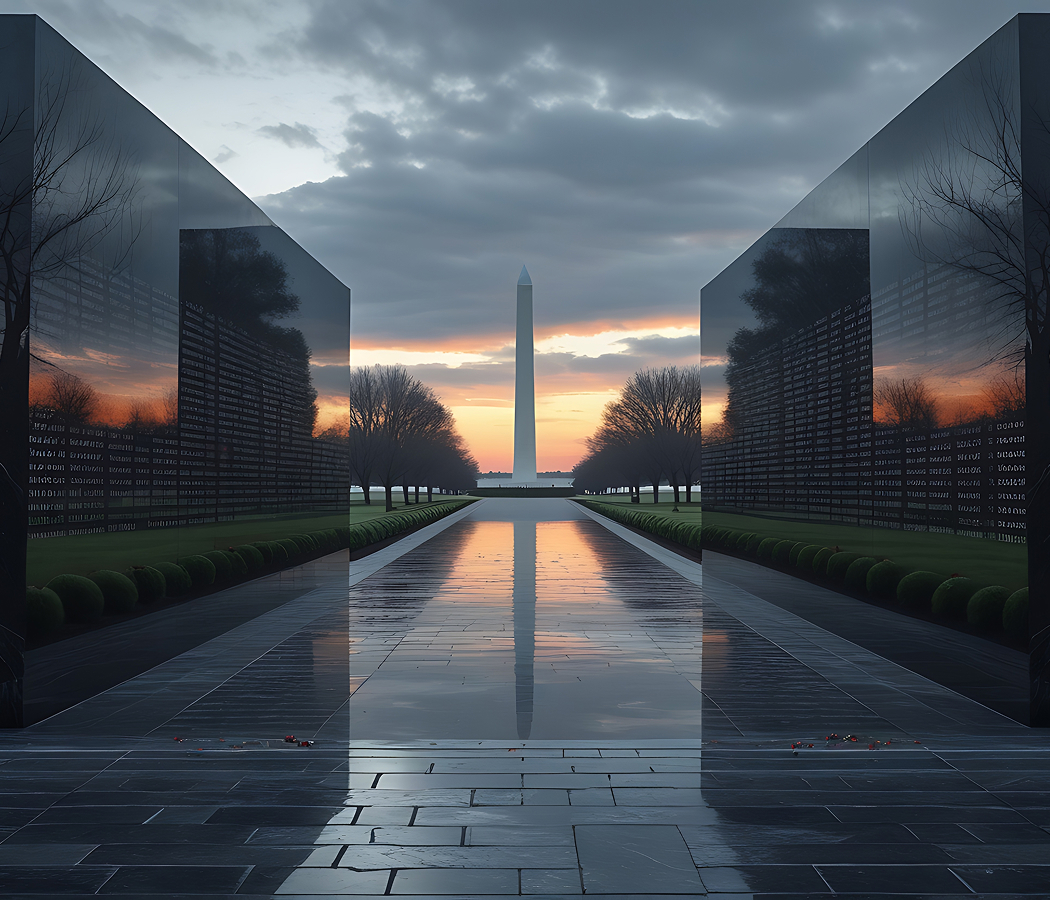
Set behind the White House South Portico near Constitution Avenue and just north of the Ellipse, the lawn occupies the descending southern half of the President's Grounds between the West Wing, East Wing and tree-lined perimeter, with the Washington Monument commanding the central axis and the Jefferson Memorial extending that sightline toward the Potomac basin. Broad turf falls away from the mansion before curving into a perimeter drive, giving the grounds a far deeper visual field than the more formal northern approach from Pennsylvania Avenue. Dense tree masses along the eastern and western edges frame the open center, concentrating attention on the White House above and the expansive core beyond the fence. The South Portico projects into that composition through a semicircular bow and six Ionic columns, creating a raised architectural terminus above the lawn. The result is a presidential landscape whose open central vista and wooded edges connect the White House directly to the expansive geography of the capital.
What defines The White House South Lawn.
The White House South Lawn is best known for converting the private southern grounds of the Executive Mansion into one of the presidency's principal ceremonial landscapes across more than two centuries of architectural and landscape change. James Hoban's original White House design lacked the projecting southern porch that now dominates the elevation, although his 1792 proposal already envisioned a porch opening from the three southern parlors. Benjamin Henry Latrobe prepared new portico proposals in 1817, and Hoban supervised construction of the South Portico in 1824 during James Monroe's presidency using Seneca sandstone from Maryland. The finished structure spans 61 feet across the 168-foot south elevation, with six Ionic columns wrapping around its curved central bay and a double staircase rising 13 feet from the ground. Andrew Jackson added an orangery and trees to the grounds during the 1830s, and Ulysses S. Grant later placed General Orville Babcock in charge of converting the property into pleasure gardens with major fountains on both sides of the mansion. Franklin D. Roosevelt commissioned Frederick Law Olmsted Jr. to reconsider the President's Grounds, producing the 1935 Olmsted Plan that remains foundational to their landscape organization. Olmsted regraded the South Grounds, raised heavily planted berms along the sides and protected a broad open vista extending from the mansion toward the Washington Monument and the future Jefferson Memorial. Harry S. Truman altered the architectural endpoint of that vista in 1947 and 1948 with Lorenzo S. Winslow's balcony across the South Portico, a $16,050.74 addition that became one of the most contested exterior modifications in White House history.
The Easter Egg Roll transformed the lawn into a recurring stage for public participation beginning on April 22, 1878, after Congress had restricted egg rolling on the Capitol Grounds and Rutherford B. Hayes opened the White House grounds to children on Easter Monday. Benjamin Harrison added the United States Marine Band in 1889 under John Philip Sousa, binding presidential music to the gathering during its nineteenth-century expansion. Between 50,000 and 60,000 children attended the revived 1921 event after its World War I interruption, demonstrating the extraordinary scale the tradition had reached by the Harding administration. WRC carried the festivities by radio for the first time in 1929, extending an event physically confined to the grounds into national broadcasting. Wartime restrictions interrupted the tradition again in 1942, food conservation prevented its return from 1946 through 1948 and reconstruction of the Executive Mansion kept the lawn unavailable from 1949 through 1952. Pat Nixon's staff created the tradition of the White House Easter Bunny in 1969, and the Nixon administration added organized egg-roll races in 1974. Ronald and Nancy Reagan began distributing signed wooden eggs in 1981, establishing the keepsake tradition that became inseparable from the modern event. The Easter Egg Roll traces an unusual continuity between nineteenth-century public recreation and the contemporary presidency through a single piece of White House ground.
How The White House South Lawn fits.
The White House South Lawn works as the presidential anchor for a Downtown Washington outing connecting a house designed by the architect who reshaped the early capital, a museum devoted to the domestic objects of American history and a public interpretation center occupying the commercial blocks facing the Executive Mansion.
Begin at Decatur House, completed in 1818 for naval officer Stephen Decatur from a design by Benjamin Henry Latrobe. Its prominent position on Lafayette Square placed one of Washington's earliest surviving private residences directly within the developing presidential neighborhood, and Decatur lived there for only fourteen months before dying after his 1820 duel with Commodore James Barron. Later owner John Gadsby expanded the property, and Secretary of State Henry Clay rented the house during the 1820s. Continue to DAR Museum, housed within the Daughters of the American Revolution's headquarters complex and centered on American decorative arts and domestic history. Its period rooms organize furniture, ceramics, textiles, paintings and household objects into geographically and chronologically distinct interiors, turning changes in American domestic production into the principal interpretive thread. Conclude at The People's House: A White House Experience, created by the White House Historical Association as a three-floor interpretive center devoted to the Executive Mansion and the people who have inhabited, worked in and shaped it. The progression moves from Latrobe's surviving residential architecture through collections tracing American domestic culture and culminates in a dedicated interpretation of the presidency's physical home, placing the South Lawn within the architectural and social history concentrated around the President's Grounds.
Where your story begins.
Foresyte Travel reveals places that feel extraordinary long before you arrive.
Enjoy editorial crafted for luxury travelers.
Foresyte may earn a commission when you book.