
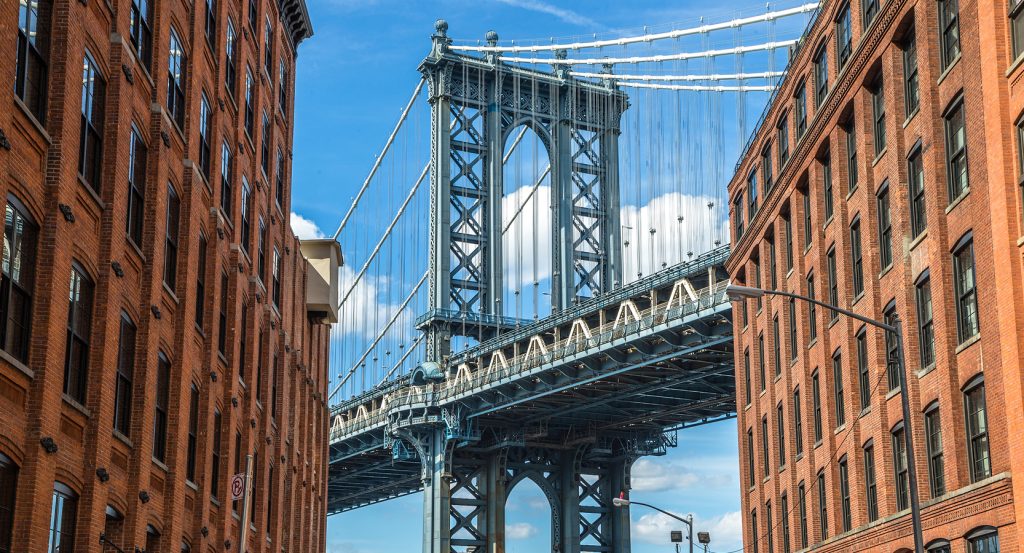
Why Williamsburg Bridge matters.
Williamsburg Bridge is a mighty suspension crossing where the Lower East Side's dense urban fabric meets exposed steel engineering, rail infrastructure and a 1,600-foot span across the East River.
Set along Delancey Street near Clinton Street and just steps from Seward Park, the bridge rises from the Lower East Side before crossing the East River toward South 5th Street in Williamsburg. Twin 310-foot steel towers carry four immense main cables above deep stiffening trusses, giving the crossing a visibly structural character in which load-bearing components define its silhouette. A central pair of rapid-transit tracks runs between four two-lane roadways, placing J, M and Z trains inside the bridge deck as motor traffic moves on either side. Separate pedestrian and bicycle routes climb through the steelwork, creating long elevated sightlines toward Lower Manhattan, Brooklyn and the river before descending into Williamsburg. The result is an unusually legible piece of infrastructure whose towers, cables, trusses, trains and elevated paths expose the engineering of an East River crossing throughout the trip between Manhattan and Brooklyn.
What defines Williamsburg Bridge.
Williamsburg Bridge is best known for opening in 1903 with the world's longest suspension span, surpassing the Brooklyn Bridge and retaining that distinction until the Bear Mountain Bridge opened in 1924. Proposals for another East River crossing had circulated before the Brooklyn Bridge was complete, and Leffert L. Buck became chief engineer for the Williamsburg project in 1895 after an engineering career that included major work at Niagara. Construction began in 1896 after Buck's plans received approval, with R. S. Buck, O. F. Nichols and H. D. Robinson contributing to the structural design and architect Henry Hornbostel contributing architectural work. Steel replaced the massive masonry towers associated with earlier suspension bridges, making Williamsburg the first suspension bridge exceeding 1,000 feet to use steel towers. Four cables, each composed of more than 10,000 wires, supported a superstructure stiffened by parallel trusses 40 feet deep, an exceptional depth tied to the elastic theory used in its design. The original deck accommodated four trolley lines, two elevated railway tracks, four carriage lanes and two pedestrian walks, imposing unusually heavy transportation demands on a single suspension structure. Bridge Commissioner Gustav Lindenthal attempted to alter Buck's design after entering office in 1902, but Mayor Seth Low blocked the effort with construction already far advanced. The crossing opened in December 1903 and immediately created a direct transportation corridor between the crowded Lower East Side and northern Brooklyn, helping accelerate residential movement into Williamsburg, Greenpoint and surrounding districts.
A profound engineering crisis nearly ended that history eight decades later as deterioration forced New York to confront replacement against comprehensive reconstruction. Rehabilitation had begun with roadway work in 1983, followed by suspender replacement, foundation repairs, painting and emergency interim repairs during the remainder of the decade. The main cables received extensive work between 1991 and 1994, including oiling, wrapping and replacement of all suspenders under a $90 million contract. South roadway reconstruction followed between 1994 and 1997 at $295 million, using a new orthotropic deck and rebuilding the southern footwalk. Transit infrastructure then received a $175 million campaign between 1997 and 2000 that completely replaced the approaches and rehabilitated the railway structure across the main bridge. North roadway reconstruction ran from 1999 through 2002 at another $250 million, followed by a $290 million campaign addressing towers, saddle stops, seismic components, fenders and other systems between 2003 and 2012. The wider reconstruction program exceeded $1 billion across successive contracts, effectively renewing roadways, rail infrastructure, cables and major steel components. NYC DOT's 2024 counts reached an average 87,987 vehicles, 8,645 cyclists and 4,440 pedestrians per day, alongside the rail traffic carried between Manhattan and Brooklyn. The sustained reconstruction campaign preserved a pioneering steel suspension bridge as an intensively used transportation corridor more than 120 years after its first opening.
How Williamsburg Bridge fits.
Williamsburg Bridge works as the anchor for a Lower East Side outing connecting Eastern European Jewish religious architecture, immigrant domestic history and the municipal transformation of street commerce.
Begin at Museum at Eldridge Street, housed within the Eldridge Street Synagogue built in 1887 as the first grand American synagogue purpose-built by Eastern European Jewish immigrants. The congregation drew worshippers from Russia, Poland, Lithuania and neighboring regions during a migration era in which 2.5 million Jews entered the United States between 1880 and 1924, with large numbers settling on the Lower East Side. Thousands attended services during the synagogue's strongest decades, and Aharon Yudelovitch became its first full-time pulpit rabbi in 1918. A preservation campaign lasting 20 years culminated in the building's 2007 rededication, followed in 2010 by an expansive stained-glass window created by artist Kiki Smith and architect Deborah Gans. Continue to Tenement Museum, whose principal building at 97 Orchard Street was constructed in 1863 by German immigrant Lucas Glockner after he entered Lower East Side real estate with fellow tailors Adam Stumm and Jacob Walter. The five-story building contained 22 apartments of 325 square feet, and 7,000 people from more than 20 nations lived there between 1863 and 1935. German immigrants John and Caroline Schneider operated a lager beer saloon inside the property from 1864 through 1886, and later households included the East Prussian Gumpertz family, Russian Jewish Levines and Italian Baldizzis. Historian Ruth Abram and social activist Anita Jacobson founded the museum in 1988 after Jacobson encountered the long-shuttered upper floors during their search for a surviving pre-1867 tenement. Conclude at Essex Market, rooted in the pushcart economy that filled Lower East Side streets with independent peddlers during the late nineteenth and early twentieth centuries. Mayor Fiorello La Guardia pursued indoor municipal markets as part of an effort to move vendors from crowded streets, and Essex Street Municipal Market opened on January 9, 1940 with four buildings and 475 vendors. Jewish and Italian merchants shaped its early commercial life before Puerto Rican migration during the 1950s expanded the range of goods sold there. The progression moves from an 1887 synagogue created by Eastern European Jewish immigrants through the domestic and working lives preserved at 97 Orchard Street and culminates in La Guardia's conversion of the neighborhood's pushcart economy into a municipal market, tracing institutions shaped by the communities surrounding the bridge's Manhattan approach.
Where your story begins.
Foresyte Travel reveals places that feel extraordinary long before you arrive.
Enjoy editorial crafted for luxury travelers.
Foresyte may earn a commission when you book.







































































































