
Why Baldwin Hills matters.
Baldwin Hills is an elevated enclave where South Los Angeles's residential character meets fault-raised terrain, winding hillside streets and a striking concentration of twentieth-century architecture above the surrounding basin.
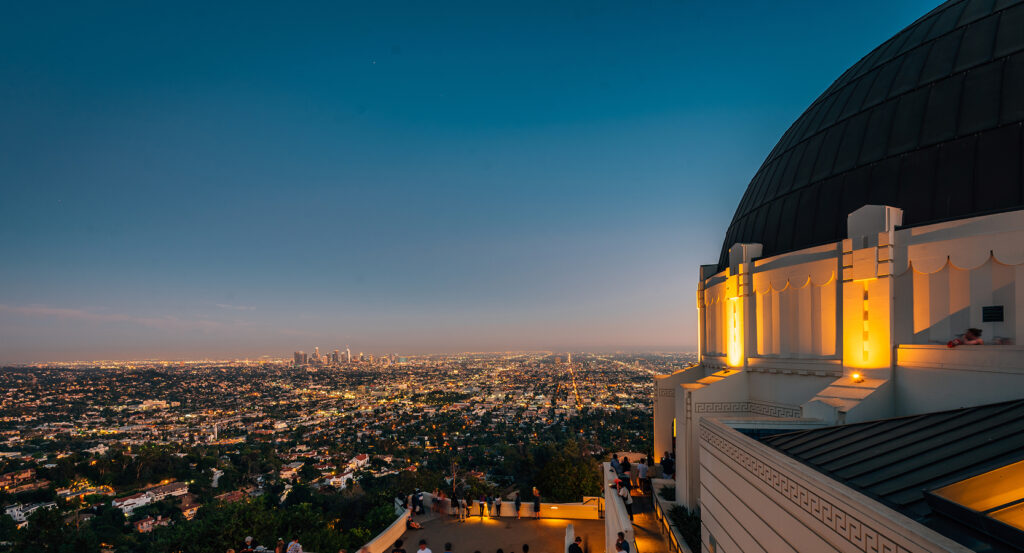
Positioned between Crenshaw, Leimert Park, and Culver City, the neighborhood occupies an irregular chain of ridges rising sharply above the flatter urban territory extending toward Downtown and the Pacific. Curving roads climb slopes broken by detached houses, apartment complexes, remnant grassland and planted hillsides, with successive elevations opening long views across the Los Angeles Basin. Movement through the neighborhood follows La Brea Avenue and Stocker Street before branching onto residential roads that climb, descend and bend around the underlying landform. Steeper interior streets deepen that physical character through terraced parcels, retaining walls and houses positioned above the roadway, giving the hills a residential geometry governed by elevation. The result is a neighborhood whose topography separates it physically from surrounding South Los Angeles and gives its residential districts an elevated scale rarely sustained across such a large section of the central basin.
What defines Baldwin Hills.
Baldwin Hills is best known for occupying an uplifted landscape whose twentieth-century development became inseparable from one of the Los Angeles Basin's major petroleum fields. The hills take their modern name from Elias Jackson “Lucky” Baldwin, who gained control of portions of Rancho La Cienega o Paso de la Tijera during the late nineteenth century after the Mexican-era property had passed through Vicente Sánchez and later owners. Petroleum extraction changed the land on an entirely different scale after Standard Oil struck a substantial reserve in 1924. Production exceeded 50,000 barrels per day within a year, covering sections of the ridges with derricks, roads and industrial infrastructure as Los Angeles entered one of the most consequential petroleum expansions in its history. Removal of underground fluids eventually lowered portions of the oil field by as much as ten feet, introducing subsidence into terrain already crossed by active faults. Los Angeles completed Baldwin Hills Reservoir in 1951 on a hilltop site between La Cienega and La Brea avenues, creating a 20-acre body holding close to 300 million gallons. Petroleum operators began injecting salt water into nearby formations three years later as part of enhanced extraction, adding another subterranean intervention around the reservoir. A leak appeared on December 14, 1963, followed within hours by collapse of the dam and release of between 130 million and 180 million gallons down the northern slope. The flood killed five people, destroyed 64 houses and damaged another 117 houses and 96 apartment buildings as water and debris cut through the residential territory below. The reservoir never returned to service, leaving the 1963 collapse as the defining rupture in a landscape transformed first by petroleum extraction, then by large-scale water storage and finally by the physical consequences of altering an unstable hillside.
The Broadway-Crenshaw Center introduced a separate postwar chapter in 1947 by placing a new form of automobile-oriented retail at the northern foot of Baldwin Hills. The May Company opened its Streamline Moderne building in October with Albert C. Martin and Associates responsible for the design, followed in November by Albert B. Gardner's five-story Broadway department store across Santa Barbara Avenue. The Broadway development joined its department-store anchor with Woolworth, Vons, a bank, drugstore and smaller specialty shops, concentrating multiple retailers around extensive automobile access at a scale still novel in American commercial development. Its 35-acre property encompassed 550,000 square feet, and Edward W. Carter brought Raymond Loewy Associates into the Broadway project after reconsidering the interior organization used at an earlier Pasadena branch. Silverwoods added a 22,500-square-foot store in 1949 as the center expanded into a major shopping destination serving the residential districts spreading across the surrounding hills and Crenshaw corridor. African American households moving westward during the 1950s and into Baldwin Hills during the 1960s transformed the surrounding customer base, placing the center within the commercial geography of an increasingly prominent Black middle-class community. Mayor Tom Bradley later encouraged consolidation of the separate properties, and a $90 million expansion begun in 1986 connected the department-store sites through an enclosed retail complex completed in 1988. The Broadway-Crenshaw Center then became Baldwin Hills Crenshaw Plaza, carrying the commercial history of the neighborhood from postwar automobile retail through the emergence of Baldwin Hills and Crenshaw as nationally significant centers of Black professional and cultural life.
How Baldwin Hills fits.
Baldwin Hills works as the anchor for an outing connecting reclaimed petroleum terrain, an internationally significant experiment in modern residential design and a hillside suburb central to Los Angeles's Black architectural and social history.
Begin at Baldwin Hills Scenic Overlook, where a 420-foot summit rises above land whose geological and industrial history remains visible across the surrounding ridges. The 58-acre property occupies terrain altered by decades of petroleum extraction before restoration converted the summit and slopes into public open space, with a one-mile climbing route winding around the steep staircase ascending from Jefferson Boulevard. Native habitat restoration has returned portions of the hillside to coastal scrub as pumpjacks continue operating across neighboring land, placing two radically different chapters of Baldwin Hills land use within the same panorama. The summit exposes the scale of the underlying landform particularly clearly, opening sightlines from the Pacific across the Los Angeles Basin toward the surrounding mountains. Continue to Village Green, conceived as Baldwin Hills Village and completed in 1942 as one of the country's most influential experiments in multifamily residential design. Clarence Stein worked with Reginald Johnson, Robert Alexander, Fred Barlow Jr. and Lewis E. Wilson on the architectural plan, arranging low-rise residences around an extensive interior green separated from automobile circulation. Landscape architect Fred Barlow Jr. developed planted courts and pedestrian paths into the residential composition, advancing Garden City principles at a scale rarely achieved in Los Angeles apartment construction. First tenants arrived during World War II, New England Mutual Life Insurance Company acquired the property in 1949 and condominium conversion followed during the 1970s. National Register recognition arrived in 1993, followed by National Historic Landmark designation in 2001, securing the former Baldwin Hills Village as one of the major surviving works of American modern residential design. Conclude in View Park Historic District, where the Los Angeles Investment Company developed an expansive hillside suburb between the 1920s and 1950s across curving streets overlooking the basin. The neighborhood first attracted national attention when the 1932 Los Angeles Olympics placed the men's Olympic Village on the hills, concentrating athletes from participating nations in a single purpose-built complex for the first time in Games history. Residential construction subsequently produced Italian, Spanish, English and other Revival houses for middle-income and affluent buyers under racial restrictions that initially excluded nonwhite ownership. The 1948 Shelley v. Kraemer decision ended judicial enforcement of such covenants, and Black families began purchasing homes there during the following decade. View Park became predominantly Black during the 1960s and developed into an affluent African American residential center associated with homeowners including Ray Charles, Ike and Tina Turner and Bebe Moore Campbell. Its 1,800 properties now compose one of California's largest National Register historic districts and the largest in the United States recognized for association with African American history. The progression moves from petroleum terrain reclaimed as elevated open space through Stein's modern residential experiment and culminates in View Park's transition into a major Black residential center, connecting landscape, architecture and social change across the Baldwin Hills.
Where your story begins.
Foresyte Travel reveals places that feel extraordinary long before you arrive.
Enjoy editorial crafted for luxury travelers.
Foresyte may earn a commission when you book.





































































































