
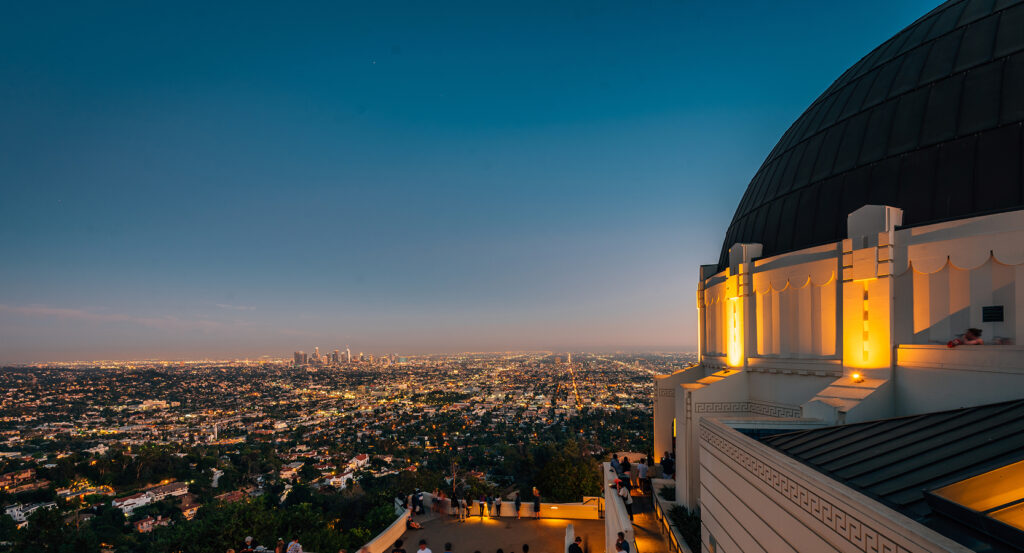
Why Baldwin Hills Scenic Overlook matters.
Baldwin Hills Scenic Overlook is an elevated urban preserve where Culver City's basin-edge character meets restored coastal sage scrub, dramatic topography and panoramic geography spanning the Pacific Ocean, metropolitan Los Angeles and its surrounding mountain ranges.
Set above Jefferson Boulevard near Hetzler Road and just steps from Culver City Park, the overlook occupies the northwestern ridge of the Baldwin Hills between Downtown Culver City and the Inglewood Oil Field, rising from the Ballona Creek watershed at the point where the coastal plain folds upward into a chain of isolated hills between the Santa Monica Mountains and Palos Verdes Peninsula. Its 420-foot summit commands an exceptional cross-section of Southern California geography, with Santa Monica Bay and the Pacific extending west, the Santa Monica Mountains defining the northern horizon, the San Gabriel Mountains closing the basin to the northeast and the Palos Verdes Peninsula marking the coast to the south. Restored slopes interrupt the dense residential, commercial and industrial development spreading across the surrounding plain, leaving the ridgeline visibly detached from the gridded city below. The ascent concentrates that vertical change into a steep hillside crossed by a winding trail and direct staircase before the terrain levels near the summit. The result is a compact mountain landscape whose abrupt elevation, restored slopes and commanding position above Ballona Creek reveal the physical structure of the Los Angeles Basin with unusual geographic clarity.
What defines Baldwin Hills Scenic Overlook.
Baldwin Hills Scenic Overlook is best known for converting land threatened by intensive residential development into a 58-acre public preserve commanding one of the broadest metropolitan panoramas in Los Angeles. The Baldwin Hills had undergone decades of alteration after Standard Oil discovered a substantial petroleum reserve there in 1924, with production surpassing 50,000 barrels per day within a year. Petroleum extraction eventually lowered portions of the Baldwin Hills oil field by as much as ten feet through subsidence, leaving industrial infrastructure and extensively disturbed terrain across the surrounding ridges. Development pressure intensified during the late twentieth century as the remaining open slopes acquired enormous real-estate value within the urbanized basin. Los Angeles County and the Santa Monica Mountains Conservancy formed the Baldwin Hills Regional Conservation Authority in 1999 to coordinate land acquisition and preservation across the hills. A developer had already graded the Vista Pacifica property for a proposed residential project when public agencies intervened. The conservation authority arranged its acquisition in 2000, committing $36 million to preserve land previously scheduled for immediate housing development, with broader public funding bringing the purchase associated with Vista Pacifica to more than $40 million. The transaction ranked among California's most expensive urban park acquisitions of its period and secured the dominant northwestern summit for public open space. State planning subsequently centered the property on public access, habitat rehabilitation and interpretation of the Ballona Creek watershed, turning land shaped by petroleum extraction and grading into the foundation of the modern overlook.
Construction beginning in 2006 translated that preservation victory into an unusually deliberate work of landscape architecture. California State Parks selected Safdie Rabines Architects for the principal structures and Wallace Roberts & Todd for landscape architecture, with habitat restoration undertaken by Earthworks and engineering contributions from Nabih Youssef & Associates, Integrated Engineering and Fuscoe. The $7 million project restored previously graded ridgelines and reestablished native vegetation across severely disturbed ground. Safdie Rabines placed a 10,000-square-foot visitor center inside a hollow near the summit, using polished concrete retaining walls, floor-to-ceiling glazing and curving roof forms to integrate the building with the reconstructed terrain. Three interconnected structures contain the principal interior functions and an outdoor pavilion, with circulation extending through an amphitheater assembled from recycled concrete. Engineered mounds near the summit deliberately withhold the Downtown skyline during the final approach before the city opens into view at the observation point. The direct ascent from Jefferson Boulevard uses 282 irregular steps fabricated from recycled concrete recovered on the property, creating a radically different route from the winding trail crossing the same slope. Baldwin Hills Scenic Overlook reopened in April 2009, converting a heavily altered development site into a state park whose architecture, reconstructed landform and native habitat were conceived as parts of the same restoration project.
How Baldwin Hills Scenic Overlook fits.
Baldwin Hills Scenic Overlook works as the anchor for a daytime outing connecting Culver City's emergence as a motion-picture production center, an independent museum that challenged conventional ideas of collecting and a Cold War archive created after the disappearance of an entire political system.
Begin at The Culver Studios, whose origins reach to 1918 when filmmaker Thomas H. Ince established his second Culver City production complex on a 14-acre property provided through an arrangement with city founder Harry Culver. Ince had already helped make motion-picture production an economic foundation of the newly incorporated city, and his new complex centered on a classical administration building modeled after George Washington's Mount Vernon. After Ince's death in 1924, Cecil B. DeMille acquired the studio in 1925 with Pathé America, beginning a succession through Pathé, RKO-Pathé, Selznick International Pictures, Desilu and later operators. Gone with the Wind and Citizen Kane became two of the productions associated with the property during its studio history, linking Ince's purpose-built filmmaking plant with works central to American cinema. The surviving administration building and production grounds preserve a physical lineage extending from silent-era industrial filmmaking through successive generations of Hollywood production. Continue to Museum of Jurassic Technology, created by artist and filmmaker David Wilson in 1984 as a traveling collection presented through galleries, museums and community centers before Wilson and Diana Wilson established a permanent home in Culver City in 1988. Wilson had studied at Kalamazoo College and completed an MFA in Experimental Animation at California Institute of the Arts in 1976, bringing filmmaking, miniature construction and collecting into an institution modeled partly on the eclectic cabinets that preceded modern museums. The original Culver City premises occupied a near-derelict former industrial building, yet the museum gradually expanded until Wilson purchased the property in 1999. Lawrence Weschler brought wider attention to the institution through his 1995 book Mr. Wilson's Cabinet of Wonder, examining its deliberate movement between verifiable history, elaborate invention and museological convention. The MacArthur Foundation awarded Wilson a fellowship in 2001 for work examining how cultural artifacts are organized and preserved, transforming a small independent collection into an internationally discussed experiment in what a museum itself might represent. Conclude at Wende Museum, founded in 2002 by historian Justinian Jampol in response to the dispersal and destruction of cultural artifacts following the collapse of communist governments across Eastern Europe. Its German name means “turning point,” referring directly to the political rupture surrounding the fall of the Berlin Wall and the subsequent disappearance of the German Democratic Republic. The institution assembled objects from state agencies, private households, dissident circles and other sources vulnerable to loss during that transition, developing an archive concerned with Cold War political culture and its aftermath. Culver City granted the museum a 75-year lease in 2012 for a former United States National Guard Armory constructed in 1949 and decommissioned in 2011. Renovation converted the military building into the museum's permanent public home in 2017, placing Cold War collections inside an American structure built during the opening years of the same geopolitical era. Subsequent campus development extended the former armory through gardens, installations and the Glorya Kaufman Community Center, carrying an archive formed from political dissolution into a broader cultural institution. The progression moves from Thomas Ince's construction of an industrial filmmaking center through David Wilson's reinvention of the private museum and culminates in Wende Museum's preservation of objects displaced by the collapse of Cold War governments, connecting three Culver City institutions built around the production, reinterpretation and survival of cultural memory.
Where your story begins.
Foresyte Travel reveals places that feel extraordinary long before you arrive.
Enjoy editorial crafted for luxury travelers.
Foresyte may earn a commission when you book.





































































































