
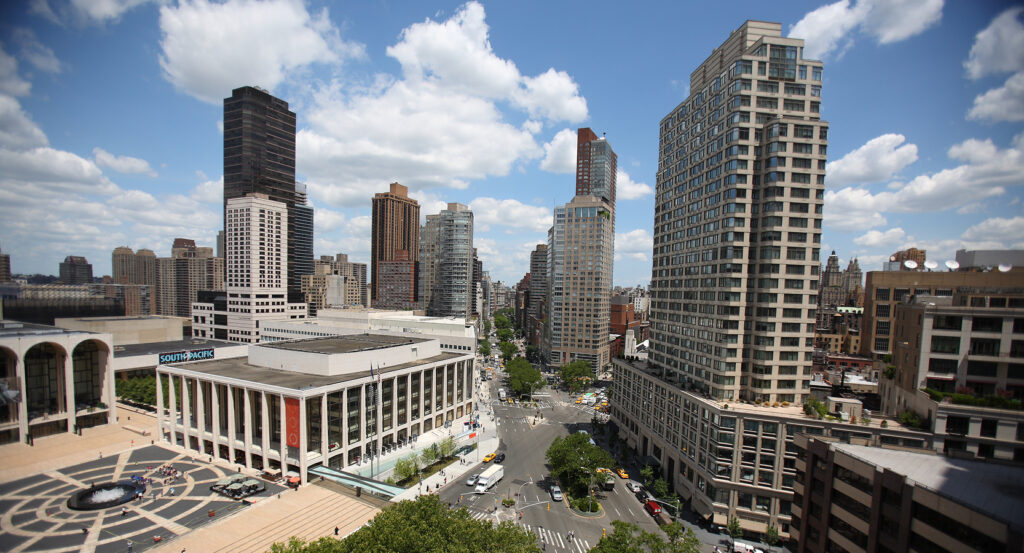
Why David H. Koch Theater matters.
David H. Koch Theater is a refined dance theater where Lincoln Square's performing-arts concentration meets Philip Johnson's travertine architecture, George Balanchine's choreographic priorities and a stage built around the physical demands of ballet.
Set along Columbus Avenue near West 63rd Street and just steps from Hearst Plaza, the theater occupies the southern side of Lincoln Center's principal plaza, facing north across Josie Robertson Plaza toward David Geffen Hall. Philip Johnson and John Burgee clad the largely windowless south, east and west elevations in travertine but opened the plaza facade behind a tall glass wall, giving the building a markedly different public face toward Lincoln Center's central court. Inside, a broad orchestra and five ascending seating tiers wrap a 2,586-seat auditorium beneath a gold latticed ceiling centered on a large spherical chandelier, concentrating the room around the performance platform. The Grand Promenade extends across the plaza-facing side behind full-height glazing, with three balcony levels rising around its travertine floor and gold-leaf ceiling to form an immense intermission hall overlooking the campus. The result is a theater whose stone exterior, transparent northern face, vertically stacked auditorium and expansive Promenade translate the scale of Lincoln Center into architecture conceived specifically around dance.
What defines David H. Koch Theater.
David H. Koch Theater is best known for becoming New York City Ballet's permanent home in 1964, bringing George Balanchine and Lincoln Kirstein's company into a building Philip Johnson developed in close consultation with both men. New York City Ballet had spent sixteen years at New York City Center before moving to the New York State Theater, as the building was originally named, with its gala opening on April 23, 1964. Balanchine's A Midsummer Night's Dream, created two years earlier, opened the company's first repertory season in the new theater on April 24, joining Mendelssohn's music to the first full-length ballet Balanchine had created in America. Five days later, Clarinade premiered there to Morton Gould's Derivations for Clarinet and Jazz Band, with Benny Goodman playing clarinet, Suzanne Farrell and Arthur Mitchell among the dancers and Robert Irving conducting; it was Balanchine's first choreography for the company after the move from City Center. The larger stage subsequently supported expanded productions, including a new staging of The Nutcracker and Balanchine's first New York City Ballet production of Ballet Imperial. Balanchine followed in 1965 with the three-act Don Quixote, set to a commissioned score by Nicolas Nabokov, designed by Esteban Francés with costumes executed by Karinska and created around Suzanne Farrell as Dulcinea. Balanchine himself appeared as Don Quixote opposite the 19-year-old Farrell at the May 27 preview gala, a performance preserved on 16mm film and later restored by The New York Public Library for the Performing Arts. The theater remained central to Balanchine's later large-scale undertakings, including the 1972 Stravinsky Festival, the 1975 Ravel festival, Union Jack, Vienna Waltzes and the 1982 Stravinsky Centennial Celebration.
A major renewal began four decades later when David H. Koch pledged $100 million in 2008 toward renovation and the building's future operation, prompting the New York State Theater to receive his name. JCJ Architecture led the first comprehensive work on Johnson's building since 1964, undertaking a project encompassing 250,000 square feet and valued by the firm at $107 million. The auditorium received two center aisles through the former continental seating arrangement, along with new seats and carpeting, reshaping circulation across the orchestra level. An operable orchestra pit expanded production flexibility, and replacement stage lighting, new auditorium lighting positions and a media center strengthened the theater's technical infrastructure for performance, recording and broadcast. Lobby finishes were renewed as part of the same campaign, retaining Johnson's principal public interiors through a substantial technical modernization. The building's artistic program carries another strand of its original conception: Lincoln Kirstein arranged enormous Carrara-marble enlargements of Elie Nadelman sculptures for opposite ends of the Grand Promenade, and Johnson incorporated commissioned work by Lee Bontecou and Jasper Johns into the stair halls. Those commissions placed twentieth-century American sculpture directly inside the theater's circulation spaces, extending the collaboration among Johnson, Balanchine and Kirstein beyond the auditorium into a broader union of architecture, dance and visual art.
How David H. Koch Theater fits.
David H. Koch Theater works as the anchor for a Lincoln Square outing connecting one of the world's great performing-arts archives, four centuries of self-taught art and the artistic program of a nineteenth-century Catholic church.
Begin at The New York Public Library for the Performing Arts, whose origins gathered separate collections devoted to theater, music, dance and recorded sound before Lincoln Center gave them a purpose-built institutional home. President Dwight D. Eisenhower participated in the 1959 groundbreaking, Richard Rodgers contributed $150,000 toward a recorded-sound archive in 1962 and Genevieve Oswald's Dance Collection received divisional status in 1964. Gordon Bunshaft of Skidmore, Owings & Merrill designed the building, which formally opened on November 30, 1965 after a dedication attended by William Schuman, John D. Rockefeller III and Mayor Robert F. Wagner. The institution now holds upward of eight million items spanning sources as early as eleventh-century music through modern theater, dance, film and recorded sound, and received a Tony Honor for Excellence in Theatre in 2025. Continue to American Folk Art Museum, founded on June 23, 1961 and developed into the national museum devoted to folk and self-taught artists. Its holdings encompass more than 7,000 works across four centuries and nearly every continent, ranging from portraits and quilts to work by contemporary self-taught artists. The institution's physical history has been unusually mobile: after operating its Lincoln Square location for decades, it sold its West 53rd Street building to the Museum of Modern Art in 2011 to eliminate bond debt and reestablished Lincoln Square as its principal home. Conclude at Church of St. Paul the Apostle, begun in 1876 from plans associated with architect Jeremiah O'Rourke before Paulist priest and West Point-trained engineer George Deshon assumed control of the project. The massive church uses rock-faced granite salvaged from Manhattan structures that included portions of the Croton Aqueduct embankment, the Croton Distributing Reservoir and Booth's Theatre. Its later artistic program brought major American practitioners into the interior, including Stanford White, John La Farge and Augustus Saint-Gaudens, adding an ambitious decorative chapter after the church's 1885 dedication. The progression moves from Bunshaft's purpose-built center for preserving performance history through a museum devoted to self-taught creation and culminates in a granite church shaped by O'Rourke, Deshon and major American artists, connecting archival memory, independent art and sacred architecture around Lincoln Square.
Where your story begins.
Foresyte Travel reveals places that feel extraordinary long before you arrive.
Enjoy editorial crafted for luxury travelers.
Foresyte may earn a commission when you book.







































































































