
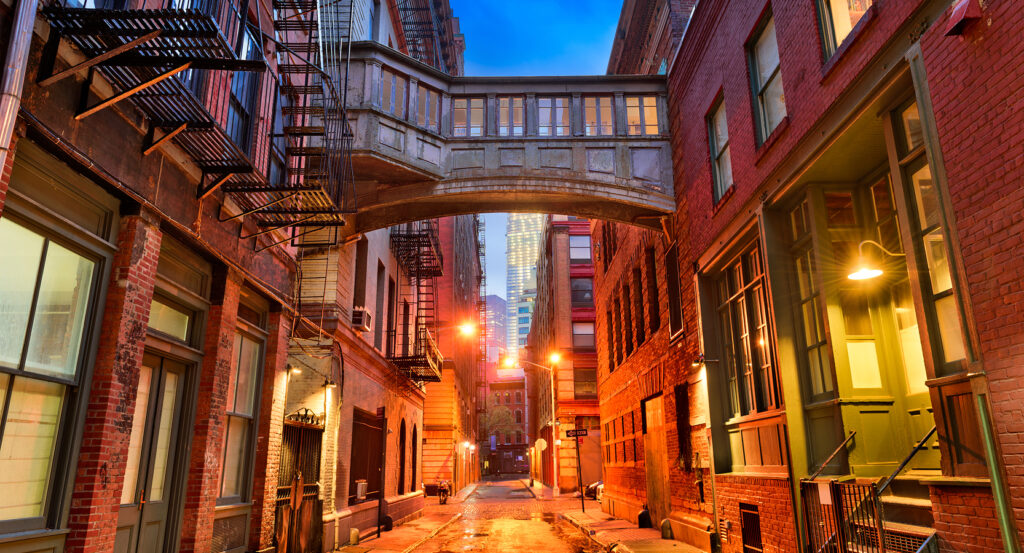
Why Duane Park matters.
Duane Park is an intimate triangular green where Tribeca's mercantile streetscape meets historic landscape design, mature planting and one of Manhattan's earliest purpose-built neighborhood parks.
Set along Duane Street where it widens toward Hudson Street and just steps from Staple Street, the park occupies an irregular parcel created where early Lower Manhattan street alignments converged at different angles. Curving paths divide densely planted beds beneath a tree canopy, with historic-style lamps, benches and perimeter fencing reinforcing the enclosure of the small garden. Landscape architect Signe Nielsen shaped the late-1990s configuration around a meandering circulation pattern, expanding planted areas within a site that had acquired extensive paving during the twentieth century. The present layout places greenery close to surrounding sidewalks on all sides, creating a compact planted room amid Tribeca's nineteenth-century store-and-loft blocks. The result is a remarkably concentrated urban garden whose triangular footprint, curving paths, layered planting and close relationship with Tribeca's masonry streets preserve the physical character of a park conceived more than two centuries ago.
What defines Duane Park.
Duane Park is best known for being the first parcel specifically purchased by New York City for use as a public park, beginning with an unusual remnant of Manhattan's colonial landholding pattern. Dutch governor Wouter van Twiller granted 62 acres in the area to Roeloff and Annetje Jans in 1636, and Annetje later married Everardus Bogardus, minister of the Reformed Dutch Church of New Amsterdam. The property became known as Dominie's Bouwerie before passing through successive Dutch and English control and eventually reaching Trinity Church through a royal grant in 1705. Street planning in 1794 produced an awkward triangular remnant where Duane Street encountered another grid on a different axis, leaving a parcel unsuitable for conventional construction. The city purchased that ground from Trinity Church in 1797 and reserved it for park use, creating what Friends of Duane Park calls New York's second-oldest public park and its first municipally purchased park property. James Duane supplied the name, carrying into the site the legacy of a Revolutionary-era lawyer and public official who served in the Continental Congress, became a federal judge and held office as New York's first post-independence mayor. Formal garden beds, trees and an iron fence appeared in 1804, followed by additional forest trees in 1825 as the surrounding district remained near the northern edge of the expanding city. Commerce later displaced much of that residential character, with warehouses filling nearby blocks and transportation infrastructure advancing along Hudson Street and Greenwich Street. By 1871 the small park had deteriorated severely enough to prompt municipal rehabilitation, leading to renewed planting with deciduous trees, evergreens and shrubs.
A decisive redesign arrived during the reform administration of Mayor Abram Hewitt, when park superintendent Samuel Parsons Jr. enlisted Calvert Vaux to rethink several small New York parks. Vaux, whose collaborations with Frederick Law Olmsted included Central Park and Prospect Park, faced less than an acre at Duane Street yet applied scenic principles through paths entering from all three sides, grass, shrubs and a flower bed. A horse trough stood at the western end, tying the garden physically to the commercial traffic moving through the surrounding warehouse district. That scheme disappeared substantially in 1940 when concrete replaced much of the planted ground, a simpler steel fence succeeded the ornate iron enclosure and ten sycamores were positioned around the perimeter. Designers also installed a flagpole with a base honoring Annetje Jans Bogardus, linking the twentieth-century alteration back to the site's seventeenth-century land history. Another contraction arrived in 1954 when the western end was paved into Duane Street and the southern sidewalk disappeared as truck activity intensified around nearby food warehouses. Friends of Duane Park formed in 1994 after neighborhood residents organized around deteriorated planting, litter and the heavily paved layout, eventually raising private funds and securing $150,000 in city capital support through Council Member Kathryn Freed for a deeper rehabilitation. The redesigned park reached its ribbon cutting in spring 1999, restoring a greener configuration after more than half a century of contraction and industrial-era alteration. A newer campaign launched in 2021 seeks to reclaim the 26 percent of historic parkland lost during twentieth-century street changes, with the proposal advancing through discussions involving the Parks Department, Department of Transportation and City Council through 2026.
How Duane Park fits.
Duane Park works as the anchor for a Tribeca outing connecting New York firefighting and cinema, experimental sound-and-light art and a miniature institution devoted to contemporary objects.
Begin at Hook & Ladder Company 8 Firehouse, whose present three-story building was designed by New York Fire Department Superintendent of Buildings Alexander H. Stevens and completed in 1903. The fire company had occupied the site since 1866, but the new building originally stretched twice the width seen now and contained two vehicle bays; the 1913 widening of Varick Street removed half of the structure. More than seven decades later, its surviving single-bay exterior became the headquarters of the fictional Ghostbusters in Ivan Reitman's 1984 film, generating an enduring association between an operating FDNY house and New York film history. A city-managed rehabilitation beginning in the 2010s renewed the roof, windows, masonry, mechanical systems and interior facilities. Continue to Dream House, the long-running sound-and-light installation created by composer La Monte Young and artist Marian Zazeela and maintained at 275 Church Street through the MELA Foundation. The project originated with Young and Zazeela's first public Dream House at Heiner Friedrich Gallery in Munich in 1969, followed by presentations at the Metropolitan Museum of Art in 1971 and Documenta 5 in Kassel in 1972. Dia Art Foundation later commissioned a six-year iteration at 6 Harrison Street from 1979 to 1985, and the Church Street installation opened in 1993. Young's sustained frequencies and Zazeela's light environments joined in a durational artwork whose Tribeca incarnation continued for more than three decades, later incorporating work by their senior disciple Jung Hee Choi. Conclude at Mmuseumm, the tiny nonprofit institution at 4 Cortlandt Alley founded in 2012 by Alex Kalman and brothers Josh and Benny Safdie. Installed inside a former freight-elevator shaft, the museum developed exhibitions from ordinary contemporary objects arranged with the intensity of a cabinet of curiosities, turning overlooked artifacts into evidence of larger social conditions. Its 2026 program, Modern Rubble Around the World, assembles remnants associated with destruction and displacement across different countries, extending the institution's object-centered method into questions of memory, loss and survival. The progression moves from a working 1903 firehouse transformed through cinema through Young and Zazeela's decades-long experiment in sustained sound and light and culminates in Mmuseumm's dramatic compression of contemporary history into a former elevator shaft, tracing three distinctly Tribeca forms of adaptation across architecture, art and collecting.
Where your story begins.
Foresyte Travel reveals places that feel extraordinary long before you arrive.
Enjoy editorial crafted for luxury travelers.
Foresyte may earn a commission when you book.







































































































