
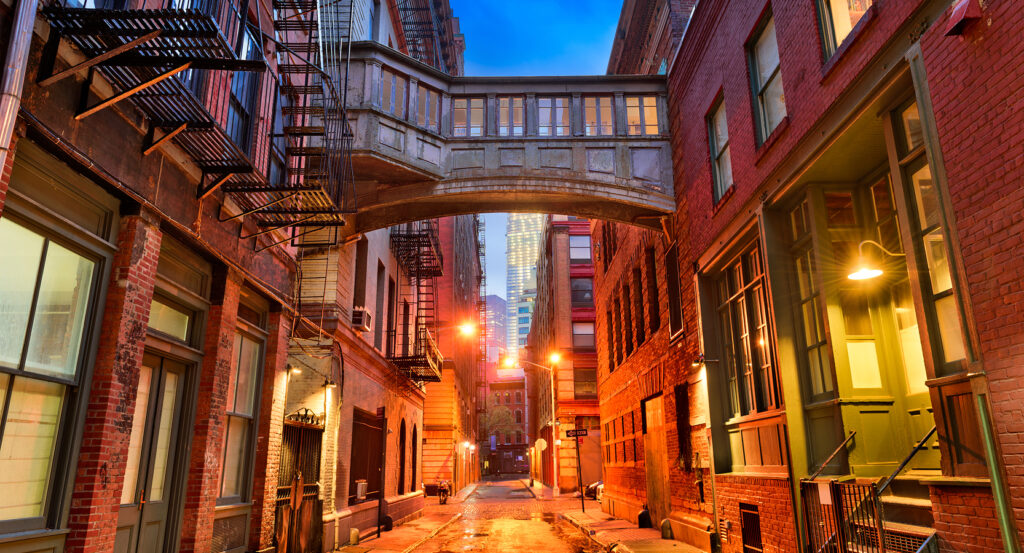
Why Tribeca matters.
Tribeca is the soul of downtown sophistication, where cobblestone streets and cast-iron façades whisper stories of old New York while creativity hums beneath every corner.
Short for “Triangle Below Canal,” Tribeca has transformed from a gritty warehouse district into one of Manhattan's most coveted and cinematic enclaves. Its architecture feels timeless, those red-brick buildings and massive loft windows tell of a time when artists moved in for cheap space and left behind a legacy of culture and cool. Today, Tribeca strikes that rare balance between refinement and authenticity: sleek restaurants beside industrial remnants, art galleries in spaces that once stored spices, and cafés where movie stars blend quietly with lifelong locals. The energy is subtle, confident, grounded, a rhythm that moves slower than Midtown but deeper than almost anywhere else in the city. It's where New York exhales, creative but composed, worldly but warm, a living canvas of old bones and new dreams.
What defines Tribeca.
Beneath its polished surface lies a rich narrative of rebirth, a story that mirrors New York's own evolution from industry to imagination.
In the late 19th century, Tribeca was the heart of Manhattan's produce and textile trade, its warehouses stacked with goods from across the globe. But as shipping and manufacturing declined in the mid-20th century, the district fell quiet, abandoned buildings and empty streets echoing with the ghosts of commerce. Then came the artists. In the 1970s, painters, sculptors, and filmmakers began renting vast, light-filled lofts for a fraction of what they'd pay uptown, transforming the neighborhood into a creative sanctuary. It was here that a new kind of urban aesthetic took root, one that celebrated raw materials, open space, and quiet rebellion. The area's artistic soul eventually gave rise to the Tribeca Film Festival, founded in 2002 by Robert De Niro and Jane Rosenthal to revitalize Lower Manhattan after 9/11. What began as an act of community healing evolved into one of the most respected film events in the world, a tribute to Tribeca's enduring ability to transform hardship into art. Even now, that same spirit lives in every gallery, every converted loft, every hidden courtyard, the belief that beauty and resilience can occupy the same space.
How Tribeca fits.
To experience Tribeca is to slip behind New York's noise and discover a neighborhood that thrives on quiet confidence and understated luxury.
Start the morning with coffee from a minimalist café like Laughing Man or Blue Bottle, then stroll the cobblestone blocks along Greenwich and Harrison Streets, where sunlight catches on cast-iron columns and ivy-covered brick. Explore the area's design boutiques and contemporary galleries, each blending artistry with urban edge. Stop for lunch at a landmark like Bubby's, where comfort food meets nostalgia, or at Locanda Verde for an elevated Italian experience that still feels like home. In the afternoon, wander along the Hudson River Park promenade, among the city's most tranquil escapes, or visit Pier 25 for a riverside pause with skyline views. As evening falls, Tribeca glows with the soft buzz of intimacy, candlelit tables in MICHELIN-starred dining rooms, wine bars tucked behind unmarked doors, and streets where the city's pulse feels slower, steadier, wiser. End the night with a cocktail overlooking the water, the Freedom Tower gleaming in the distance, and you'll understand why Tribeca endures: not as a trend or a performance, but as New York distilled, elegant, creative, and endlessly alive beneath its calm exterior.
Where your story begins.
Foresyte Travel reveals places that feel extraordinary long before you arrive.
Enjoy editorial crafted for luxury travelers.
Foresyte may earn a commission when you book.







































































































