
Why Edge matters.
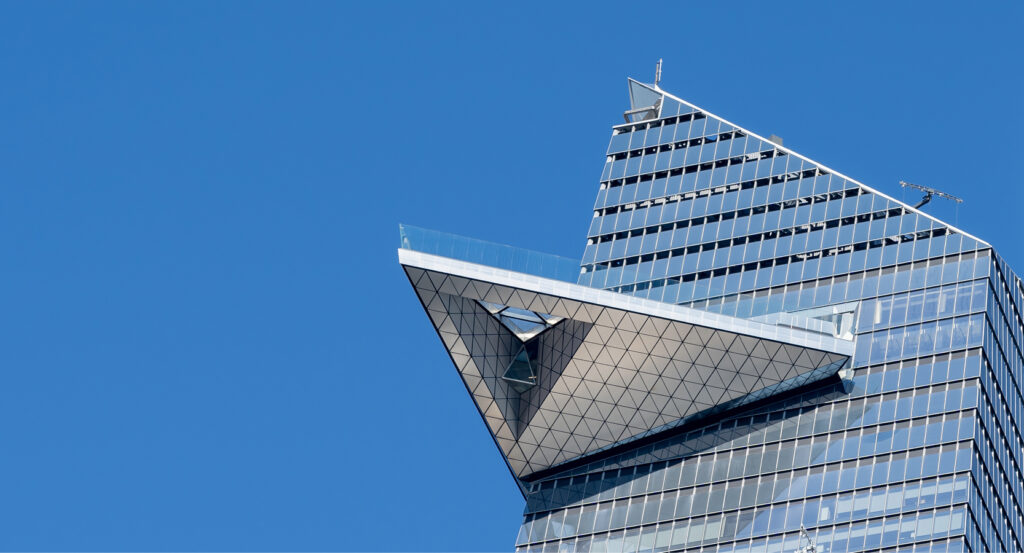
Edge is a soaring observation deck where Hudson Yards' vertical architecture meets an 80-foot cantilever, exposed structural engineering and open-air views from more than 1,100 feet above Manhattan.
Set on the 100th floor of 30 Hudson Yards near 11th Avenue and just steps from Bella Abzug Park, the deck projects from the southern and eastern faces of Kohn Pedersen Fox's 1,296-foot tower above the West Side rail yards. Its triangular platform extends 80 feet beyond the building and provides 7,500 square feet of outdoor area, giving the deck a sharp prow suspended beyond the tower facade. Seventy-nine nine-foot glass panels surround the perimeter. 6 degrees to preserve uninterrupted sightlines toward the Hudson River, Midtown, Lower Manhattan and distant terrain beyond New York City. A 225-square-foot glass floor opens a direct view toward the streets below, and stepped outdoor seating climbs toward the 101st floor along the tower-facing side of the platform. The result is an observation deck whose cantilevered triangle, outward-leaning perimeter, transparent floor and stepped upper edge turn the upper reaches of 30 Hudson Yards into an unusually exposed piece of public architecture.
What defines Edge.
Edge is best known for extending the public realm of 30 Hudson Yards beyond the face of its supertall tower through an engineering system assembled from 15 enormous prefabricated sections. Related Companies and Oxford Properties Group developed the tower with Kohn Pedersen Fox, whose William Pedersen led a design connecting 30 Hudson Yards architecturally with its companion tower at 10 Hudson Yards. Thornton Tomasetti devised the structural solution for 30 Hudson Yards and its adjoining retail podium above an operating rail yard, where multistory transfer trusses redirect tower columns toward permissible foundation locations between tracks. Edge created a separate structural challenge high above that system, requiring its primary frame, secondary facade structure, fireproofing and soffit panels to be integrated into large modules at Cimolai's plant in Italy. The sections were fully assembled there to confirm alignment, dismantled for shipment to New York and delivered to the site for lifting into position. Individual sections weighed between 35,000 and 100,000 pounds, and the completed deck reached 765,000 pounds before live loads were added. Some lifts required two cranes working simultaneously, yet prefabrication allowed the principal pieces to be assembled on the tower in less than four months, sharply reducing field labor at extreme elevation. Edge opened on March 11, 2020 at 1,131 feet above street level, giving the engineering campaign a public destination suspended from one of New York's tallest office towers.
Rockwell Group developed a separate interior and arrival program that extends from the lower entry sequence to the transition onto the exterior platform. LAB at Rockwell Group created Journey to Edge around the transformation of the West Side rail yards, carrying the architectural story of Hudson Yards through a sequence encountered before the elevator ascent. High-speed elevators then climb 100 floors in under a minute before the enclosed interior gives way to the exposed platform. L'Observatoire International designed a lighting program unveiled with the opening, adding a nighttime component to the deck's architectural presence on the skyline. Interior Design subsequently selected Edge for its 2020 Best of Year honor in the Outdoor Space category and separately honored Journey to Edge in the Art Exhibition/Installation category. The following year, the NYCxDESIGN Awards recognized Edge in both the Outdoor Space and NYC's Shining Moment categories. Another chapter arrived in November 2021 with City Climb, a course ascending the exterior crown of 30 Hudson Yards through 32 steps to The Cliff and another 161 steps on a steep incline to The Apex at 1,271 feet. Climbers travel while attached through dual cables to a trolley system, extending Edge's original architectural premise upward across the exterior of the tower itself.
How Edge fits.
Edge works as the anchor for a West Side outing connecting the preservation of an elevated freight railway, a mechanically expandable arts building and the Hudson River's industrial maritime history.
Begin at High Line, whose steel infrastructure originated as part of the West Side Improvement and opened to freight traffic in 1934, carrying meat, dairy products and produce above streets once crowded by rail operations. Freight declined with interstate trucking, and the final train crossed the structure in 1980 carrying three carloads of frozen turkeys. Joshua David and Robert Hammond founded Friends of the High Line in 1999 as demolition threatened the abandoned railway, beginning the preservation campaign that eventually produced a public park designed by James Corner Field Operations with Diller Scofidio + Renfro and planting designer Piet Oudolf. The first park section opened in 2009, followed by northern sections in 2011 and 2014 and the Spur in 2019. Continue to The Shed, conceived after the Hudson Yards Development Corporation sought proposals in 2008 for a cultural building beside the High Line and selected Diller Scofidio + Renfro with Rockwell Group. The 200,000-square-foot Bloomberg Building uses an eight-million-pound movable shell riding on six enormous bogie wheels derived from gantry-crane technology; a rack-and-pinion drive deploys the structure across the adjoining plaza in about five minutes. Its translucent ETFE skin encloses the 17,000-square-foot McCourt when deployed, producing a controlled performance hall beneath a structural envelope engineered by Thornton Tomasetti and Hardesty & Hanover. The institution opened on April 5, 2019 after a construction program that began with steel prefabrication in 2015. Conclude at Intrepid Museum, centered on the aircraft carrier Intrepid, commissioned in 1943 and deployed to the Pacific during World War II. The Essex-class carrier survived five kamikaze strikes and a torpedo hit, later returned to service with a redesigned angled flight deck and completed three tours during the Vietnam War before supporting NASA recovery operations for the Mercury-Atlas 7 and Gemini 3 spacecraft. Decommissioning followed in 1974, and real-estate developer Zachary Fisher led the campaign that saved the vessel from scrapping and brought it to Manhattan as a museum opening in 1982. The collection subsequently expanded around major technological artifacts including the submarine Growler, the prototype space shuttle Enterprise and a British Airways Concorde. The progression moves from an industrial railway reclaimed through landscape architecture through The Shed's mobile cultural engineering and culminates aboard a naval vessel whose military, aerospace and preservation histories preserve another major chapter of the West Side's relationship with large-scale infrastructure.
Where your story begins.
Foresyte Travel reveals places that feel extraordinary long before you arrive.
Enjoy editorial crafted for luxury travelers.
Foresyte may earn a commission when you book.







































































































