
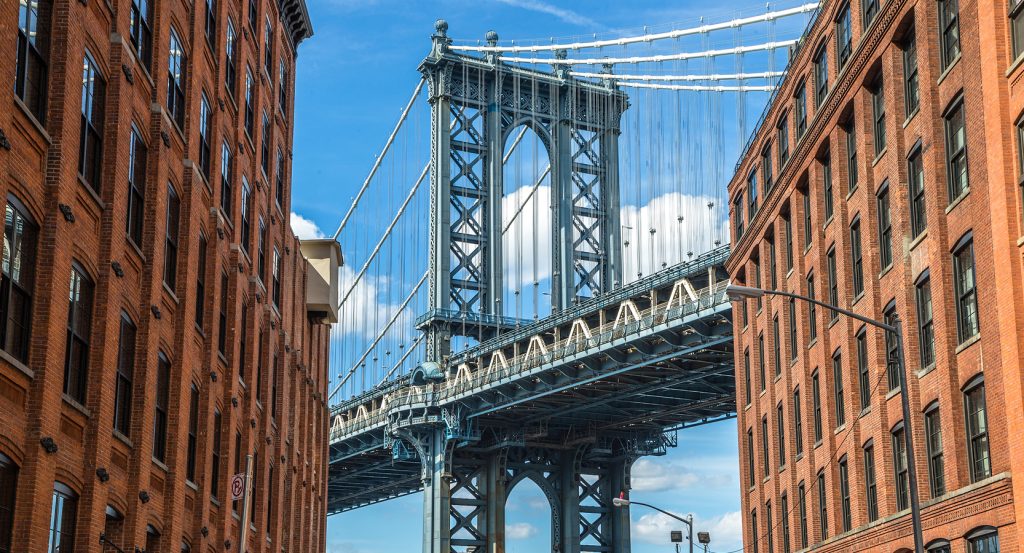
Why Flatbush Avenue Extension matters.
Flatbush Avenue Extension is a landmark Downtown Brooklyn corridor where engineering innovation, commercial growth, and urban transformation converge along one of the borough's most strategically important thoroughfares.
Running between the Manhattan Bridge and Flatbush Avenue through Downtown Brooklyn and DUMBO, this prominent corridor connects landmark office towers, major transit hubs, historic civic buildings, educational institutions, neighborhood businesses, and architecturally significant commercial districts that collectively demonstrate Brooklyn's remarkable metropolitan evolution. Early twentieth-century skyscrapers, modern mixed-use developments, thriving pedestrian corridors, and striking transportation infrastructure create an urban landscape where generations of commerce, mobility, and redevelopment continue to intersect. Flatbush Avenue Extension emerged during Brooklyn's early twentieth-century modernization to improve access between the newly completed Manhattan Bridge and the borough's growing civic center, permanently reshaping Downtown Brooklyn's street network. The result is a corridor defined by engineering achievement, economic vitality, and metropolitan connectivity.
What defines Flatbush Avenue Extension.
Flatbush Avenue Extension is best known for being constructed between 1908 and 1909 to create a direct approach to the newly completed Manhattan Bridge, among the world's largest suspension bridges at the time.
The project required the demolition and realignment of numerous city blocks, fundamentally transforming Downtown Brooklyn while establishing a broad ceremonial boulevard connecting the bridge to the borough's commercial core. Its completion dramatically improved transportation between Brooklyn and Manhattan, stimulated large-scale commercial development, and reinforced Brooklyn's emergence as one of New York City's principal business districts. Today, the avenue continues to serve as one of Brooklyn's busiest transportation corridors while preserving the historic relationship between the borough and one of its most iconic engineering landmarks.
How Flatbush Avenue Extension fits.
Flatbush Avenue Extension works as an exploration of Downtown Brooklyn's engineering landmarks, civic architecture, and urban history.
Begin at the Manhattan Bridge, where one of New York City's great engineering achievements immediately establishes the corridor's defining historical legacy. Continue toward Brooklyn Borough Hall, whose stately Greek Revival architecture reflects the civic leadership that shaped modern Brooklyn. From there, make your way to the New York Transit Museum, where immersive exhibits provide broader perspective on the transportation innovations that transformed Brooklyn during the early twentieth century. Along the route, you'll encounter architecturally significant office buildings, neighborhood cafés, thriving commercial streets, historic civic landmarks, welcoming public plazas, and major transit hubs that reveal the corridor's exceptional depth. The progression moves naturally from iconic suspension bridge to landmark civic building to celebrated transit museum, demonstrating how Flatbush Avenue Extension connects engineering innovation, civic history, and metropolitan growth within one of Brooklyn's most influential corridors. Flatbush Avenue Extension remains one of the borough's most rewarding thoroughfares, preserving a distinctive balance between historical significance, architectural ambition, and urban connectivity.
Where your story begins.
Foresyte Travel reveals places that feel extraordinary long before you arrive.
Enjoy editorial crafted for luxury travelers.
Foresyte may earn a commission when you book.







































































































