
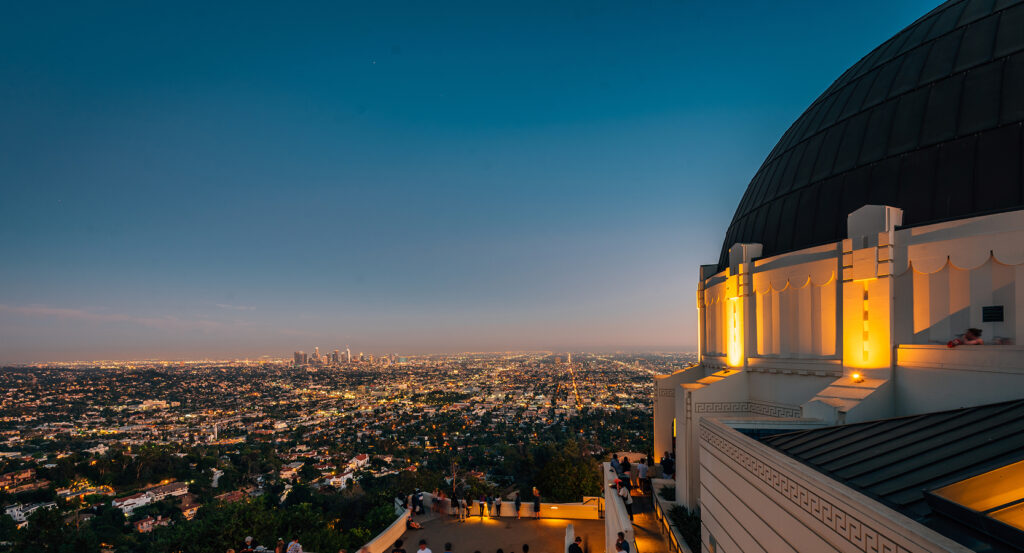
Why Fryman Canyon matters.
Fryman Canyon is a secluded enclave where the eastern Santa Monica Mountains' rugged character meets oak-shaded residential roads, estate-scale hillside parcels and a canyon landscape whose early ranch holdings became one of Studio City's most distinctive residential pockets.
Positioned between Laurelwood, Studio City, and Laurel Canyon, the neighborhood occupies steep terrain north of Mulholland Drive where wooded ravines descend toward the San Fernando Valley and narrow ridges repeatedly divide the slopes above Ventura Boulevard. Custom houses sit among mature oaks and sycamores on irregular parcels, with long driveways, retaining walls and substantial changes in elevation replacing the tighter residential grid across the Valley floor. Fryman Road supplies the primary encounter through the lower canyon, climbing from Laurel Canyon Boulevard into increasingly enclosed hillside streets where houses recede behind vegetation and the surrounding slopes become the dominant physical presence. Iredell Street creates a secondary passage through early residential territory, carrying the neighborhood deeper into winding roads and cul-de-sacs that preserve the estate-scaled dimensions established during its principal period of subdivision. The result is a neighborhood whose large parcels, wooded ravines and contour-following streets preserve the physical transition from interwar country estates to the secluded hillside residential development that reshaped Studio City during the middle twentieth century.
What defines Fryman Canyon.
Fryman Canyon is best known for developing from the extensive ranch holdings of hotelier Harry C. Fryman into Briarcliff Manor, an estate subdivision created across the hills above Studio City beginning in 1939. Fryman arrived in Southern California from Ohio during the late nineteenth century, worked as a bellboy at Pasadena's Mount Lowe Hotel and rose to manage the property before establishing himself as a Los Angeles hotel operator. He built the Hayward Hotel in Downtown during the opening decade of the twentieth century and subsequently directed his attention toward land investment. By the late 1920s, Fryman had begun purchasing ranch and agricultural acreage in the hills surrounding Laurel Canyon, eventually assembling holdings of 1,000 acres. Fryman and Donald Barker owned the former ranch ground from which the earliest Briarcliff Manor tract emerged, with subdivision beginning in 1939 and additional tracts following through 1945. The first section placed expansive parcels along Iredell Street at Fryman Road, with lots extending from 100 by 180 feet to holdings of one, five and ten acres. Beverly Crest Realty marketed Briarcliff Manor with Arthur M. Kelley as general sales manager, presenting one- to five-acre estate parcels across oak and sycamore terrain. Most surviving houses associated with the district date to the 1940s, when Colonial, French and other custom residences began occupying the former ranch slopes. Myrna Loy, Ray Milland, Ginger Rogers and George Brent became associated with the early residential community, linking its estate development with the entertainment industry growing across Studio City below. Fryman's land assembly and Briarcliff Manor subdivision established the unusually generous parcel structure that continues to distinguish the canyon from the denser Valley neighborhoods immediately beyond its hills.
Major General Walter P. Story created an earlier residential foothold in these hills after visiting Los Angeles pioneer Jules Viole, whose country property stood on Iredell Road. Story purchased sixteen adjoining acres in 1923 and constructed a summer residence there decades before most of the surrounding canyon entered subdivision. His career joined the emerging residential landscape with two powerful strands of early twentieth-century Los Angeles development: metropolitan real estate and the California National Guard. Story had returned permanently to Los Angeles in 1905, pioneered early motor transit operations in the West and entered real estate development in 1907. The Walter P. Story Building rose at 6th Street and Broadway in 1910 as one of the young business district's early skyscraper office buildings, and Story later participated in the Los Angeles Stock Exchange Building completed on Spring Street in 1921. His military career included World War I service, creation of Camp Merriam, now Camp San Luis Obispo, as the California National Guard's first training site in 1928 and appointment as a major general in 1937. He assumed command of the 40th Infantry Division in 1941 and retained his Fryman Canyon property until his death in 1957. The surviving portion of Story's country estate anchors Fryman Canyon's residential history in a period preceding Briarcliff Manor, when isolated acreage in these mountains functioned as seasonal retreat ground for prominent Angelenos whose principal careers remained concentrated in the metropolitan center.
How Fryman Canyon fits.
Fryman Canyon works as the anchor for an outing connecting the site of California's 1847 capitulation, the motion-picture complex that gave Studio City its name and a former mountain fire station transformed into the headquarters of an urban forestry organization.
Begin at Campo de Cahuenga, where Mexican commander Andrés Pico and U.S. Army Lieutenant Colonel John C. Frémont agreed to the Capitulation of Cahuenga on January 13, 1847, ending armed conflict in California during the Mexican-American War before the Treaty of Guadalupe Hidalgo formalized the territorial transfer the following year. The original adobe disappeared in 1900, Los Angeles acquired the property in 1923 and a Mission Revival and Spanish Colonial Revival memorial structure opened in 1950 after a campaign led by Irene T. Lindsay of the San Fernando Valley Historical Society. Construction of the Metro subway later exposed foundations of the original adobe beneath Lankershim Boulevard, portions of which survive inside the grounds with the remaining footprint traced through decorative pavement. Continue to Radford Studio Center, where Mack Sennett transformed a former lettuce ranch into a motion-picture complex designed by architect Harold Cross and constructed by the Austin Company of California beginning in November 1927. The facility opened for production on May 1, 1928 with an administration building, production facilities and two immense soundstage structures whose interiors accommodated multiple simultaneous productions. Mascot Pictures acquired the property in 1935 and soon joined Consolidated Film Corporation, Monogram Pictures and other interests in forming Republic Pictures, establishing the lot's next major chapter. CBS acquired the complex in 1963, and productions across subsequent decades included Gilligan's Island, The Mary Tyler Moore Show, Seinfeld and Will & Grace. Conclude at Coldwater Canyon Park, where the Los Angeles Fire Department established Mountain Patrol Station 1 during the 1920s and crews cut fire roads and trails through the surrounding mountains as horseback patrols watched the slopes for fire. TreePeople's predecessor began using the grounds as a nursery in 1974, raising thousands of seedlings before the fire operation departed and the 45-acre property became the organization's home later in the decade. Andy Lipkis had started the organization's precursor as a teenager in 1973, and the environmental group subsequently turned the former fire facility into a center for urban forestry and environmental education. A major campus expansion opened in 2008 with the La Kretz Urban Watershed Garden, an environmental learning center and nursery, extending the property's century-long association with stewardship of the mountains into a broader program centered on the urban environment. The progression moves from the site where military conflict in California ended through the film complex that named Studio City and culminates at a former fire station devoted to urban forestry, connecting state formation, motion-picture production and environmental stewardship across the eastern Santa Monica Mountains.
Where your story begins.
Foresyte Travel reveals places that feel extraordinary long before you arrive.
Enjoy editorial crafted for luxury travelers.
Foresyte may earn a commission when you book.





































































































