
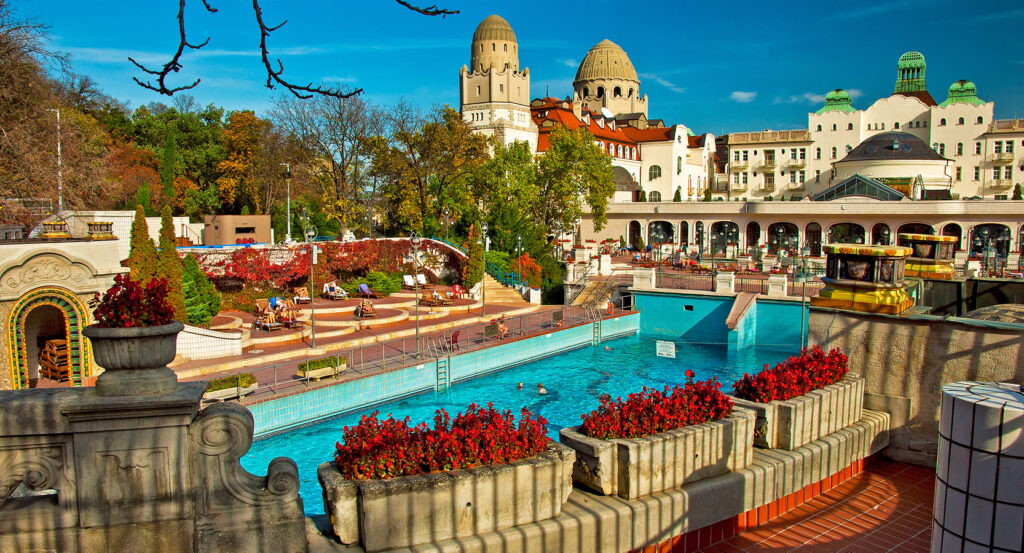
Why Gellért Thermal Bath matters.
Gellért Thermal Bath is a historic bathhouse where Gellért Hill's healing springs, Hungarian bathing traditions, Art Nouveau craftsmanship, and centuries of wellness converge within one of Budapest's most celebrated thermal spas.
Set along Kelenhegyi út near Szent Gellért tér and just steps from Liberty Bridge, this elegant bathing complex welcomes visitors through marble colonnades, stained-glass windows, mosaic floors, thermal pools, steam chambers, relaxation halls, and vaulted bathing spaces supplied by naturally heated mineral waters rising from deep beneath Buda. Intricate ceramic ornament, sculpted interiors, flowing fountains, and abundant natural light evoke the atmosphere of an early twentieth-century grand spa while preserving traditions rooted in the city's geothermal landscape. Every pool reflects Budapest's enduring relationship with thermal bathing, where architecture, hydrotherapy, and centuries of cultural practice continue enriching daily life.
What defines Gellért Thermal Bath.
Gellért Thermal Bath is best known for opening in 1918 alongside the Hotel Gellért as one of Europe's finest Art Nouveau thermal bathing complexes, drawing upon mineral-rich hot springs documented since the thirteenth century when King Andrew II is believed to have used the waters and later developed under Ottoman rule after the conquest of Buda in 1541. Designed principally by architects Ármin Hegedűs, Artúr Sebestyén, and Izidor Sterk, the bath was constructed between 1912 and 1918 with lavish Art Nouveau interiors featuring Zsolnay ceramic ornamentation, colorful stained glass, carved stone columns, bronze details, decorative mosaics, vaulted ceilings, and sculptural fountains that established a new standard for European spa architecture. The complex contains numerous thermal pools supplied by springs emerging from Gellért Hill at temperatures reaching 35°C to 40°C, with mineral waters containing calcium, magnesium, bicarbonate, sulfate, sodium, and fluoride traditionally associated with therapeutic bathing for musculoskeletal disorders, joint conditions, circulation, and rehabilitation. In 1927 the bath expanded with Budapest's first wave pool, followed in 1934 by one of Europe's earliest bubble bath systems, innovations that reinforced its reputation as one of the continent's leading thermal destinations. Despite sustaining damage during the Second World War, the complex underwent careful restoration throughout the twentieth and twenty-first centuries while preserving its original Art Nouveau character and continuing to operate as one of Budapest's most historically significant thermal bathhouses.
Beyond its celebrated pools, the complex preserves a comprehensive expression of early twentieth-century spa culture. Visitors move through thermal halls, plunge pools, steam rooms, saunas, massage facilities, medicinal bathing areas, and elegant relaxation spaces where decorative ceramics, stained glass, sculptural details, and carefully proportioned interiors reflect the ambition of Budapest's golden age of bath construction. Fed continuously by the natural springs beneath Gellért Hill, the waters remain central to both medical wellness programs and everyday bathing traditions, sustaining a cultural practice that has shaped the city for centuries.
How Gellért Thermal Bath fits.
Gellért Thermal Bath works as part of an exploration through the southern reaches of Buda's historic riverside.
Begin at Liberty Bridge, where sweeping Danube views introduce the neighborhood before continuing to Gellért Thermal Bath for a restorative thermal bathing experience. Continue to Gellért Hill Cave, whose chapel carved into the hillside reveals another dimension of the area's spiritual history. Conclude at Citadella, where panoramic viewpoints overlooking both Buda and Pest provide a memorable finale connecting Budapest's geothermal landscape with its dramatic hilltop setting. The progression moves naturally from the riverfront to thermal bathing before concluding above the city skyline, revealing why Gellért Thermal Bath remains one of Budapest's defining wellness experiences.
Where your story begins.
Foresyte Travel reveals places that feel extraordinary long before you arrive.
Enjoy editorial crafted for luxury travelers.
Foresyte may earn a commission when you book.





































































































