
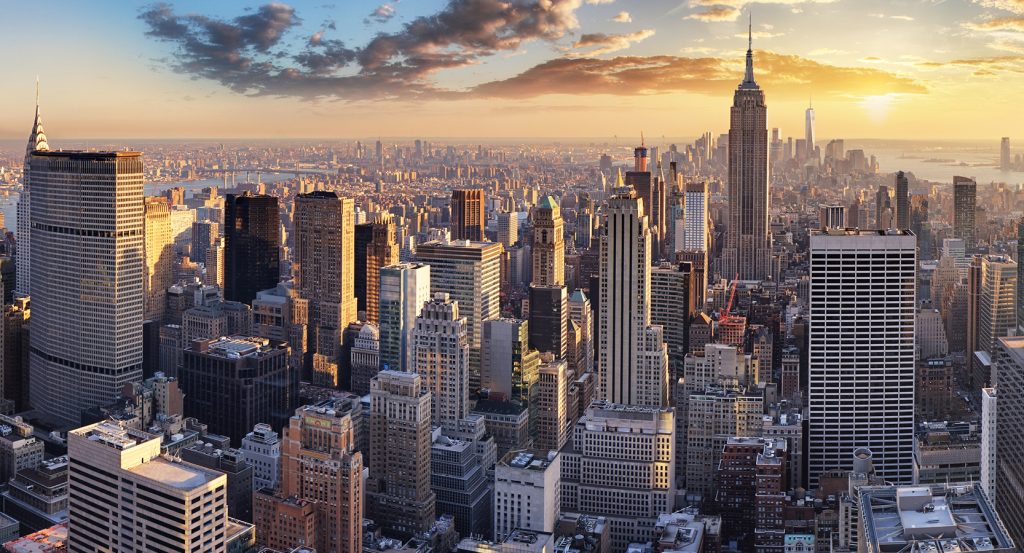
Why you should experience Henn na Hotel New York in New York, NY.
Henn na Hotel New York is an eccentric Japanese hotel where Garment District's fashion-making inheritance, Penn Station intensity, Japanese technological culture and unapologetically peculiar hospitality converge inside the American outpost of a hotel brand built around perpetual evolution.
Set along West 35th Street near 7th Avenue and just steps from Penn Station, the hotel inhabits the same Garment District whose character crystallized after garment manufacturers began concentrating west of Broadway during the early twentieth century, turning surrounding blocks into the working machinery of American fashion. The property translates that restless context through unmistakably Japanese interventions, including a life-sized animatronic Tyrannosaurus rex in the lobby, TOTO Washlets throughout guest bathrooms and LG Styler closets in selected accommodations that steam and refresh clothing. Executive rooms and suites extend the concept through Kassatex linens, streaming televisions and the Styler system, while suites introduce deep soaking tubs and private balconies to a hospitality style built around technological utility. The result is a hotel where a dinosaur receptionist, Japanese bathroom engineering and clothing-care technology give Garment District's century-old culture of making and reinvention an appropriately strange twenty-first-century counterpart.
What you should know about Henn na Hotel New York.
Henn na Hotel New York is best known for opening on October 1, 2021 as Henn na Hotel's first United States property, second international location after South Korea and 21st hotel overall, bringing to Manhattan a Japanese hospitality concept whose original Huis Ten Bosch property opened in Nagasaki in March 2015 and became Guinness World Record holder as the first robot-staffed hotel. H.I.S. Hotel Holdings selected New York for the brand's American debut after expanding Henn na Hotel across Japan around a philosophy of technological evolution expressed through animatronic service agents, life-sized dinosaurs, holographic characters, LG Styler clothing-care systems, futon temperature-conditioning technology and in-room tablets. The New York property adapted that lineage to 235 West 35th Street through its animatronic Tyrannosaurus rex and Japanese guestroom technology while retaining human-operated hospitality, a telling evolution for a brand whose Japanese name, “Henn na,” carries the intended meaning of continuous change. Guestrooms further embed Japanese domestic technology through TOTO Washlets in all bathrooms, while selected Executive Rooms and Suites incorporate LG Styler closets capable of steaming and refreshing garments, an unusually fitting amenity within Manhattan's historic apparel district.
Executive chef Isami Nagai gives that Japanese character a culinary expression through GOSUKE, the hotel's in-house restaurant, following a career encompassing 35 years of Japanese cooking experience in Tokyo and New York. Nagai's menu centers on sushi and sashimi alongside Japanese kitchen preparations, connecting the property's technological Japanese style with a restaurant grounded in traditional technique and seafood handling. The dining room incorporates a long sushi counter where preparation remains visible, while dishes documented by the hotel include bara chirashi, sushi rolls, sashimi, bento-style compositions and fried seafood preparations served across lunch and dinner. GOSUKE gives Henn na Hotel New York a second expression of its country of origin, pairing Nagai's decades of professional experience with the TOTO, LG and Henn na technologies that carry contemporary Japanese design culture through the rest of the property.
How to fold Henn na Hotel New York into your trip.
Henn na Hotel New York works as the anchor for an afternoon tracing fashion scholarship, manuscript collecting and urban reinvention through the creative institutions surrounding the Garment District.
Begin at Museum at FIT, founded in 1969 as the Design Laboratory to support Fashion Institute of Technology education before Richard Martin and Harold Koda helped elevate its curatorial ambitions during the 1980s, with a permanent collection now exceeding 50,000 garments and accessories from the eighteenth century onward and representing designers including Cristóbal Balenciaga, Gabrielle Chanel, Christian Dior, Halston, Rei Kawakubo and Vivienne Westwood. Continue to The Morgan Library & Museum, where Charles McKim's 1906 library for Pierpont Morgan eventually became the nucleus of a cultural institution expanded in 2006 through Renzo Piano's $106 million project, which doubled exhibition space, connected three historic structures through new steel-and-glass pavilions and marked Piano's first completed New York commission. Conclude at Bryant Park, where Lusby Simpson's competition-winning classical plan opened in 1934 before Daniel A. Biederman and Andrew Heiskell founded the Bryant Park restoration organization in 1980, leading to a Hanna/Olin-designed rehabilitation that reduced crime by 92 percent, doubled annual visitation and culminated in the park's celebrated 1992 reopening. The progression moves from fashion as collected material through Morgan's culture of connoisseurship into one of Manhattan's defining exercises in public-space revival, framing Henn na Hotel New York within a district repeatedly shaped by design, collecting and deliberate reinvention.
Where your story begins.
Foresyte Travel reveals places that feel extraordinary long before you arrive.
Experience premium editorial crafted for luxury travelers.







































































































