Why High Roller matters.
High Roller is a towering observation wheel where the Las Vegas Strip's entertainment culture meets advanced structural engineering, panoramic views of the Mojave Desert and the transformation of the former Imperial Palace resort corridor into a pedestrian entertainment district.
Set along the eastern end of The LINQ Promenade near Las Vegas Boulevard and just steps from the pedestrian plaza connecting The LINQ Hotel with Flamingo Las Vegas, the attraction occupies a purpose-built observation complex behind the Strip's densely developed hotel frontage. A circular steel structure rises 550 feet above the surrounding resorts, with twenty-eight enclosed passenger cabins suspended around the wheel's perimeter. The boarding platform connects directly with the promenade, allowing passengers to enter slowly moving cabins as the wheel completes its continuous rotation. Curved glass walls create broad sightlines across the surrounding skyline, with the distant Spring Mountains and the desert landscape forming the backdrop beyond the resort corridor. The result is an observation attraction whose immense scale and carefully engineered movement provide a comprehensive aerial perspective on the geography of Las Vegas.
What defines High Roller.
High Roller is best known for becoming the world's tallest observation wheel when it opened in 2014, establishing a major engineering achievement within Caesars Entertainment's redevelopment of the Central Las Vegas Strip. Caesars Entertainment developed the attraction as the centerpiece of The LINQ, a pedestrian entertainment district constructed between the former Imperial Palace and Flamingo resorts. The project formed part of a broader effort to transform underused land behind the Strip into a destination organized around restaurants, entertainment venues and public pedestrian space. Construction began in 2012, bringing together international engineering firms and specialized contractors responsible for a structure requiring exceptional precision. Arup served as the principal engineering consultant, developing the wheel's structural system and coordinating the technical challenges associated with its unprecedented height. The design incorporated a single-rim configuration supported by a system of steel cables, drawing on principles used in large suspension structures. The wheel's central hub and spindle were manufactured in China before being transported to Las Vegas for assembly. Approximately 3.5 million pounds of steel were incorporated into the structure, establishing the substantial physical requirements of the observation wheel. The outer rim was assembled in sections and raised through a carefully sequenced construction process that required specialized lifting equipment. The passenger cabins were manufactured by Sigma, a subsidiary of the French company Poma, drawing on engineering expertise developed through cable transportation systems. Each cabin accommodates up to forty passengers, producing a total maximum capacity of 1,120 people across the wheel. The High Roller opened to the public on March 31, 2014, surpassing the 541-foot Singapore Flyer as the world's tallest observation wheel. The attraction retained that distinction until Ain Dubai opened in 2021 at a height of 820 feet. Its construction established Las Vegas as a significant location in the international development of large-scale observation wheels, joining the city's architectural performance with a complex form of passenger transportation engineering.
Arup's structural design gives the observation wheel its defining technical character through a cable-supported rim that distributes substantial loads across a carefully balanced circular system. The wheel measures 520 feet in diameter, with the additional height of its supporting structure bringing the overall installation to 550 feet. A central spindle connects the rotating assembly to two inclined support legs, transferring loads into foundations engineered for the substantial weight and movement of the structure. The outer rim is held in position by 112 steel cables arranged in a tensioned configuration that maintains the wheel's geometry throughout rotation. Each passenger cabin is mounted outside the rim and uses an independent rotation system to maintain a level floor as the wheel moves. The cabins incorporate curved glass panels extending across much of their exterior surfaces, providing unobstructed views from multiple positions within the enclosed space. Climate-control systems maintain interior conditions during the extreme summer temperatures characteristic of the Mojave Desert. A complete revolution takes thirty minutes, creating a slow and continuous ascent that allows the surrounding city to unfold gradually through changing elevations. The wheel moves at one foot per second, allowing passengers to board and disembark from a platform designed for continuous operation. LED lighting installed across the structure transforms its exterior appearance after dark, with programmable colors and patterns creating large-scale visual displays visible across the Strip. The attraction's lighting system extends its architectural presence beyond the observation experience, making the wheel a prominent element of the nighttime skyline. The combination of structural engineering, controlled cabin movement and panoramic glazing creates an observation system that functions simultaneously as transportation infrastructure, entertainment attraction and illuminated urban monument.
How High Roller fits.
High Roller works as the observation centerpiece for a Central Las Vegas Strip outing connecting a major outdoor entertainment plaza, a historic casino resort and one of the city's most recognizable theatrical fountain installations.
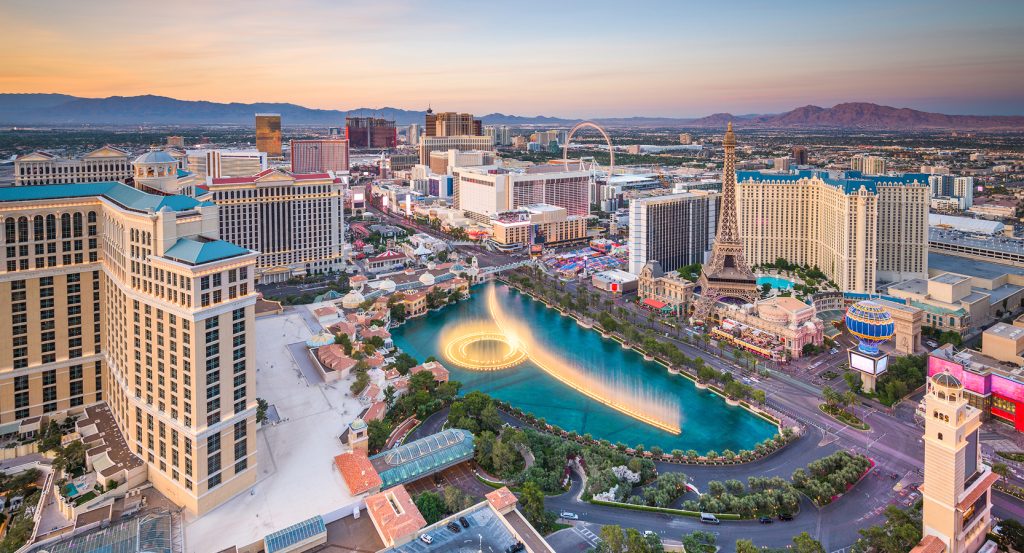
Begin at The LINQ Promenade, the pedestrian entertainment district developed by Caesars Entertainment as part of the transformation of the former Imperial Palace resort corridor. The project opened in 2013 and 2014 through successive phases, introducing a concentrated collection of restaurants, bars, retail establishments and entertainment attractions. Its design established a direct pedestrian route between Las Vegas Boulevard and the eastern portion of the property, creating a commercial environment organized around foot traffic and public gathering spaces. The promenade's development accompanied the rebranding of the Imperial Palace as The Quad and subsequently The LINQ Hotel, reflecting a broader repositioning of the resort toward contemporary entertainment. Restaurants and outdoor seating areas occupy the central walkway, giving the district a character distinct from the enclosed casino floors of neighboring properties. Continue to Flamingo Las Vegas, opened by Benjamin Siegel and his associates in December 1946 as one of the earliest luxury casino resorts on the Strip. The property became associated with the development of Las Vegas as a destination for elaborate hospitality, entertainment and gambling during the postwar decades. Its original architectural program introduced tropical landscaping, luxury accommodations and sophisticated entertainment facilities into a desert resort environment. Following Siegel's death in 1947, the property continued operating under successive owners and underwent substantial expansions that transformed the original complex. The Flamingo name endured through those changes, preserving a direct connection with the early history of the modern Las Vegas Strip. Conclude at Fountains of Bellagio, the grand water installation created by WET Design for the Bellagio resort, which opened in 1998. The fountain occupies an artificial lake along Las Vegas Boulevard and incorporates more than one thousand individually controlled water devices. Powerful jets rise to heights exceeding four hundred feet, producing choreographed displays synchronized with music and lighting. The system's performances draw on classical compositions, popular standards and contemporary recordings, creating distinct sequences of movement across the water. The installation became one of the defining public spectacles of the Strip, demonstrating how engineering and theatrical design transformed resort frontage into a major entertainment attraction. The progression moves from a pedestrian district created through resort redevelopment through a historic property central to the rise of modern Las Vegas and culminates in an immense water installation whose choreography defines the city's nighttime performance.
Where your story begins.
Foresyte Travel reveals places that feel extraordinary long before you arrive.
Enjoy editorial crafted for luxury travelers.
Foresyte may earn a commission when you book.