
Why Hogwarts Express matters.
Hogwarts Express is a cinematic railway tableau where Universal City's filmmaking character meets the scarlet locomotive, Hogsmeade Station and one of the Harry Potter series' most recognizable transportation settings.
Set within Universal Studios near the entrance to Hogsmeade and high above the San Fernando Valley, the locomotive occupies the eastern Santa Monica Mountains where the terrain drops toward Studio City and the Los Angeles River. The theme park extends across a steeply divided property, with its Upper Lot occupying the ridge and production facilities descending across the slopes toward the Valley floor. Cahuenga Pass cuts through the mountains farther east, forming the historic transportation corridor between Hollywood and the Valley. The stationary train stands immediately inside the themed village, placing a familiar piece of railway imagery at the threshold between the park's broader entertainment landscape and its recreation of wizarding Britain. The result is a carefully positioned cinematic object that announces the transition into Hogsmeade before Hogwarts Castle dominates the landscape beyond.
What defines Hogwarts Express.
Hogwarts Express is best known as the stationary locomotive and Hogsmeade Station installation greeting arrivals to The Wizarding World of Harry Potter at Universal Studios. The themed land entered public technical rehearsals in February 2016 before its official April 7 opening, following more than two years of construction. Universal marked opening day with Harry Potter film performers Warwick Davis, Tom Felton, Evanna Lynch, James Phelps and Oliver Phelps alongside park president Larry Kurzweil and the Hogwarts Express conductor. Hollywood's train differs fundamentally from the operating Hogwarts Express created at Universal Orlando Resort: the California version remains stationary and functions as an environmental centerpiece and photo setting. Its placement near the Hogsmeade entrance reproduces the fictional railway terminus associated with students arriving for Hogwarts School of Witchcraft and Wizardry. A recreated passenger compartment also permits photographs within a train-cabin setting, extending the locomotive beyond its exterior presentation.
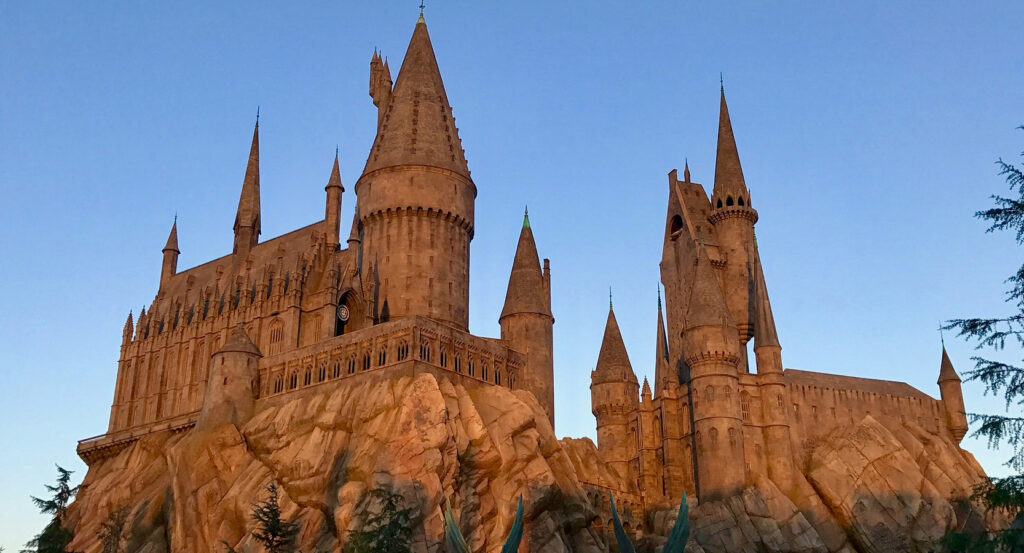
The locomotive's saturated red body, black smokebox and tender reproduce the visual language established for the train in the Harry Potter films, with steam effects strengthening the impression of a recent arrival at Hogsmeade. A uniformed conductor extends the railway conceit into live character performance beside the engine. Hogsmeade Station provides the architectural backdrop, with luggage, railway details and the adjacent village completing the fictional arrival scene. The cabin photo setting shifts the viewpoint inside the train through upholstered seating and compartment detailing associated with Harry's journeys to school. Hogwarts Castle rises beyond the village, giving the stationary locomotive a visual destination even though no railway connects the two. The installation turns a nonmoving train into an arrival sequence, using scenic design, steam, costume and spatial placement to reproduce one of the series' recurring transitions between ordinary Britain and the wizarding world.
How Hogwarts Express fits.
Hogwarts Express works as the starting point for an outing connecting California mission history, a surviving nineteenth-century rail depot and the entertainment industry that transformed the southeastern San Fernando Valley.
Begin at Campo De Cahuenga, where representatives of John C. Frémont and Mexican governor Andrés Pico signed the Capitulation of Cahuenga on January 13, 1847, ending armed conflict in California during the Mexican-American War. The original adobe disappeared during the nineteenth century, and the present Mission Revival structure was dedicated in 1950 near the historic site, preserving archaeological remnants beneath and around the building. Continue to Lankershim Depot, constructed in the 1890s beside the Southern Pacific Railroad as the surrounding agricultural settlement developed around wheat, fruit and transportation connections. The depot became closely associated with the community first called Toluca and later Lankershim before North Hollywood received its current name in 1927. Conclude at Warner Bros. Studios, whose Burbank property developed after Warner Bros. acquired First National Pictures in 1928 and consolidated production on the former First National lot. Soundstages, exterior streets and production facilities subsequently supported generations of film and television work as the southeastern Valley became one of the principal production centers of the American entertainment industry. The progression moves from the political transfer that closed California's Mexican era through a railway depot tied to the Valley's agricultural settlement and culminates inside the studio infrastructure that reshaped the region around filmmaking.
Where your story begins.
Foresyte Travel reveals places that feel extraordinary long before you arrive.
Enjoy editorial crafted for luxury travelers.
Foresyte may earn a commission when you book.





































































































