Why Hyatt Regency San Francisco matters.
Hyatt Regency San Francisco is an architecturally audacious hotel where the Financial District's waterfront gateway meets John Portman's futuristic hospitality architecture through a vast interior atrium, sharply inclined concrete geometry and a revolving rooftop space revived after seventeen years of dormancy.
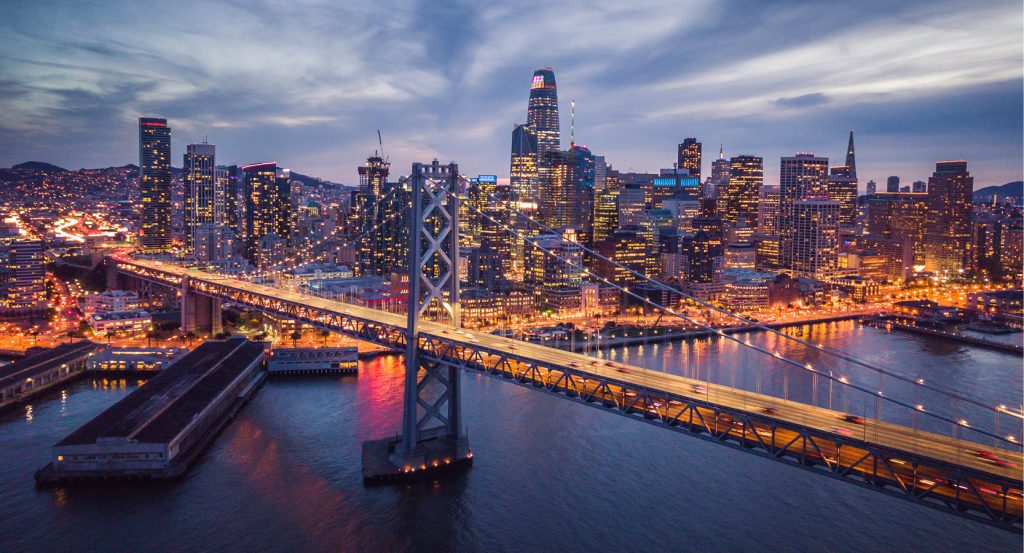
Set along Drumm Street near Market Street and just steps from Ferry Building, the hotel occupies the Financial District's eastern edge between Embarcadero Center, California Street's ascent toward Nob Hill and the waterfront corridor extending north toward the historic piers and south toward Rincon Hill. The wedge-shaped structure rises through two vertical walls and a dramatically inclined elevation that pulls successive levels inward above the interior void. Seventeen tiers of balcony corridors overlook a vast central volume filled with angular terraces, sculptural forms and glass elevators. Charles O. Perry's five-story aluminum Eclipse sculpture provides a curvilinear counterpoint to the severe geometry surrounding the atrium. The result is a hotel whose sloping mass, immense interior volume and sculptural centerpiece preserve one of John Portman's most ambitious experiments in turning a high-rise hotel into an enclosed urban performance.
What defines Hyatt Regency San Francisco.
Hyatt Regency San Francisco is best known for John Portman's dramatic atrium architecture, developed as the culminating hospitality component of Embarcadero Center and one of the purest San Francisco expressions of his campaign to reinvent the American downtown hotel. Portman worked with developers Trammell Crow and David Rockefeller on the larger Embarcadero Center, a redevelopment that inserted offices, plazas, retail functions and hospitality into blocks near the foot of Market Street. The hotel became Portman's third major Hyatt commission after Atlanta and O'Hare, allowing ideas first explored in those projects to reach a more dramatic architectural resolution on a triangular San Francisco parcel. A seven-sided prism solved the unusual site through a sharply sloping wall that carries successive levels inward above the atrium. Portman oriented the stepped mass toward the plaza and bay, opening the development visually toward the waterfront. The interior rises through seventeen tiers of balcony corridors around a soaring central void whose original composition incorporated mature trees, fountains, terraced seating and a running brook. Charles O. Perry created Eclipse as a five-story sphere of interlocking aluminum curves at the center of that angular environment. Glass elevators rise through the atrium as moving architectural elements, a Portman signature that later gained cinematic recognition when the building appeared in The Towering Inferno, High Anxiety and Time After Time. The hotel underwent a $50 million private-interior renovation completed in 2022 under Looney & Associates, whose urban-modernist concept drew geometric patterns from Portman's architecture. Sunstone Hotel Investors had acquired the property for $262.5 million in December 2013 under a continuing Hyatt operating arrangement. A major ownership turn followed on July 30, 2026, when funds affiliated with Blackstone Real Estate acquired the hotel from Sunstone for $279 million. The transaction placed Portman's Embarcadero building within Blackstone's real-estate portfolio more than half a century after its development reshaped the relationship between Hyatt architecture and San Francisco's waterfront.
Equinox extended Portman's architectural experiment into dining through a rooftop restaurant built around a motorized circular floor and panoramic glass. The outer dining ring completed a full rotation in 50 minutes, shifting perspectives continuously across the Financial District, Treasure Island, Bay Bridge and Ferry Building. A stationary central platform anchored the mechanism inside the moving perimeter. More than 200 wheels beneath the floor supported the rotation through horizontal and vertical assemblies driven by motors, gearboxes and rubber contact surfaces. The restaurant operated for 34 years before closing in 2007, ending one of the building's most distinctive original functions. Regency Club subsequently occupied the rooftop and divided the former Equinox interior into areas devoted to dining, business and relaxation. Dennis Alcaire, a hotel engineer whose tenure began in 1977, helped initiate the effort to reactivate the dormant machinery decades later. Darrell Johnson joined the engineering effort as the team spent months servicing wheels, motors, gearboxes and control components beneath the floor. The rotating system moved again in April 2024 after seventeen years of inactivity, returning Portman's kinetic rooftop concept to operation. Revolve became the renewed character for special access to the moving top-floor setting, with the mechanism completing its original architectural purpose above the atrium. Eclipse Kitchen & Bar develops the culinary counterpart at lobby level through California cooking, regional wines and cocktails directly beneath Portman's balcony tiers. Executive Chef Gregory Grohowski assumed leadership of the hotel's culinary operations in 2025 after more than three decades across Hyatt properties. Grohowski's seasonally driven direction emphasizes local ingredients across Eclipse Kitchen & Bar, Regency Club and the wider food program. Equinox, Revolve and Eclipse Kitchen & Bar together connect dining to the building's architecture at opposite ends of the vertical section, placing one program inside the atrium and another within the rotating crown.
How Hyatt Regency San Francisco fits.
Hyatt Regency San Francisco works as an anchor for an outing connecting San Francisco's transit preservation movement, the postwar redevelopment of the Embarcadero and a waterfront institution that changed international approaches to participatory science education.
Begin at San Francisco Railway Museum, operated by Market Street Railway directly beside the historic streetcar tracks near the foot of Market Street. Market Street Railway began in 1977 when three transit preservationists organized to save a Municipal Railway trolley bus facing destruction. The organization gained broader influence through the San Francisco Historic Trolley Festival launched in 1983 during reconstruction of the cable-car system. Successive festivals helped build support for permanent historic streetcar operation, eventually contributing to the F-Market & Wharves line. The museum interprets that history through railway artifacts, archival photography, audiovisual displays and a full-size replica of the operator's platform from a 1911 San Francisco streetcar. Continue to Embarcadero Plaza, developed through the Golden Gateway redevelopment project as a major civic space at the foot of Market Street. Landscape architect Lawrence Halprin collaborated with architects Mario Ciampi and John Savage Bolles on the plaza, completed in 1972. Canadian sculptor Armand Vaillancourt created Vaillancourt Fountain as its dominant artwork in 1971. The composition uses 101 precast concrete boxes assembled around structural steel, turning water, raw concrete and circulation into an immense piece of public sculpture within the city's Civic Art Collection. Conclude at Exploratorium, founded by physicist Frank Oppenheimer in 1969 as an institution joining scientific inquiry, art and human perception through direct participation. Oppenheimer's approach influenced more than 1,000 hands-on institutions internationally and changed expectations for how museums teach science. The Exploratorium relocated from the Palace of Fine Arts to Pier 15 in 2013 after a major partnership with the Port of San Francisco transformed the historic waterfront structure into a nine-acre campus. Fisher Bay Observatory connects scientific observation with San Francisco geography through historic maps, Gold Rush artifacts and direct study of the urban and natural landscape. The progression moves from San Francisco Railway Museum's preservation of the transit systems that shaped urban growth through Embarcadero Plaza's fusion of redevelopment, landscape architecture and public sculpture and culminates in Exploratorium's globally influential approach to scientific inquiry on the restored waterfront.
Where your story begins.
Foresyte Travel reveals places that feel extraordinary long before you arrive.
Enjoy editorial crafted for luxury travelers.
Foresyte may earn a commission when you book.