
Why The Juilliard School matters.
The Juilliard School is a rigorous performing-arts conservatory where Lincoln Square's cultural concentration meets intensive training in music, dance and drama inside a campus built around rehearsal, instruction and public performance.
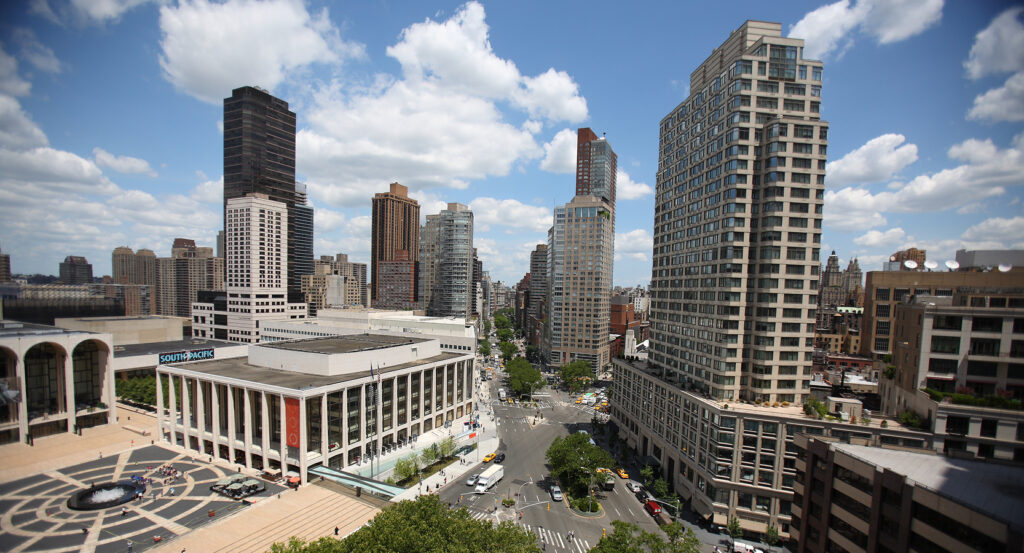
Set along West 65th Street near Broadway and just steps from Dante Park, the school occupies the northern edge of Lincoln Center in a long travertine building whose theaters, studios and teaching spaces connect directly to the surrounding performing-arts campus. Pietro Belluschi designed the original Lincoln Center home, which Juilliard occupied in 1969 after more than half a century in earlier Manhattan quarters. Diller Scofidio + Renfro with FXFOWLE completed a major renovation and expansion in 2009, extending Belluschi's structure toward Broadway and giving the school a more transparent presence along West 65th Street. Five theaters support a calendar exceeding 700 annual performances by College Division artists, placing staged work alongside the daily training conducted throughout the building. The result is a conservatory whose studios, performance halls, mid-century structure and twenty-first-century expansion place professional artistic training directly inside Lincoln Center's larger concentration of music, theater and dance.
What defines The Juilliard School.
The Juilliard School is best known for developing one of America's most influential conservatory traditions from Frank Damrosch's Institute of Musical Art, founded in 1905 with financial support from James Loeb to create a domestic counterpart to Europe's major music schools. Demand immediately exceeded expectations by nearly fivefold, driving the Institute from the Lenox Mansion at 5th Avenue and 12th Street to 120 Claremont Avenue near Columbia University in 1910. Textile merchant Augustus D. Juilliard died in 1919 and left $20 million for advancing music, then the largest single bequest of its kind, leading trustees to form the Juilliard Musical Foundation and create the Juilliard Graduate School in 1924. The Graduate School and Damrosch's Institute came under a common president in 1926 as the Juilliard School of Music, with Columbia professor John Erskine leading the combined organization before the two schools completed their institutional merger in 1946. Arthur L. Harmon of Shreve, Lamb & Harmon designed a seven-story Art Deco building beside the Institute on Claremont Avenue, and its 1931 inauguration brought performances by Sergei Rachmaninoff and an orchestra led by Leopold Stokowski alongside the premiere of Louis Gruenberg and Erskine's Jack and the Beanstalk. William Schuman assumed the presidency in 1945 and created the Juilliard String Quartet the following year with violinist Robert Mann, joined by Robert Koff, Raphael Hillyer and Arthur Winograd. Schuman also developed the Literature and Materials of Music curriculum and an active commissioning program whose works fed Juilliard's 1956 Festival of American Music. Peter Mennin's presidency brought the Drama Division in 1968 under John Houseman and Michel Saint-Denis, prompting the institution to adopt The Juilliard School name before moving to Lincoln Center in 1969. Damrosch, Augustus Juilliard, Erskine, Harmon, Schuman, Mann, Houseman and Saint-Denis collectively chart the school's development from a music institute into a multidisciplinary conservatory embedded within New York's principal performing-arts campus.
Martha Hill gave Juilliard another decisive artistic direction in 1951 when Schuman appointed her to build a Dance Division combining ballet and modern dance as equal components of professional training. Hill brought extensive experience from the Bennington School of the Dance, where she had assembled Martha Graham, Doris Humphrey, Charles Weidman and Hanya Holm during the 1930s and early 1940s, then carried the principle of stylistic breadth into Juilliard. Founding faculty included Graham, Antony Tudor and José Limón, placing major architects of twentieth-century American dance directly inside the new division. The curriculum required dancers to study music alongside movement, joining ballet and modern technique with composition and interdisciplinary work at a time when the two dance traditions had long occupied opposing artistic camps. Hill remained director until 1985, and alumni across subsequent generations included Pina Bausch, Paul Taylor, Ohad Naharin, Lar Lubovitch, Robert Battle and Jessica Lang. Juilliard widened its musical scope again in 2009 through the full-scholarship Historical Performance program endowed by Bruce and Suzie Kovner, whose first class contained 13 master's students and whose principal period-instrument ensemble became Juilliard415. Juilliard415 subsequently toured Japan, India, New Zealand and multiple European countries, appeared at the Leipzig Bachfest and became the first conservatory ensemble in residence at the Utrecht Early Music Festival in 2013. Hill's dance program and the Kovners' historical-performance initiative demonstrate how Juilliard repeatedly expanded artistic training through specialized programs built around distinctive techniques, repertories and performance practices.
How The Juilliard School fits.
The Juilliard School works as the anchor for a Lincoln Square outing connecting self-taught art, a nineteenth-century Catholic parish and an Upper West Side synagogue shaped by a major twentieth-century religious revival.
Begin at American Folk Art Museum, founded in 1961 around a field that had received limited sustained attention from major American art institutions. The collection began in 1962 with the gift of Flag Gate and grew to thousands of works spanning four centuries, including paintings, drawings, quilts, needlework, weathervanes, carousel animals, decoys, trade signs and large architectural models. Twentieth and twenty-first-century self-taught artists expanded that scope beyond historic American folk traditions, giving figures such as Minnie Evans a place alongside anonymous makers whose quilts, furniture and carved objects preserve artistic traditions outside academic training. Continue to Church of the Blessed Sacrament, whose parish began in 1887 when Father Matthew A. Taylor celebrated Easter Mass at a temporary altar inside the Havemeyer family stable near West 72nd Street. A red-brick Italianate church followed that year, but Upper West Side growth led Reverend Thomas F. Myhan to commission Columbia-trained architect Gustave E. Steinback for a larger Gothic building inspired by Sainte-Chapelle in Paris. Myhan died in 1916 before construction, and Monsignor William J. Guinan carried the project forward, laying cornerstones in 1917 and celebrating the first Mass inside the present church at Christmas 1919. Clement Heaton designed its rose window around twelve angels playing musical instruments, with a chalice and host at the center. Conclude at Lincoln Square Synagogue, whose origins reach to 1964, when Yeshiva University rabbi Steven Riskin began teaching a small congregation in Emma and Danny Mars's Lincoln Towers apartment. Riskin's leadership helped drive a Modern Orthodox revival on the Upper West Side, and the congregation subsequently occupied a synagogue-in-the-round at 200 Amsterdam Avenue where Rabbi Herschel Cohen, Rabbi Ephraim Buchwald and cantor Sherwood Goffin joined its religious life. The congregation founded a full-time Modern Orthodox and Religious Zionist Kollel before moving 100 yards south to 180 Amsterdam Avenue in 2013. The progression moves from an institution elevating self-taught artistic production through a Catholic parish rooted in the Upper West Side's nineteenth-century growth into a congregation central to the neighborhood's Modern Orthodox revival, connecting three distinct traditions of artistic, religious and intellectual education around Lincoln Square.
Where your story begins.
Foresyte Travel reveals places that feel extraordinary long before you arrive.
Enjoy editorial crafted for luxury travelers.
Foresyte may earn a commission when you book.







































































































