Why Madison Square Park matters.
Madison Square Park is a historic urban park where the Flatiron District's architectural concentration meets mature tree cover, formal lawns and a civic landscape shaped across nearly two centuries.
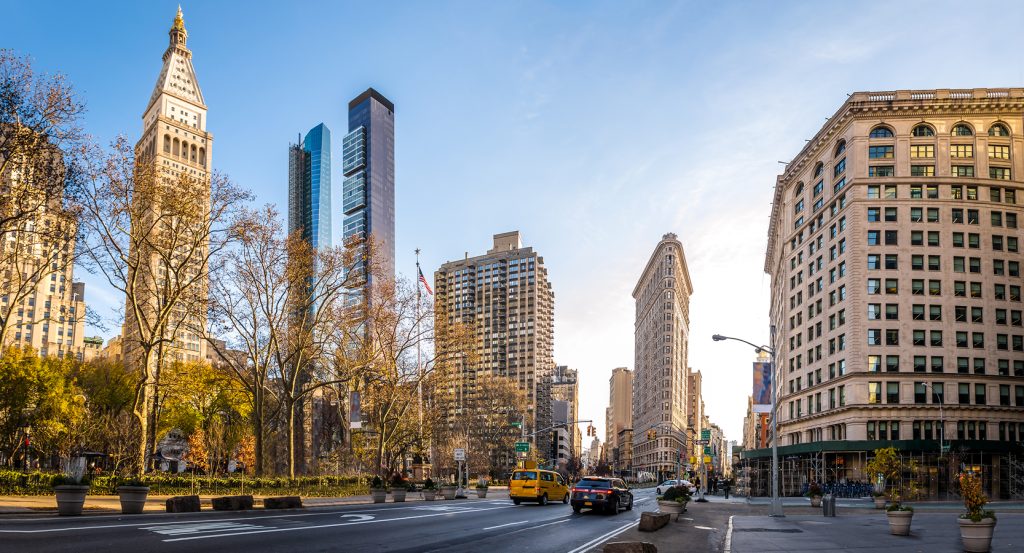
Set between Madison Avenue and 5th Avenue near East 23rd Street and just steps from the Flatiron Building, the park occupies 6.2 acres at the point where Broadway cuts diagonally through Manhattan's street grid. Curving paths move through lawns, planted beds and a substantial tree canopy, creating an irregular internal geometry against the rectilinear blocks surrounding the square. The Oval Lawn forms the principal green opening, with the Reflecting Pool extending the north-south axis toward Augustus Saint-Gaudens's bronze Admiral David Glasgow Farragut and Stanford White's sculpted pedestal. Worth Square projects from the park's western edge between Broadway and 5th Avenue, carrying the granite mausoleum of General William Jenkins Worth into the surrounding streetscape. The result is a compact civic landscape whose lawns, curved paths, mature trees, reflecting water and historic monuments preserve an unusually legible piece of nineteenth-century Manhattan amid some of the Flatiron District's densest architecture.
What defines Madison Square Park.
Madison Square Park is best known for occupying public land whose civic history predates both the Manhattan street grid and the park itself, then becoming a focal point for major episodes in nineteenth-century New York. The 1686 Dongan Charter reserved the area for public use, and the United States Army converted the land into a parade ground with an arsenal in 1807. The Commissioners' Plan of 1811 designated a much larger Grand Parade on the site before subsequent urban development reduced its dimensions. Madison Cottage, a roadhouse converted from a farmhouse at 5th Avenue and 23rd Street in 1839, supplied the Madison name to the surrounding square before the public park formally opened in 1847. William Grant and Austrian landscape architect Ignatz Pilat redesigned the grounds in 1870, replacing an earlier rectilinear arrangement as scenic landscape principles gained influence in New York parks. The arm and torch of Frédéric Auguste Bartholdi's Statue of Liberty arrived in Madison Square in 1876, where the enormous fragment remained on display for six years as admission fees helped finance construction of the statue's pedestal. That same year, the former New York and Harlem Railroad depot at 26th Street and Madison Avenue became the first Madison Square Garden, beginning a succession of arenas that retained the square's name long after leaving the neighborhood. William Kissam Vanderbilt owned that first Garden, and P. T. Barnum's circus became an important recurring attraction before structural and financial problems led to its demolition in 1889. A second Madison Square Garden opened on the site in 1890, extending the square's association with large-scale entertainment until that building closed in 1925.
A late twentieth-century revival created a separate chapter centered on horticulture, contemporary art and private stewardship of the public grounds. City Parks Foundation launched the Campaign for the New Madison Square Park in 1997 after decades of deterioration, initiating the effort that preceded a major restoration and the formation of Madison Square Park Conservancy in 2003. The park mounted its first contemporary art exhibition in 2001, and the Conservancy developed a sustained commissioning program beginning in 2004. Artists subsequently working in the park have included Sol LeWitt, Ursula von Rydingsvard, Antony Gormley, Teresita Fernández, Martin Puryear, Leonardo Drew, Krzysztof Wodiczko, Abigail DeVille, Maya Lin, Shahzia Sikander, Cristina Iglesias and Rose B. Simpson. Maya Lin's 2021 Ghost Forest placed a grove of dead Atlantic white cedar trees inside the park as an intervention addressing climate change and ecological loss, extending the art program into environmental questions tied directly to landscape. The Conservancy had taken another unexpected cultural step in 2019 by organizing Martin Puryear's United States presentation at the Venice Biennale after his Big Bling appeared in Madison Square Park in 2016. Danny Meyer's original Shake Shack developed from a temporary hot-dog cart supporting the park's first art project into a permanent James Wines-designed kiosk opened in 2004, tying the revival to an enterprise that subsequently expanded far outside New York. The contemporary park joins nonprofit stewardship, horticulture, artist commissions and a nationally expanded restaurant venture within a revival that fundamentally changed the condition and cultural role of the grounds.
How Madison Square Park fits.
Madison Square Park works as the anchor for a Flatiron outing connecting a Gilded Age mansion devoted to American arts, a reconstructed presidential childhood home and the country's first museum dedicated exclusively to poster design.
Begin at National Arts Club, founded in 1898 by author and New York Times critic Charles De Kay with artists and patrons seeking a permanent gathering place across artistic disciplines. The organization moved in 1906 to the former Samuel Tilden Mansion on Gramercy Park, a pair of 1840s houses that Tilden had joined and substantially remodeled under architect Calvert Vaux. Vaux transformed the brownstone exterior with bay windows, sandstone carving and elaborate ornament, John LaFarge created stained-glass panels for the interiors, Ellin and Kitson produced carved fireplace surrounds and woodwork, and Donald MacDonald fashioned the stained-glass dome above Tilden's former library. The building received New York City architectural protection in 1966 and National Historic Landmark designation in 1976. Continue to Theodore Roosevelt Birthplace National Historic Site, preserving the East 20th Street location where Theodore Roosevelt was born on October 27, 1858 and lived until age 14. The original brownstone was demolished in 1916, and the Women's Roosevelt Memorial Association acquired the site after Roosevelt's death in 1919, reconstructing the house and adjoining property as a memorial complex. The present historic rooms recreate five spaces from Roosevelt's childhood household, supported by family furnishings and collections concerning his early life and later career. Congress authorized Theodore Roosevelt Birthplace National Historic Site in 1962, and the National Park Service subsequently assumed administration of the property. Conclude at Poster House, founded in 2015 to create the first museum in the United States devoted exclusively to the poster and opened on West 23rd Street on June 20, 2019. LTL Architects converted 15,000 square feet across two floors of a building erected 1901 for the National Cloak Company, retaining exposed brick, barrel vaults and cast-iron columns as part of the new museum architecture. The institution examines posters across art, advertising and mass communication through temporary exhibitions and a growing permanent collection, placing a medium created for streets and public circulation inside a purpose-built museum environment. The progression moves from Vaux, LaFarge and MacDonald's transformation of the Tilden Mansion through the reconstruction of Roosevelt's childhood household and culminates in LTL Architects' museum for graphic communication, connecting decorative arts, preserved domestic history and public visual culture across the neighborhoods surrounding Madison Square.
Where your story begins.
Foresyte Travel reveals places that feel extraordinary long before you arrive.
Enjoy editorial crafted for luxury travelers.
Foresyte may earn a commission when you book.