
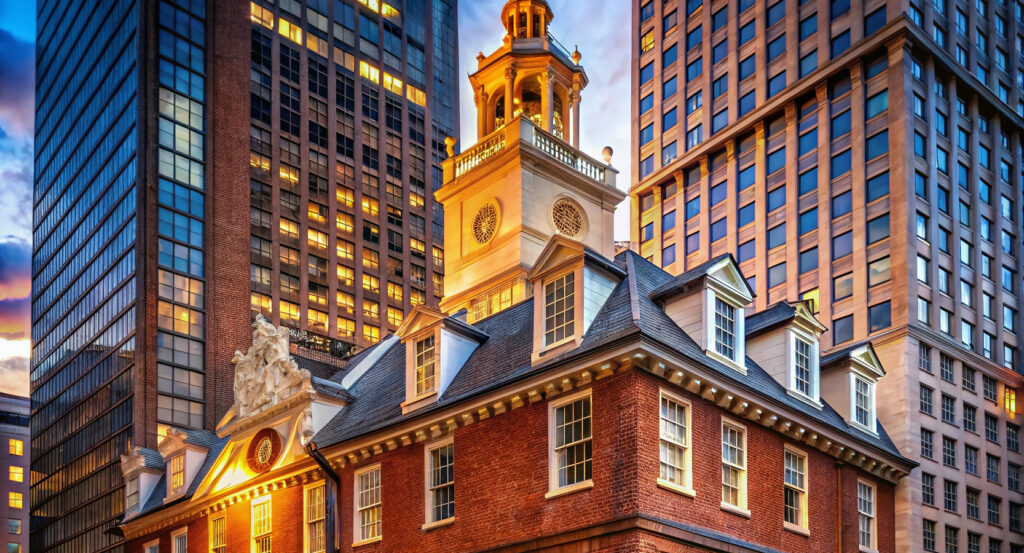
Why you should experience Boston Merchants' Exchange in Boston, Massachusetts.
Boston Merchants' Exchange is a distinguished historic commercial building where Downtown's maritime heritage, mercantile ambition, architectural innovation, and global trade created one of nineteenth-century America's most influential business centers.
Set along State Street near India Street and just steps from the Old State House, this elegant granite landmark welcomes visitors to one of Boston's most historically significant commercial addresses, where merchants, shipowners, insurers, and financiers once conducted business at the heart of New England's international trading network. Monumental masonry, refined Federal-era detailing, and centuries of commercial history create an atmosphere where Boston's rise as a global port city remains vividly preserved. Every visit reveals the extraordinary enterprise that transformed the city into one of America's foremost centers of commerce. The result is an experience defined by architectural distinction, maritime legacy, and one of Boston's most important commercial landmarks.
What you should know about Boston Merchants' Exchange.
Boston Merchants' Exchange is best known for opening in 1842 as the permanent headquarters of the Boston Marine Society and the city's expanding community of merchants, insurers, brokers, shipowners, and commercial organizations, replacing an earlier exchange destroyed in the Great Boston Fire of 1835. Designed by prominent Boston architect Isaiah Rogers, whose later commissions included the internationally celebrated Tremont House and Astor House Hotel, the five-story granite building combined Greek Revival architecture with advanced commercial planning to accommodate exchange rooms, counting houses, insurance offices, shipping agents, reading rooms, and meeting spaces serving Boston's rapidly expanding maritime economy. The structure also incorporated the celebrated Merchants' Exchange Reading Room, where newspapers, shipping manifests, marine intelligence, commodity prices, and international commercial reports arrived daily from ports throughout Europe, the Caribbean, South America, and Asia, making the building one of the nation's principal centers for maritime information exchange before the telegraph transformed global communications. Positioned only steps from Long Wharf, India Wharf, Central Wharf, and the Custom House, the building occupied the operational heart of nineteenth-century Boston's waterfront, where merchants financed voyages, insured cargoes, negotiated commodity contracts, and coordinated international trade that helped establish Boston as one of the United States' leading commercial ports. The building was designated a National Historic Landmark in 1970 in recognition of its exceptional significance to American maritime commerce and nineteenth-century commercial architecture.
Beyond its remarkable commercial history, Boston Merchants' Exchange represents one of the finest surviving examples of the city's transition from an Atlantic trading port into a sophisticated financial and mercantile capital. Careful preservation has retained much of Isaiah Rogers' original granite exterior while allowing the landmark to remain an active component of Downtown's historic streetscape. Its proximity to Faneuil Hall, the Custom House, Long Wharf, and the Old State House demonstrates the remarkable concentration of political, financial, and maritime institutions that collectively shaped the economic development of the early United States. Architectural preservation, mercantile innovation, maritime enterprise, and urban continuity combine to create one of Boston's most significant historic commercial buildings.
How to fold Boston Merchants' Exchange into your trip.
Boston Merchants' Exchange works as the commercial centerpiece of an exploration through Downtown.
Begin at the Old State House, where revolutionary history introduces the remarkable civic foundations surrounding Boston Merchants' Exchange. Continue to Long Wharf, whose historic waterfront demonstrates the maritime commerce that sustained the exchange for generations. Conclude at Faneuil Hall, where merchants, traders, and public debate provide a memorable finale celebrating the remarkable relationship between commerce, politics, and maritime enterprise that defines Boston. The progression moves naturally from colonial government to historic commercial exchange before concluding through two defining Boston landmarks, revealing why Boston Merchants' Exchange remains one of America's essential mercantile landmarks.
Where your story begins.
Foresyte Travel reveals places that feel extraordinary long before you arrive.
Experience premium editorial crafted for luxury travelers.







































































































