
Why Old State House matters.
Old State House is a historic civic building where Downtown's revolutionary heritage, colonial governance, political debate, and early American democracy preserve one of the nation's most influential public buildings.
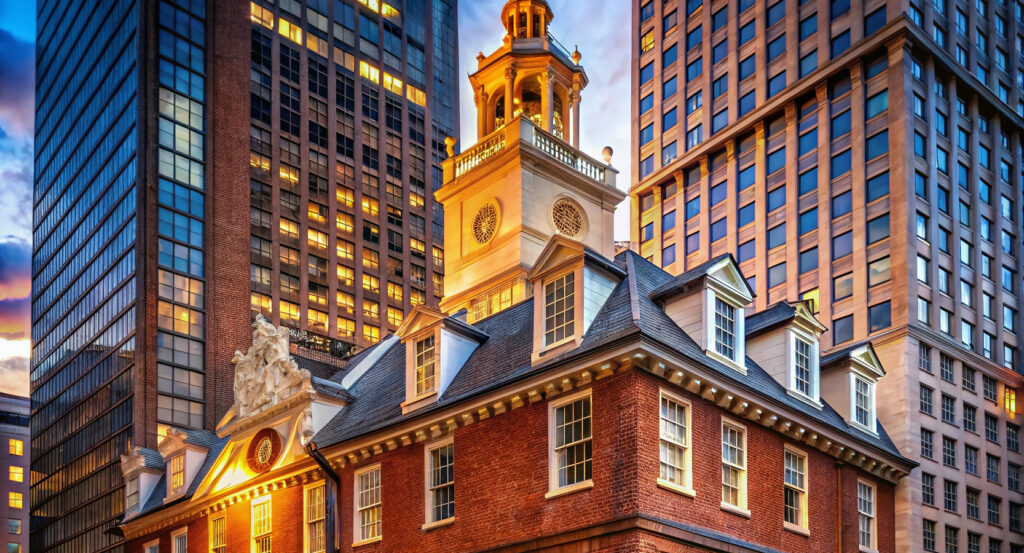
Set along State Street near Washington Street and just steps from Boston Massacre Site, this distinguished Georgian structure welcomes visitors through elegant council chambers, restored legislative halls, period galleries, and carefully preserved interiors where governors, merchants, revolutionaries, and lawmakers shaped the course of colonial and early American history. Red brick façades, white stone trim, symmetrical proportions, and the gilded lion and unicorn above the eastern entrance reflect the building's eighteenth-century origins while exhibitions immerse visitors in the political tensions that transformed Boston into the birthplace of the American Revolution. Every room reveals the debates, decisions, and conflicts that forever changed the future of the United States.
What defines Old State House.
Old State House is best known for being completed in 1713 as the seat of the colonial government of the Province of Massachusetts Bay, serving as the center of executive, legislative, judicial, and commercial life for more than six decades while standing immediately beside the site of the Boston Massacre on 5 March 1770, among the defining events leading to the American Revolution. Designed under the supervision of Robert Twelves following the destruction of Boston's earlier Town House in the Great Fire of 1711, the Georgian building housed the Royal Governor's Council Chamber, the Massachusetts General Court, merchant exchange, and courts where many of colonial America's most consequential political decisions were debated. On 18 July 1776, the Declaration of Independence was publicly proclaimed to Boston citizens from the building's eastern balcony, formally announcing the colonies' separation from Great Britain only days after its adoption in Philadelphia. Carefully restored during the late nineteenth and twentieth centuries after narrowly escaping demolition amid Boston's commercial expansion, the building became one of the earliest properties preserved by the Bostonian Society, now Revolutionary Spaces, and was designated a National Historic Landmark in 1960 while continuing to anchor Boston's Freedom Trail. Today, original architectural elements, period furnishings, historical collections, and immersive exhibitions preserve more than three centuries of political history, allowing visitors to experience one of the oldest surviving public buildings in the United States and a setting closely associated with the nation's founding.
Beyond its historical significance, the building offers a rare opportunity to stand within the chambers where colonial government operated during the decades preceding independence. Restored council rooms, legislative spaces, exhibits interpreting the Boston Massacre, original masonry, eighteenth-century woodwork, and sweeping views toward modern Boston reinforce the contrast between the colonial capital and the contemporary city that surrounds it. Every gallery deepens appreciation for the individuals, institutions, and debates that shaped the emergence of representative government in North America.
How Old State House fits.
Old State House works as the centerpiece of an exploration through Downtown's Revolutionary-era heritage.
Begin at Faneuil Hall, where colonial commerce and public debate established one of Boston's foremost gathering places before continuing to Old State House to explore the political center of eighteenth-century Massachusetts. Continue to Boston Massacre Site, where events on King Street accelerated the movement toward independence only steps from the building. Conclude at Old South Meeting House, where passionate public assemblies helped shape the Boston Tea Party and the Revolutionary movement. The progression moves naturally from civic gathering place to colonial government before concluding through two defining chapters of Boston's revolutionary story, revealing why Old State House remains one of America's most important historic civic buildings.
Where your story begins.
Foresyte Travel reveals places that feel extraordinary long before you arrive.
Enjoy editorial crafted for luxury travelers.
Foresyte may earn a commission when you book.







































































































