
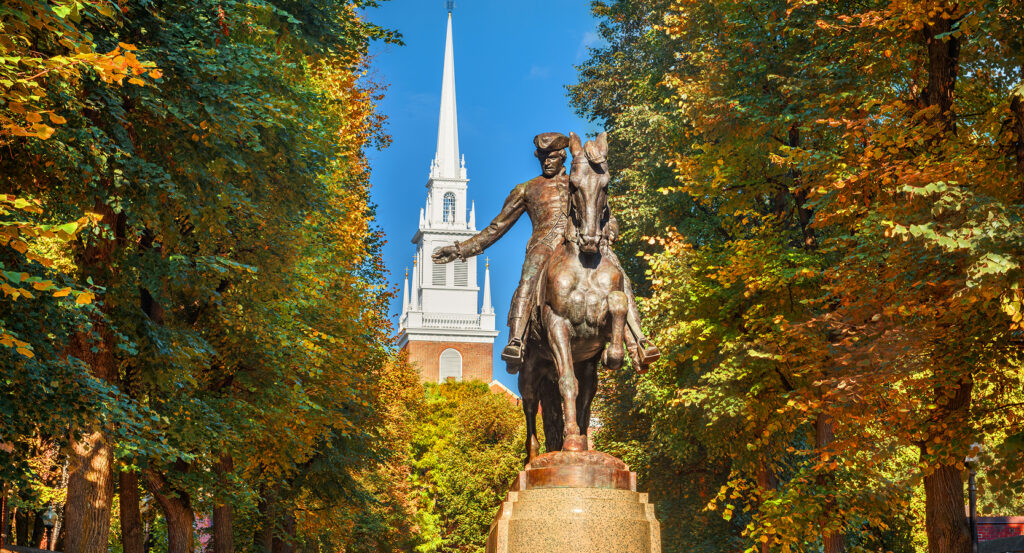
Why Old South Meeting House matters.
Old South Meeting House is a historic colonial gathering place where Downtown's Revolutionary legacy, civic debate, architectural preservation, and democratic ideals commemorate one of America's most influential public assembly sites.
Set along Washington Street near Milk Street and just steps from Old State House, this beautifully preserved Georgian building welcomes visitors beneath soaring timber trusses, elegant arched windows, hand-crafted box pews, and one of the nation's finest surviving eighteenth-century meeting halls. Warm brickwork, historic interiors, and centuries of preserved civic history create an atmosphere that vividly recalls the debates that shaped the American Revolution. Every architectural detail reflects another chapter in the nation's founding. The result is an experience defined by historical significance, architectural excellence, and one of America's most important colonial meeting houses.
What defines Old South Meeting House.
Old South Meeting House is best known for hosting the largest public gathering before the American Revolution on 16 December 1773, when 5,000 colonists assembled inside and around the meeting house before marching to Griffin's Wharf to carry out the Boston Tea Party, among the defining events leading to American independence. Constructed between 1729 and 1730 by architect and master builder Thomas Dawes, the Georgian meeting house replaced an earlier Puritan church while becoming the largest building in colonial Boston, capable of accommodating extraordinary public gatherings far beyond religious services. Throughout the eighteenth century, influential figures including Samuel Adams, John Hancock, James Otis Jr., Joseph Warren, and Benjamin Franklin participated in meetings, debates, and public assemblies within its walls, transforming the building into the political heart of revolutionary resistance against British rule. During the British occupation of Boston (1775-1776), the meeting house was seized and used as a riding school for cavalry, causing extensive interior damage before careful restoration following the Revolution. Threatened with demolition during the late nineteenth century, the building was saved in 1876 through one of the nation's earliest successful historic preservation campaigns, becoming a museum dedicated to Boston's Revolutionary history. Today, designated a National Historic Landmark and an official Freedom Trail site, Old South Meeting House preserves its remarkable eighteenth-century architecture while presenting exhibitions that explore the origins of American democracy, free speech, and civic participation. Together, Revolutionary history, exceptional Georgian architecture, pioneering preservation, and enduring democratic significance establish Old South Meeting House as one of the most important historic buildings in the United States.
The meeting house continues demonstrating how civic architecture can shape the course of history by providing a place where ordinary citizens gathered to debate extraordinary questions of liberty and self-government. Faithfully restored interiors, nationally significant historical interpretation, exceptional architectural preservation, and centuries of continued public engagement reinforce Old South Meeting House's standing among America's most influential colonial buildings while illustrating Boston's central role in the birth of the United States.
How Old South Meeting House fits.
Old South Meeting House works as part of an exploration through Boston's Revolutionary Freedom Trail.
Begin at Old State House, where colonial government and the Boston Massacre introduce the political tensions that culminated at Old South Meeting House before exploring its historic interior. Continue to Old Corner Bookstore, where Boston's literary heritage provides a fascinating complement to the city's Revolutionary legacy. Conclude at Faneuil Hall, where centuries of public debate and civic gatherings provide a memorable finale celebrating the remarkable democratic traditions that define historic Boston. The progression moves naturally from colonial government to Revolutionary activism before concluding at America's celebrated marketplace of ideas, revealing why Old South Meeting House remains one of the nation's defining symbols of democratic participation.
Where your story begins.
Foresyte Travel reveals places that feel extraordinary long before you arrive.
Enjoy editorial crafted for luxury travelers.
Foresyte may earn a commission when you book.







































































































