
Why The Basilica of St. Patrick's Old Cathedral matters.
The Basilica of St. Patrick's Old Cathedral is a commanding Gothic Revival church where Nolita's nineteenth-century immigrant history meets Joseph François Mangin's austere stone architecture, an enclosed cemetery and more than two centuries of Catholic life in Lower Manhattan.
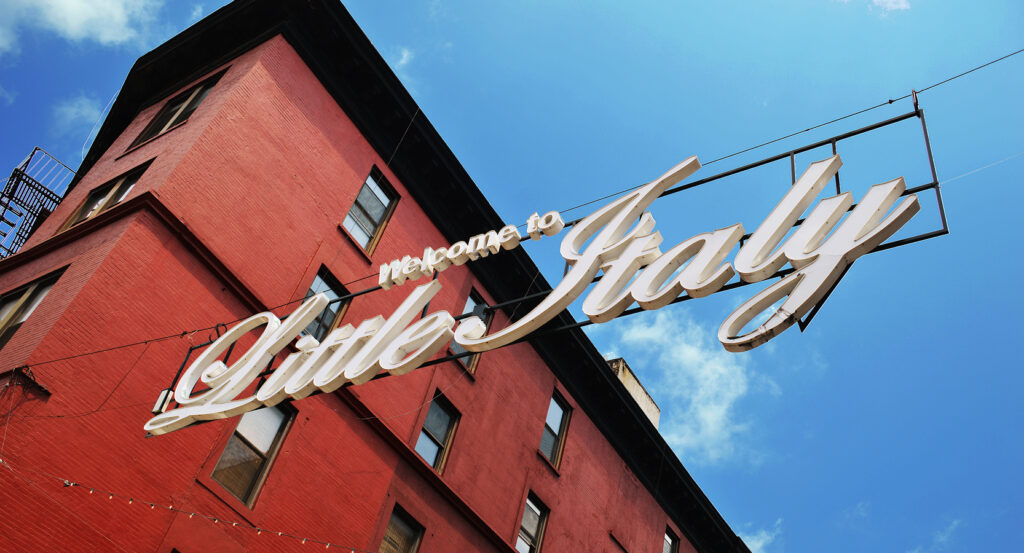
Set along Mott Street near Prince Street and just steps from Petrosino Square, the basilica occupies a walled ecclesiastical campus whose churchyard and former school buildings preserve an unusually extensive religious precinct amid Nolita's dense street grid. Joseph François Mangin designed the cathedral at 120 by 80 feet with an 85-foot interior vault, creating one of the earliest major Gothic Revival churches in New York. Rough gray fieldstone side walls contain eight pointed-arch stained-glass windows on both the north and south elevations, with high brick cemetery walls enclosing burial ground beside the church. The Mott Street front remains severe and largely unornamented, placing recessed pointed arches and a steep gable above a broad masonry plane whose restraint sharply separates the church from the surrounding commercial blocks. The result is a rare Lower Manhattan religious compound where cathedral-scale Gothic architecture, enclosed burial ground and surviving parish buildings preserve the physical world of New York Catholicism before the city's center moved far north of Prince Street.
What defines The Basilica of St. Patrick's Old Cathedral.
The Basilica of St. Patrick's Old Cathedral is best known for serving as the original cathedral of the Roman Catholic Diocese of New York, created by Pope Pius VII in 1808 as Catholic immigration began reshaping the city. Father Anthony Kohlmann led the early diocesan organization, and trustees including Dominick Lynch, Andrew Morris and Cornelius Heeney helped finance a cathedral dedicated to Ireland's patron saint. Kohlmann laid the cornerstone on June 8, 1809, but the Napoleonic Wars prevented New York's first appointed bishop, Luke Concanen, from reaching his diocese before his death in Italy in 1810. John Connolly arrived as the first resident bishop in 1815, the same year the completed cathedral opened as the largest Catholic church in the United States. New York's Catholic population subsequently climbed from 15,000 in 1815 to more than 200,000 by 1842, placing the cathedral at the center of a rapidly expanding community shaped heavily by Irish immigration. Archbishop John Hughes confronted the anti-Catholic nativism accompanying that growth, and members of the Ancient Order of Hibernians joined efforts to protect the cathedral precinct against threatened attacks during the nineteenth century. A major fire gutted the church in 1866, leaving the masonry shell and prompting reconstruction completed in 1868. Cathedral status transferred to the new St. Patrick's on 5th Avenue after its opening in 1879, ending the Mott Street church's role as the archdiocesan seat. Pope Benedict XVI elevated the former cathedral to a minor basilica in 2010, recognizing the church's enduring place within American Catholic history.
Henry Erben's 1868 pipe organ carries a separate chapter of New York craftsmanship into the basilica's interior, replacing an earlier Erben instrument lost in the 1866 fire. Erben had apprenticed with Thomas Hall beginning in 1817 before building an international organ business whose instruments reached Havana, Guatemala, Venezuela, Colombia and the American West. Cathedral trustees spent $15,000 on the new three-manual instrument, which traveled by horse and carriage from Erben's nearby factory and was assembled by hand inside the rebuilt church. European immigrant and American craftsmen fabricated its components, with some workers signing the pipes they produced, and the completed organ incorporated elements of the emerging orchestral style at the end of Erben's six-decade career. The basilica later acquired an 1859 Hall & Labagh chancel organ originally built for St. George's Chapel in Newburgh; Brunner & Associates restored that instrument before its 2016 inauguration on Mott Street. Friends of the Erben Organ undertook a comprehensive restoration of the 1868 instrument from February 2024 through June 2026, accompanied by restoration of its original choir loft and historic acoustic environment. The Erben and Hall & Labagh instruments now place two closely connected branches of nineteenth-century New York organ building inside the same basilica, extending the church's historical importance from ecclesiastical architecture into American musical craftsmanship.
How The Basilica of St. Patrick's Old Cathedral fits.
The Basilica of St. Patrick's Old Cathedral works as the anchor for a downtown outing connecting an intact nineteenth-century domestic interior, an experimental contemporary-art institution and an immigrant tenement shaped by successive waves of Lower East Side migration.
Begin at Merchant's House Museum, the late-Federal and Greek Revival row house Joseph Brewster built in 1832 before hardware merchant Seabury Tredwell purchased it in 1835 for his wife Eliza, their children and Irish servants. The Tredwells remained for nearly a century, ending with Gertrude Tredwell's death in the house in 1933; George Chapman subsequently preserved the property, opening it as a museum in 1936 with the family's furnishings and possessions still inside. Its holdings approach 4,500 Tredwell objects, including more than 100 pieces of furniture, 39 dresses and a set of 12 mahogany chairs attributed to Duncan Phyfe, giving the surviving rooms exceptional depth as a domestic collection. Continue to New Museum, founded by curator Marcia Tucker with founding trustee Allen Goldring in 1977 as an institution devoted exclusively to contemporary art and ideas. Tucker directed the museum through 1999, organizing exhibitions including “Bad” Painting, Bad Girls and A Labor of Love, alongside solo presentations devoted to John Baldessari, Pat Steir and other artists. The institution opened its purpose-built 50,000-square-foot Bowery building in December 2007 on its thirtieth anniversary, giving Downtown Manhattan its first purpose-built art museum erected from the ground up. Conclude at Tenement Museum, where German immigrant Lucas Glockner constructed 97 Orchard Street in 1863 as a five-story building containing 22 apartments of 325 square feet apiece. 7,000 people from more than 20 nations lived there between 1863 and 1935, including German, Irish, Eastern European Jewish and Sephardic families whose apartments and businesses now anchor the museum's interpretation of immigration. Historians Ruth Abram and Anita Jacobson founded the museum in 1988 after encountering the long-shuttered upper floors, eventually restoring apartments and Schneider's Lager Beer Saloon as spaces centered on specific former residents. The progression moves from the Tredwells' preserved merchant household through Tucker's institution for contemporary art into Glockner's immigrant tenement, tracing domestic prosperity, artistic experimentation and mass migration across the nineteenth- and twentieth-century neighborhoods surrounding the old cathedral.
Where your story begins.
Foresyte Travel reveals places that feel extraordinary long before you arrive.
Enjoy editorial crafted for luxury travelers.
Foresyte may earn a commission when you book.







































































































