
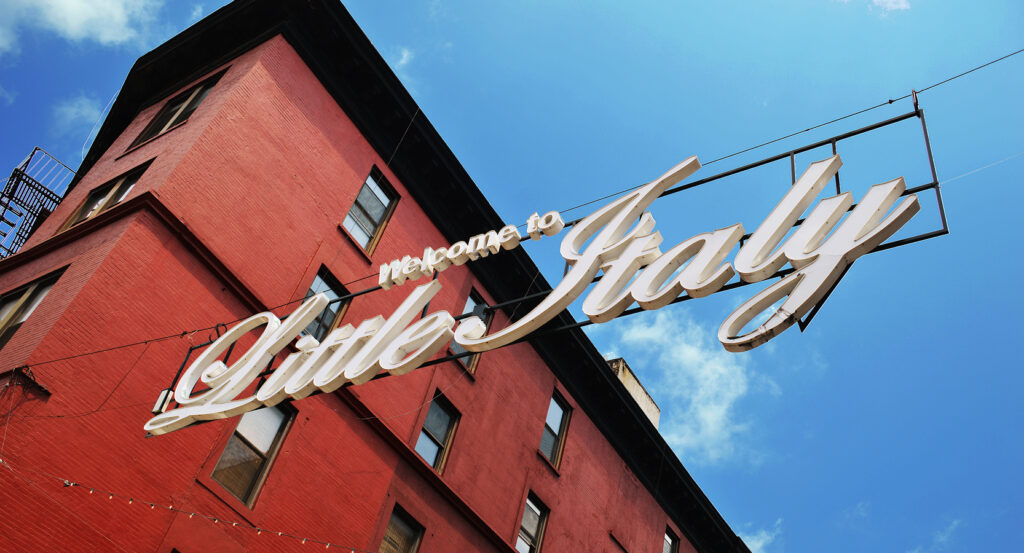
Why Mulberry Street matters.
Mulberry Street is a historic Little Italy corridor where Italian-American heritage, immigrant history, neighborhood traditions, and generations of family-owned businesses preserve one of Lower Manhattan's most enduring cultural streetscapes.
Running through Little Italy between Canal Street and Houston Street, this celebrated avenue unites historic tenements, traditional restaurants, neighborhood churches, specialty food shops, cafés, and annual cultural festivals within a streetscape that has represented the heart of New York's Italian-American community for more than a century. Ornamental street decorations, sidewalk dining, historic storefronts, and preserved architectural character reinforce an atmosphere where immigration, entrepreneurship, and community character remain inseparable from the corridor's enduring appeal. The result is a destination defined by cultural continuity, living history, and neighborhood tradition.
What defines Mulberry Street.
Mulberry Street is best known for serving as the historic center of Little Italy after becoming the principal residential and commercial corridor for hundreds of thousands of Italian immigrants who settled in Lower Manhattan during the late nineteenth and early twentieth centuries, transforming the street into one of America's most influential Italian-American neighborhoods through churches, social clubs, family businesses, specialty food markets, and enduring cultural traditions. Originally laid out during Manhattan's eighteenth-century expansion and named for the mulberry trees that once grew nearby, the corridor experienced dramatic demographic change following large-scale immigration from southern Italy, particularly Naples and Sicily, between the 1880s and the First World War. Mulberry Street became internationally recognized through institutions including Church of the Most Precious Blood, founded in 1888 to serve the growing Italian Catholic population, while neighborhood bakeries, butcher shops, salumerias, cafés, and restaurants established culinary traditions that continue defining Little Italy today. Since 1926 the avenue has hosted the internationally renowned Feast of San Gennaro each September, an eleven-day celebration honoring Naples' patron saint through religious processions, live entertainment, traditional cuisine, and cultural festivities that attract hundreds of thousands of attendees annually while preserving one of New York City's most important expressions of Italian-American heritage.
Historic cast-iron storefronts, late nineteenth-century tenement buildings, family-operated businesses, devotional traditions, and generations of neighborhood institutions collectively preserve an authentic streetscape that reflects the evolution of immigrant life in Lower Manhattan. Independent restaurants, pastry shops, cafés, specialty grocers, and cultural organizations continue sustaining the corridor's historic character while celebrating the traditions introduced by successive generations of Italian-American families. Mulberry Street continues demonstrating how immigration, entrepreneurship, religious devotion, and neighborhood culture collectively shaped one of New York City's most recognizable historic corridors.
How Mulberry Street fits.
Mulberry Street works as part of a curated exploration through Little Italy's rich cultural and culinary heritage.
Begin at Church of the Most Precious Blood, where the spiritual heart of Little Italy provides historical context before strolling along Mulberry Street. Continue to Italian American Museum, whose exhibitions illuminate the immigrant experiences and community traditions that shaped the corridor for generations. Conclude at The Feast of San Gennaro when visiting in September, or Columbus Park throughout the remainder of the year, where neighborhood life and nearby historic streets provide a fitting finale celebrating the enduring legacy of Italian-American culture in Lower Manhattan. The progression moves naturally from sacred heritage to community history before concluding through Little Italy's defining public gathering spaces, revealing why Mulberry Street remains the symbolic heart of New York's Italian-American story.
Where your story begins.
Foresyte Travel reveals places that feel extraordinary long before you arrive.
Enjoy editorial crafted for luxury travelers.
Foresyte may earn a commission when you book.







































































































