Why Pesky's Pole matters.
Pesky's Pole is a storied ballpark marker where Fenway's baseball heritage meets Johnny Pesky's six-decade relationship with the Boston Red Sox and one of Major League Baseball's most peculiar outfield geometries.
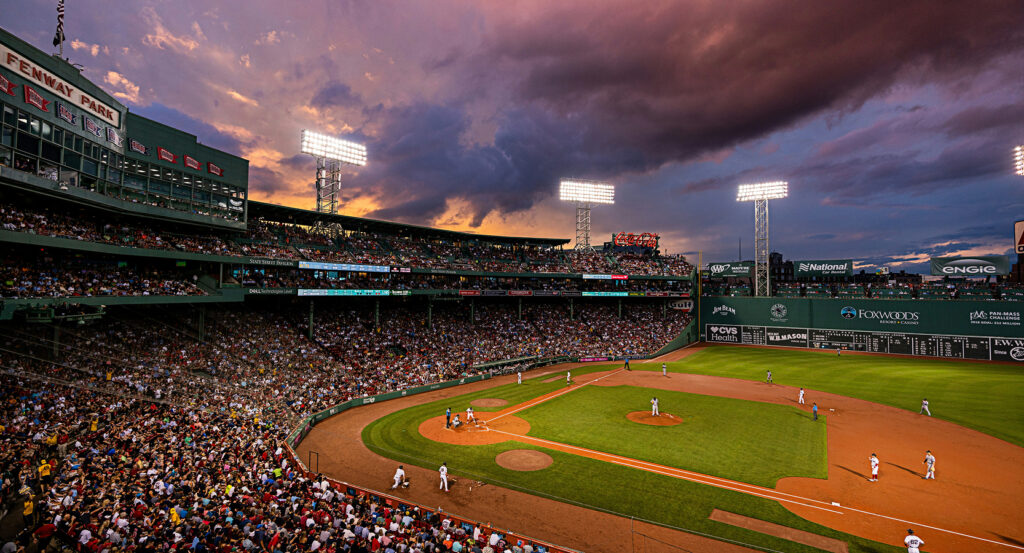
Set along Fenway Park's right-field line near the corner of the grandstand and just below the seating that turns toward the outfield, the yellow pole occupies the point where the foul line reaches a wall only 302 feet from home plate. The boundary immediately bends away from that corner, rapidly increasing the distance required for a fair ball to leave the park. Layers of handwritten signatures cover the lower portion of the pole, transforming its surface into an accumulation of fan and player inscriptions. Its narrow vertical form rises above the low right-field wall in sharp contrast with the enormous left-field structure across the diamond. The result is a physically modest piece of ballpark equipment whose location, accumulated markings and association with Johnny Pesky have turned an ordinary foul pole into one of Fenway Park's most recognizable features.
What defines Pesky's Pole.
Pesky's Pole is best known for carrying the name of Johnny Pesky, the infielder whose association with the Boston Red Sox eventually encompassed playing, managing, coaching, broadcasting and decades as a club ambassador. Born John Michael Paveskovich in Oregon in 1919, Pesky reached Boston in 1942 and immediately produced 205 hits while leading the American League with 22 sacrifice hits. Military service during World War II interrupted his major-league career for three seasons, yet he returned in 1946 with 208 hits as Boston captured the American League pennant. Another 207 hits followed in 1947, giving Pesky more than 200 in each of his first three full major-league seasons. Power was never central to that production: he hit only 17 home runs across 1,270 career games and six in 539 games at Fenway. Teammate and later broadcaster Mel Parnell attached Pesky's name to the right-field pole, creating a nickname whose humor depended on the contrast between Pesky's contact hitting and the unusually short distance down the line. The Red Sox formalized the association on September 27, 2006, Pesky's 87th birthday, dedicating the structure as Pesky's Pole and placing a commemorative plaque at its base. Two years later the club retired his number 6, completing an institutional tribute to a figure whose relationship with the organization lasted 61 years before his death in 2012.
The geometry responsible for the pole's fame dates principally to a 1940 alteration designed around Ted Williams. Red Sox owner Tom Yawkey moved the bullpens from foul territory into right field after Williams' extraordinary 1939 rookie season, shifting the fence inward by 20 feet. The change shortened the right-field line from 325 feet to 302 and reduced the right-field power alley from 402 feet to 380, creating an area soon nicknamed Williamsburg. The fence curves sharply away from the pole, making the inviting corner a much narrower target than its headline distance suggests. Mark Bellhorn exploited that geometry in Game 1 of the 2004 World Series, striking the pole high above right field for an eighth-inning home run that broke a 9-9 tie against St. Louis. Boston won 11-9 and subsequently swept the Cardinals to secure its first World Series championship in 86 years. David Ortiz produced another unusual collision in batting practice on July 21, 2016, driving a ball hard enough to lodge it inside the wire mesh attached to the structure. Pesky's Pole draws its baseball significance from this collision of engineered geometry, clubhouse folklore and consequential moments, with a 1940 alteration ultimately becoming inseparable from the memory of a player whose greatest value came from almost everything except home-run power.
How Pesky's Pole fits.
Pesky's Pole works as the sporting anchor for an outing connecting a Beaux Arts museum built around an encyclopedic collection, Isabella Stewart Gardner's intensely personal Venetian palace and Frederick Law Olmsted's transformation of a tidal marsh into urban parkland.
Begin at Museum of Fine Arts, Boston, founded in 1870 and first opened in Copley Square on July 4, 1876 inside a building by Sturgis and Brigham. Rapid collection growth pushed the institution toward a larger site, and architect Guy Lowell developed the master plan for its new Beaux Arts home on Huntington Avenue. The building opened in November 1909, followed by Lowell's Evans Wing in 1915 and John Singer Sargent's expansive decorative programs for the Rotunda and Colonnade during the 1920s. I.M. Pei added the West Wing in 1981, and Foster + Partners later created the Art of the Americas Wing and Shapiro Family Courtyard as part of a campaign that raised $504 million. Continue to Isabella Stewart Gardner Museum, whose founder acquired land near the Fens after her growing collection outgrew plans for an expanded Beacon Street residence. Gardner worked intensively with architect Willard T. Sears, directing the placement of architectural fragments gathered in Italy and repeatedly altering construction as the building rose. Fenway Court opened with a musical celebration on January 1, 1903 featuring Bach, Mozart, Chausson and Schumann performed by Boston Symphony Orchestra musicians and Cecilia Society singers. Its galleries joined paintings, sculpture, furniture and architectural fragments around a central courtyard, preserving Gardner's arrangements as an unusually personal act of collecting. Conclude at Back Bay Fens, where Frederick Law Olmsted confronted a polluted tidal marsh as part of the larger Emerald Necklace park system. His design transformed the problematic lowland through engineered waterways, planted banks and curving paths, integrating drainage infrastructure with a naturalistic public landscape. The surrounding district subsequently attracted cultural institutions that altered Boston's geography of art and education around the rehabilitated marsh. The progression moves from an encyclopedic museum shaped by successive architects through Gardner's individually composed palace and culminates in Olmsted's reconstruction of damaged tidal terrain, connecting three radically different forms of cultural and physical creation across the Fenway district.
Where your story begins.
Foresyte Travel reveals places that feel extraordinary long before you arrive.
Enjoy editorial crafted for luxury travelers.
Foresyte may earn a commission when you book.