
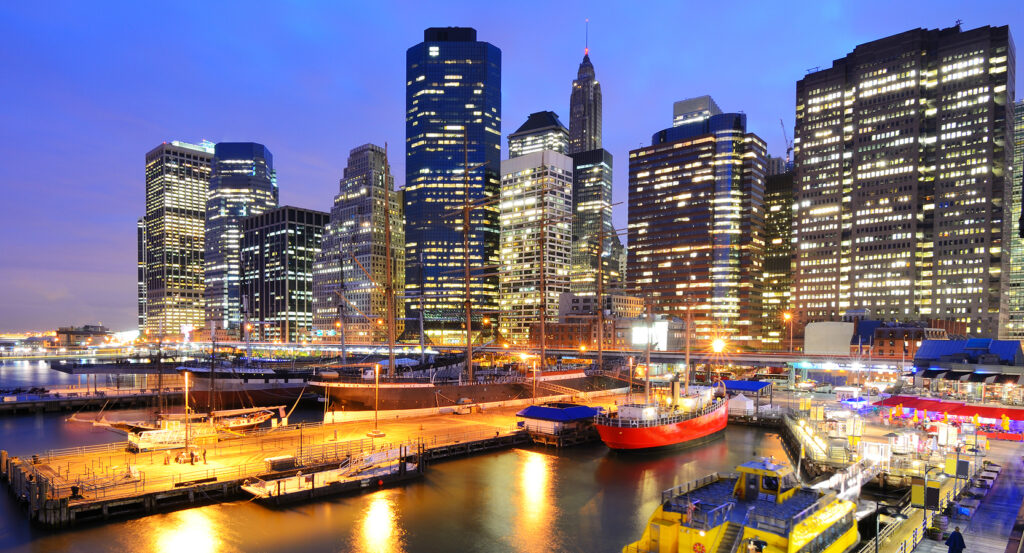
Why Pier 17 matters.
Pier 17 is a contemporary waterfront complex where the Seaport's maritime character meets open-air architecture, East River panoramas and a rooftop performance venue projecting toward the Brooklyn Bridge.
Set at the foot of Fulton Street near South Street and just steps from the The Seaport Museum, the pier extends eastward over the river from Manhattan's historic mercantile shoreline. SHoP Architects organized the 265,000-square-foot building as smaller two-story volumes beneath two broad glass-clad upper floors, breaking the lower mass into pedestrian passages that continue the surrounding street pattern toward the water. Corrugated zinc, channel glass and jatoba wood differentiate the exterior surfaces, with large operable glass walls opening the north and south elevations to river air and unobstructed bridge views. Public terraces wrap the perimeter above the water, placing the East River directly beside circulation routes before the building rises to its 1.5-acre rooftop. The result is a pier whose open passages, operable facades, layered exterior and elevated public areas reconnect the Seaport street grid with a waterfront site once dominated by an enclosed festival marketplace.
What defines Pier 17.
Pier 17 is best known for replacing the Seaport's enclosed 1980s marketplace with a SHoP Architects building conceived around public access, river views and a more porous connection between the historic district and the East River. The preceding structure, designed by Benjamin Thompson & Associates and completed in 1985, belonged to a wider redevelopment strategy that emerged after preservationists founded the The Seaport Museum in 1967 and worked with the city to protect surviving mercantile buildings. Beyer Blinder Belle produced a Seaport master plan in 1980, later expanded with Benjamin Thompson & Associates and The Rouse Company as new commercial development entered the district. Howard Hughes Corporation and the New York City Economic Development Corporation reached lease terms for a new Pier 17 in 2012 after the Landmarks Preservation Commission approved the architectural concept. Mayor Michael Bloomberg, Council Member Margaret Chin and Howard Hughes executives participated in the 2013 groundbreaking overlooking the East River and Brooklyn Bridge. SHoP Architects led the replacement project with Buro Happold as structural engineer, Langan Engineering & Environmental Services as civil engineer, L'Observatoire International as lighting consultant and Hunter Roberts Construction Group as construction manager. Building directly above the river created unusual construction demands: structural-steel fabricator Orange County Ironworks developed custom crane mats that transferred equipment loads into piles driven to East River bedrock. The completed 2018 building joined new architecture with a Seaport district whose earlier commercial power had grown from shipping, scheduled packet service, wholesale markets and a waterfront crowded with warehouses and maritime trades.
The Rooftop at Pier 17 gave the redevelopment a separate cultural chapter by turning the uppermost level into a 1.5-acre open-air performance site five stories above the East River. Live Nation joined the inaugural 2018 summer concert series, which began with Amy Schumer and Kings of Leon before Diana Ross, Sting, Gladys Knight & The O'Jays, Trevor Noah and other performers filled a 23-show first season. Eighteen dates sold out and attendance surpassed 60,000, followed by Pollstar naming the site Best New Concert Venue for 2018. A standing configuration accommodates 3,500 people, giving the roof the scale of a substantial concert hall without enclosing its views toward the Brooklyn Bridge, Lower Manhattan and surrounding harbor. SIA Acoustics developed an audio strategy intended to limit sound reaching nearby Manhattan and Brooklyn neighborhoods, addressing a technical challenge created by amplified concerts on an exposed platform above the river. Billie Eilish performed there in 2019 during her ascent to international prominence, and the Fugees staged their first reunited performance in more than 15 years on the roof in 2021. The site has also hosted the 2021 ESPYs and other major cultural events, extending its role beyond the recurring concert series. Pier 17's upper level added a major performance function to a waterfront whose cultural revival had begun decades earlier through historic preservation and maritime interpretation.
How Pier 17 fits.
Pier 17 works as the anchor for a Seaport outing connecting New York printing, nineteenth-century global cargo trade and the engineering achievement that permanently joined Manhattan and Brooklyn.
Begin at Bowne & Co., Stationers, whose name reaches back to Robert Bowne's printing firm founded in 1775 and whose Seaport incarnation occupies 211 Water Street. Printing became deeply connected with Lower Manhattan's shipping and financial industries as merchants required invoices, advertisements, stationery and other commercial paper, helping support more than 700 printing offices across New York by 1900. The The Seaport Museum and Bowne Foundation created the present nineteenth-century-style shop in 1975 for the firm's bicentennial, using historic presses from the museum collection to continue letterpress production. Its Greek Revival building belongs to the 1835-1836 Hart-Havens-Lauderback group, whose granite-framed storefronts and brick upper stories preserve another layer of the district's commercial architecture. Continue to Wavertree, built by Oswald, Mordaunt and Company at Southampton in 1885 and renamed after R. W. Leyland & Company acquired her two years later. The iron-hulled sailing ship carried jute between South Asia and Scotland before entering global tramp trade, eventually transporting grain, nitrate, lumber and other bulk cargoes through ports across several continents and completing three or more circumnavigations. A 1910 Cape Horn storm destroyed major sections of her rig, ending a 24-year sailing career and sending the hull into later service as a floating warehouse and sand barge in South America. Ship preservationist Karl Kortum rediscovered her, the The Seaport Museum purchased her for scrap value in 1968 and a procession of fireboats, tugs and ferries accompanied her arrival in New York on August 11, 1970. Conclude at Brooklyn Bridge, designed by John A. Roebling and completed in 1883 after a construction campaign carried forward by Washington A. Roebling and Emily Warren Roebling. John died in 1869 following an accident during preparatory work, and Washington assumed engineering leadership before decompression sickness severely impaired his health after work in the pneumatic caissons beneath the East River. Emily became the crucial liaison between Washington and the construction team, mastering the technical demands of the project and becoming the first person to cross the completed span during the opening celebrations. The bridge's 1,595.5-foot main span was the world's longest suspension span at completion, and its steel-wire cable system advanced methods John Roebling had developed through decades of suspension engineering. The progression moves from Bowne's commercial printing tradition through Wavertree's global cargo career and culminates in the Roeblings' unprecedented East River span, connecting the paper, ships and infrastructure that powered the Seaport's rise.
Where your story begins.
Foresyte Travel reveals places that feel extraordinary long before you arrive.
Enjoy editorial crafted for luxury travelers.
Foresyte may earn a commission when you book.







































































































