
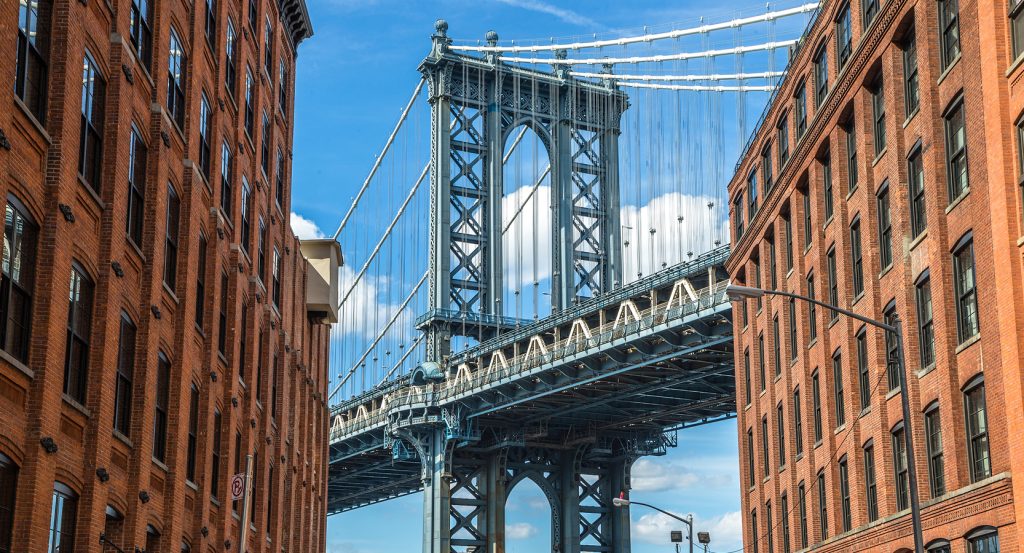
Why Brooklyn Bridge matters.
Brooklyn Bridge is a pioneering suspension bridge where Brooklyn Heights' nineteenth-century waterfront character meets Gothic stone towers, steel-wire engineering and an elevated crossing above the East River.
Set across the East River between the Brooklyn Heights waterfront and Lower Manhattan near City Hall, and just steps from Cadman Plaza, the bridge occupies a 6,016-foot corridor whose long approaches rise substantially inland before reaching the water. Two granite towers punctuated by paired pointed arches carry the suspension system high above the river, giving the crossing a masonry scale distinct from the steel-dominated East River bridges that followed. The elevated promenade runs along the centerline above the roadway, placing pedestrians within the cable system as diagonal stays and vertical suspenders converge around the walkway. A 135-foot clearance at the center preserves the broad river passage beneath the 1,595.5-foot main span, joining the towers through an uninterrupted sweep above maritime traffic. The result is a bridge whose stone portals, suspended deck, central promenade and commanding river span make structural engineering inseparable from the physical passage between Brooklyn and Manhattan.
What defines Brooklyn Bridge.
Brooklyn Bridge is best known for translating John A. Roebling's suspension-bridge engineering into a 1,595.5-foot main span that became the world's longest suspension span when it opened in 1883. Roebling had patented a durable wire-rope system in 1842 and subsequently tested suspension principles through projects including the Cincinnati-Covington Bridge, whose 1,057-foot span provided an important predecessor for the East River undertaking. New York State chartered the New York Bridge Company in 1867, and Roebling received the chief engineer position for a crossing required to clear the heavily trafficked river. A ferry slip accident injured Roebling during preparatory work in 1869, and tetanus caused his death before major construction began, transferring engineering leadership to his son Washington A. Roebling. Washington and Emily Warren Roebling had traveled through Europe studying steel manufacturing and pneumatic-caisson technology, expertise that became crucial when enormous timber caissons were sunk beneath the river to support the two towers. Compressed air permitted excavation within the submerged chambers, but decompression sickness afflicted numerous workers and severely injured Washington in 1872 after his extensive participation underground. Emily subsequently studied stress analysis, cable construction, strength calculations and catenary curves, carried Washington's instructions to the construction site and became the principal conduit between the incapacitated chief engineer and project personnel. Steel replaced iron in the suspension system to reduce dead load, and the four main cables were assembled from 5,434 galvanized steel wires apiece, an unprecedented application that helped shift suspension engineering toward steel. Fourteen years after construction began, the bridge opened on May 24, 1883, with Emily crossing alongside President Chester A. Arthur during ceremonies that completed one of the nineteenth century's most ambitious engineering undertakings.
Transportation across the bridge changed repeatedly after that opening as Brooklyn and New York grew into a consolidated metropolis. The original deck divided space among two elevated railroad tracks, two trolley tracks, a roadway and a 15-foot pedestrian walkway, placing mass transit, horse-drawn traffic and foot travel within one crossing. Rail use grew rapidly enough that more than 30 million train passengers were crossing annually within five years of completion, demonstrating how the bridge altered movement between two cities that remained politically separate until 1898. A comprehensive reconstruction between 1944 and 1954 removed railroad and trolley tracks, strengthened the inner and outer trusses, installed horizontal stays between the main cables, widened roadways and rebuilt approaches for the automobile era. FDR Drive ramps followed in 1969, further integrating the nineteenth-century crossing into Manhattan's twentieth-century road network. Federal recognition arrived in 1964, New York City protection followed in 1967 and the American Society of Civil Engineers granted National Historic Civil Engineering status in 1972. Another transportation change arrived in September 2021 when New York City converted a vehicular lane into a two-way protected bicycle path, separating cyclists from the elevated pedestrian route. By 2024, daily averages reached 103,051 vehicles, 28,845 pedestrians and 5,504 cyclists, extending the bridge's transportation role more than 140 years after its first crossing.
How Brooklyn Bridge fits.
Brooklyn Bridge works as the anchor for a Brooklyn waterfront outing connecting nineteenth-century global commerce, abolitionist organizing and the conversion of industrial architecture into contemporary performance space.
Begin at Empire Stores, a group of seven contiguous warehouses erected between 1868 and 1885 during the period when Brooklyn's shoreline operated as a major receiving point for international cargo. Thick red-brick exteriors and schist interior walls kept storage rooms cool and dark for sugar, molasses, wool, rubber and especially coffee, a commodity deeply tied to Brooklyn's industrial economy. Arbuckle Brothers later incorporated the complex into a vast coffee operation associated with Ariosa and Yuban, before waterfront decline left the warehouses abandoned during the 1960s. More than half a century of closure ended after Midtown Equities led a redevelopment designed by Studio V Architecture, with construction beginning in 2014 and finishing in 2016. Continue to Plymouth Church, founded in Brooklyn Heights in 1847 by 21 New England Congregationalists who selected Henry Ward Beecher as their first pastor. Beecher turned the congregation into an influential center of antislavery activity, and Plymouth became associated with the Underground Railroad through fugitives sheltered in its basement and Beecher's cooperation with abolitionists moving escapees north toward Canada. Beecher staged public events raising money to purchase enslaved people's freedom, and Abraham Lincoln worshipped at Plymouth during his 1860 visit to New York. The congregation's musical history also produced The Plymouth Collection in 1855, assembled by Henry Beecher, Charles Beecher and organist John Zundel with words and music printed together on the same page. Conclude at St. Ann's Warehouse, whose permanent waterfront home repurposed the roofless nineteenth-century Tobacco Warehouse after decades of theatrical work elsewhere in Brooklyn. Brooklyn Bridge Park approved a long-term lease in 2013 as St. Ann's pursued a $27 million capital campaign, and Marvel Architects designed an 18,000-square-foot enclosed building inside the surviving masonry perimeter. The project retained an open-air garden within the old brick walls and inserted a flexible theater into an industrial shell originally associated with Brooklyn's port economy, giving the waterfront's preserved architecture a performing-arts function. The progression moves from Empire Stores' global cargo economy through Plymouth Church's abolitionist activism and culminates in St. Ann's conversion of maritime architecture into a theater, tracing three consequential chapters in the Brooklyn communities reached from the bridge.
Where your story begins.
Foresyte Travel reveals places that feel extraordinary long before you arrive.
Enjoy editorial crafted for luxury travelers.
Foresyte may earn a commission when you book.







































































































