
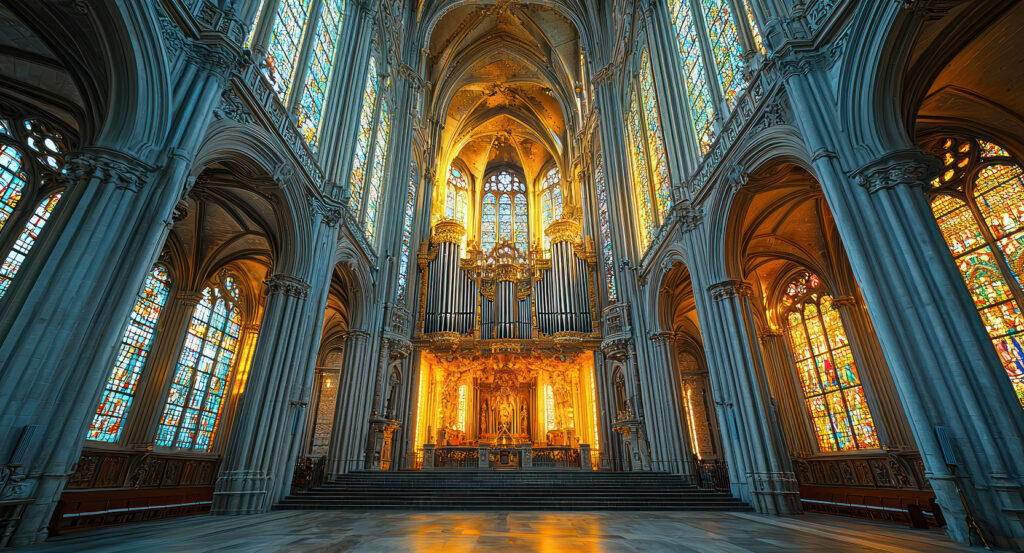
Why you should experience St. Vitus Rose Window in Prague.
The Rose Window at St. Vitus Cathedral is light made visible, a cosmic bloom suspended in glass and stone.
When sunlight strikes its surface, the entire nave dissolves into color: rubies, sapphires, and gold flooding the Gothic arches like divine breath. From afar it feels ethereal, almost immaterial; up close, it's a riot of precision, thousands of fragments perfectly balanced within an iron frame that weighs nearly ten tons. The moment you step inside and the light catches your eyes, you realize it's not decoration; it's theology rendered in geometry. Each petal of glass tells a fragment of creation, and together they form a universe. The window doesn't merely illuminate the cathedral, it consecrates it.
What you should know about St. Vitus Rose Window.
Installed in 1929 to mark the cathedral's final completion after six centuries of construction, the Rose Window was designed by Czech artist František Kysela, who conceived it as a visual Genesis.
Its 27,000 pieces of colored glass depict the first nine chapters of the Book of Genesis, light and darkness, earth and sky, the birth of humanity. Kysela's design fuses medieval symbolism with Art Nouveau sensibility: the flowing linework and glowing palettes evoke the natural world as divinely ordered chaos. The stone tracery, originally envisioned by Peter Parler's 14th-century workshop, had waited five hundred years for its glass. Even the placement was deliberate, the window crowns the cathedral's western façade, where the evening sun sets fire to its colors, turning twilight into a moving mosaic. Few realize that during World War II, the window's panels were dismantled and hidden in rural monasteries to prevent Nazi confiscation; the glass returned unbroken, a rare miracle of survival. The leaded frames were reinforced during the 1990s restoration, yet the glass remains original, each pane still hand-cut, each hue still mixed from Bohemian sand and minerals. The central medallion portrays God the Creator, surrounded by spirals of celestial order, a vision not of domination but of divine architecture itself.
How to fold St. Vitus Rose Window into your trip.
Enter the cathedral in late afternoon, when the western light ignites the glass from behind.
Stand just inside the main doors and look upward, the window hovers like a living mandala. Move slowly; as the sun shifts, so does the image. Photograph it if you must, but linger instead on what the eye can't capture, the way the colors seem to breathe. Visit again in morning light, when the tones cool and the golds fade to blue, revealing the sculptural tracery more clearly. If you climb the south tower afterward, glance back toward the façade: you'll see how the rose anchors the cathedral's entire geometry. On clear days, its reflected hues spill faintly across the opposite buildings of the Prague Castle complex, a reminder that this single window colors the whole city. The Rose Window of St. Vitus Cathedral isn't merely stained glass; it's a moment when sunlight remembers God's first words, “Let there be light”, and the world obeys again.
Where your story begins.
Foresyte Travel reveals places that feel extraordinary long before you arrive.
Experience premium editorial crafted for luxury travelers.





































































































