Why The Westin Seattle matters.
The Westin Seattle is a defining downtown hotel where Seattle's commercial skyline meets Puget Sound geography, Pacific Northwest culture and the city's transformation from port settlement into a major center of technology, trade and the arts.
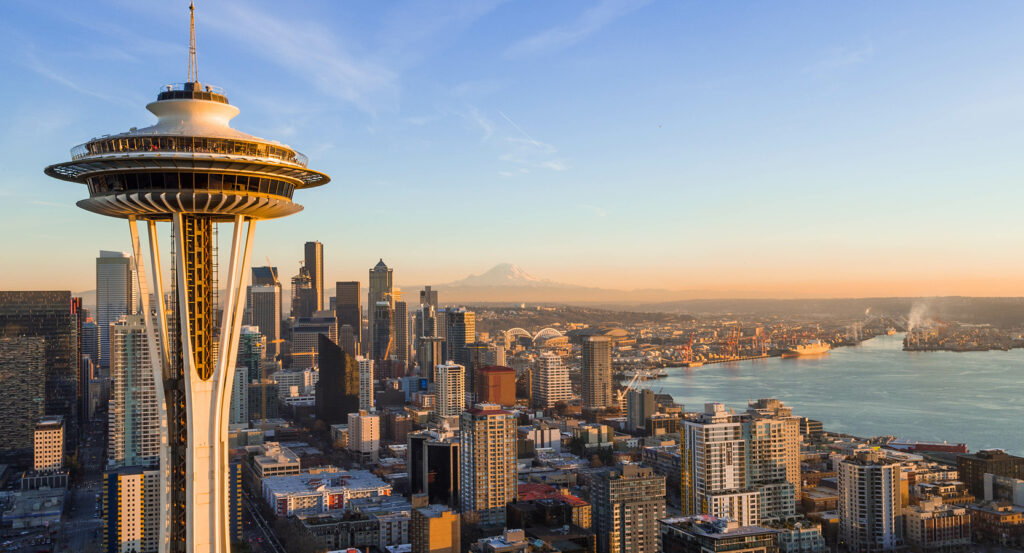
Set along 5th Avenue in Downtown, The Westin Seattle occupies a prominent position between Pike Place Market, the retail core and the streets leading toward Elliott Bay, with Lake Union and the Space Needle district extending north of the property. Its twin cylindrical towers rise above the downtown grid, creating one of the city's most recognizable modern silhouettes. Guest rooms and suites face the bay, city, mountains or surrounding neighborhoods, with upper floors providing wide views across skyscrapers, ferries, waterways and the forested landscape beyond Seattle. The hotel's public interiors create a transition from the busy streets to restaurants, lounges, meeting rooms and wellness facilities organized within the towers. 5th Avenue connects the property with theaters, offices, restaurants, shopping streets and public transit, while nearby routes lead toward the waterfront, convention center and historic commercial districts. The city's steep hills and layered infrastructure remain visible around the hotel, revealing the relationship between Seattle's dense center and its surrounding water. The property's position places visitors within walking distance of museums, markets, stadiums, public parks and the major cultural institutions of downtown. The result is a substantial urban hotel whose architecture and location connect Seattle's commercial power with its maritime, cultural and Pacific Northwest identity.
What defines The Westin Seattle.
The Westin Seattle is best known for its twin cylindrical towers, which transformed the city's downtown skyline and established an enduring architectural connection between Seattle's hospitality industry and the legacy of the 1962 World's Fair. The property's origins trace to Edward E. Carlson, president of Western International Hotels, whose leadership had helped bring the Space Needle into existence as the fair's defining landmark. Carlson reunited architect John Graham Jr. and Howard S. Wright Construction Company, whose earlier collaboration had produced the Space Needle, for an ambitious new hotel development announced in December 1966. Western International partnered with the Aluminum Company of America on the $18 million Washington Plaza Hotel, replacing the historic Orpheum Theatre with Seattle's first major new downtown hotel development in decades. Demolition began in August 1967, clearing a prominent commercial site for a futuristic tower that extended the architectural experimentation of the World's Fair into the city's expanding business district. The Washington Plaza opened on June 29, 1969, combining its original cylindrical tower with the adjoining Benjamin Franklin Hotel, an established downtown property dating to 1929. The hotel's inauguration coincided with a major Shriners convention, filling its accommodations and immediately demonstrating the commercial importance of substantial convention-oriented hospitality in Seattle. Western International's corporate history entered another chapter in 1970 when UAL Corporation acquired the hotel company, bringing Carlson into the leadership of a major American aviation and transportation enterprise. The Benjamin Franklin Hotel was demolished in July 1980 to accommodate a second cylindrical tower, replacing an earlier generation of downtown hospitality architecture with an expansion of Graham's modernist conception. Western International adopted the Westin Hotels name in 1981, and the Washington Plaza became the first property in the company to receive the new character on September 1 of that year. The rebranding coincided with the opening of Westin's corporate headquarters across the street, reinforcing the property's significance within a hospitality company whose origins were closely connected to the Pacific Northwest. The taller northern tower opened in June 1982, completing the paired architectural composition that became one of Downtown's most recognizable landmarks. The towers subsequently entered American popular culture through the cover of Modest Mouse's 1997 album The Lonesome Crowded West, extending their significance beyond commercial architecture into the visual character of Pacific Northwest alternative rock. The Westin Seattle represents a defining intersection of the city's postwar architectural ambitions, its internationally influential hospitality industry and the cultural character of the modern Pacific Northwest.
Where your story begins.
Foresyte Travel reveals places that feel extraordinary long before you arrive.
Enjoy editorial crafted for luxury travelers.