
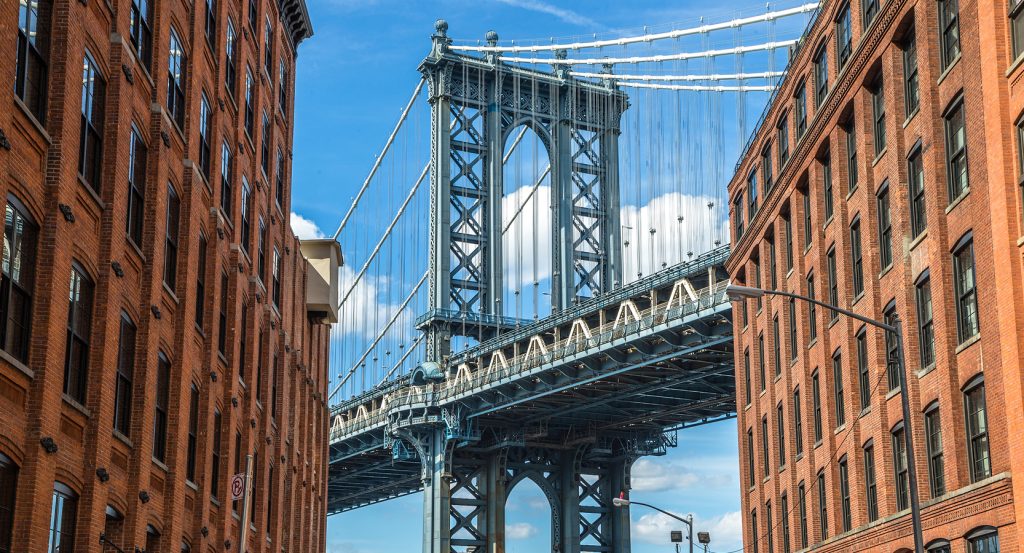
Why you should experience Adams Street in New York, NY.
Adams Street is a landmark Downtown Brooklyn corridor where civic history, architectural innovation, and metropolitan connectivity converge along one of the borough's most influential streets.
Running through DUMBO and Downtown Brooklyn between Brooklyn Heights and Vinegar Hill, this prominent corridor connects landmark civic buildings, historic warehouse districts, neighborhood businesses, educational institutions, major transportation hubs, and energetic commercial destinations that collectively showcase Brooklyn's remarkable urban evolution. Monumental civic architecture, adaptive reuse industrial buildings, architecturally significant office towers, thriving pedestrian corridors, thriving local businesses, and welcoming public spaces create an urban landscape where generations of merchants, civic leaders, entrepreneurs, educators, and commuters have shaped one of New York City's most important urban centers. Adams Street developed alongside the construction of the Brooklyn Bridge and the growth of Downtown Brooklyn, evolving into a vital corridor linking the borough's commercial, governmental, and waterfront districts. The result is a street defined by historical significance, architectural distinction, and metropolitan vitality.
What you should know about Adams Street.
Adams Street is best known for being home to Brooklyn Borough Hall, New York City's oldest surviving city hall building, completed in 1848.
Designed by architects Calvin Pollard and Gamaliel King, the landmark building originally served as Brooklyn City Hall before the city's consolidation into Greater New York in 1898. Its distinguished Greek Revival architecture and prominent civic role have made it one of Brooklyn's defining governmental landmarks for more than a century and a half. The building has witnessed the borough's transformation from an independent city into one of the world's most influential urban communities while continuing to serve as the seat of Brooklyn's borough government. Today, Brooklyn Borough Hall remains one of the city's most significant civic landmarks and a powerful symbol of Brooklyn's enduring identity.
How to fold Adams Street into your trip.
Adams Street works as an exploration of Downtown Brooklyn's civic landmarks, historic neighborhoods, and waterfront attractions.
Begin at Brooklyn Borough Hall, where New York City's oldest surviving city hall immediately establishes the street's defining civic legacy. Continue toward the New York Transit Museum, whose immersive exhibits provide broader perspective on the transportation systems that fueled Brooklyn's remarkable growth and connected its neighborhoods for generations. From there, make your way to Brooklyn Bridge Park, where award-winning waterfront landscapes and sweeping Manhattan skyline views provide a memorable conclusion while celebrating Brooklyn's enduring relationship with the East River. Along the route, you'll encounter architecturally significant civic buildings, restored warehouse structures, neighborhood cafés, thriving public plazas, major transit connections, and energetic commercial corridors that reveal the street's exceptional depth. The progression moves naturally from landmark government building to celebrated transportation museum to internationally acclaimed waterfront park, demonstrating how Adams Street connects civic leadership, urban history, and public life within one of New York City's most influential corridors. Adams Street remains one of the borough's most rewarding streets, preserving a distinctive balance between historical significance, architectural excellence, and metropolitan energy.
Where your story begins.
Foresyte Travel reveals places that feel extraordinary long before you arrive.
Experience premium editorial crafted for luxury travelers.







































































































