
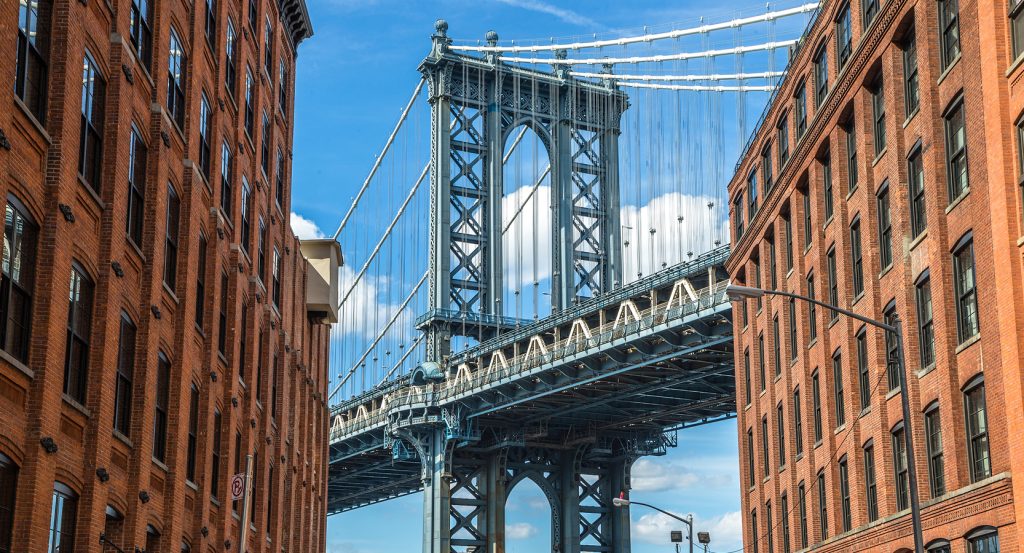
Why you should experience Brooklyn Bridge Pedestrian Walkway in New York, NY.
The Brooklyn Bridge Pedestrian Walkway is a historic elevated crossing where 19th-century American civil engineering innovation, John A. Roebling's suspension bridge design legacy, industrial-era steel cable construction, and Manhattan-to-Brooklyn urban connectivity converge across one of the world's most celebrated river-spanning infrastructures.
Set along Centre Street near City Hall Park and just steps from the Brooklyn Bridge stair access points, this elevated timber-planked walkway runs above vehicular traffic on the Brooklyn Bridge, originally completed in 1883 as part of the bridge's dual-purpose design for pedestrians, horse-drawn carriages, and early rail transit, with the pedestrian promenade positioned above the main roadway to separate foot traffic from commercial movement across the East River. Engineered under the direction of Washington Roebling after the death of John A. Roebling, and completed with significant contributions from Emily Warren Roebling, the bridge's construction pioneered the use of pneumatic caissons, steel-wire suspension systems, and large-scale masonry anchoring techniques that made it the longest suspension bridge in the world at the time of completion. The result is a landmark defined by engineering breakthroughs, architectural ambition, and one of the most influential bridge systems in global urban history.
What you should know about Brooklyn Bridge Pedestrian Walkway.
Brooklyn Bridge Pedestrian Walkway is best known for being an integral component of the Brooklyn Bridge, which opened on May 24, 1883 after 14 years of construction led initially by engineer John A. Roebling and completed by his son Washington Roebling with critical oversight and on-site coordination by Emily Warren Roebling, whose involvement in project management, technical communication, and field supervision was instrumental during the final phase of construction. The bridge was the first fixed crossing of the East River between Manhattan and Brooklyn, and at completion it held the distinction of being the longest suspension bridge in the world, with a main span of 1,595 feet supported by steel-wire cables manufactured using pioneering methods that defined modern suspension bridge engineering.
The elevated pedestrian walkway, separated from vehicular traffic below, was intentionally designed as a safety and scenic promenade, allowing uninterrupted views of New York Harbor, the Manhattan skyline, and the East River while reinforcing the bridge's dual role as infrastructure and public space. The structure's Gothic-style stone towers, constructed using limestone, granite, and Rosendale cement, were designed to symbolize permanence and civic ambition during a period of rapid industrial expansion in the United States. Over time, the walkway has become one of the most heavily visited pedestrian routes in New York City, serving as both a commuter passage and an architectural observatory of the city's evolving skyline.
How to fold Brooklyn Bridge Pedestrian Walkway into your trip.
Brooklyn Bridge Pedestrian Walkway works as the central crossing in a Lower Manhattan to Brooklyn waterfront circuit that connects civic architecture, historic infrastructure, and modern urban public space.
Begin at City Hall Park, where New York's earliest municipal architecture and surrounding civic buildings establish the governmental and historical foundation of Lower Manhattan before ascending onto the Brooklyn Bridge Pedestrian Walkway for a full traversal above the East River. Continue across to DUMBO, where restored industrial warehouses and waterfront parks frame some of the most iconic views of the Manhattan skyline from Brooklyn Bridge Park. Conclude at Jane's Carousel, where a restored 1920s amusement structure inside a glass pavilion offers a reflective endpoint to the journey along the East River shoreline. The progression moves from civic core to infrastructural crossing to recreational waterfront, revealing why the Brooklyn Bridge Pedestrian Walkway remains one of the most important pedestrian engineering experiences in the world.
Where your story begins.
Foresyte Travel reveals places that feel extraordinary long before you arrive.
Experience premium editorial crafted for luxury travelers.







































































































