
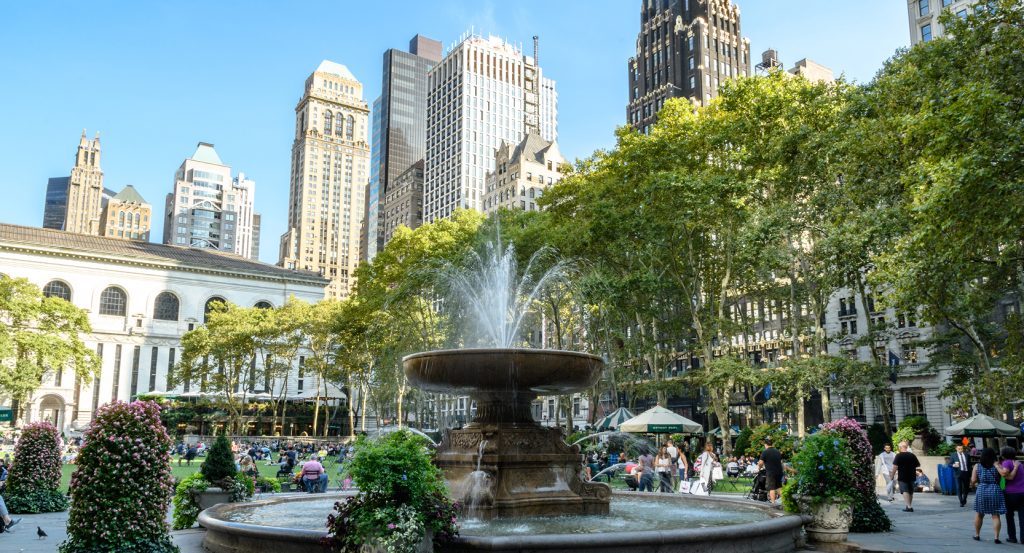
Why you should experience Josephine Shaw Lowell Memorial Fountain in New York, NY.
Josephine Shaw Lowell Memorial Fountain is a historic Bryant Park monument where Midtown's civic landscape design, Progressive Era reform history, Beaux-Arts urban planning, and early twentieth-century public art traditions converge within one of New York City's most significant commemorative fountains.
Set within Bryant Park along 6th Avenue between 40th and 41st Streets near the New York Public Library Main Branch and just steps from the park's Fountain Terrace, this pink and black granite and bronze fountain anchors the western edge of the park as a formal civic focal point within a densely layered urban plaza. Designed by architect Charles A. Platt and dedicated in 1912, the fountain reflects early 20th-century Beaux-Arts principles that emphasized symmetry, permanence, and integration of sculpture within public space, with its circular basin composition and elevated upper bowl structured to create both visual hierarchy and ambient water sound within the park's rectilinear grid. It is widely recognized as the first major public monument in New York City dedicated to a woman, honoring reformer Josephine Shaw Lowell, a key figure in late nineteenth-century social welfare policy and institutional charity reform. The result is a destination defined by civic memory, sculptural restraint, and one of Manhattan's most historically important park installations.
What you should know about Josephine Shaw Lowell Memorial Fountain.
Josephine Shaw Lowell Memorial Fountain is best known for its 1912 dedication in Bryant Park as a commemorative work honoring Josephine Shaw Lowell (1843 to 1905), a pioneering social reformer who became the first woman appointed to the New York State Board of Charities, serving from 1876 to 1889 and later helping found the New York Consumers League in 1890, which advanced labor protections and ethical consumption standards during the Progressive Era. The fountain was designed by architect Charles A. Platt using Stony Creek granite and bronze, with a 32-foot lower basin and a 13-foot upper basin, and was originally installed on the east side of Bryant Park before being relocated in 1936 to its current position on the western terrace as part of broader redesign efforts that reshaped the park's circulation and symmetry.
Beyond its commemorative function, the fountain represents a pivotal moment in New York City public art history because it is widely cited as the first major civic monument in the city dedicated to a woman, marking a shift in who was publicly memorialized within elite urban spaces traditionally reserved for military, political, and commercial figures. Its placement within Bryant Park also reflects early 20th-century park reform efforts that transformed the space from a utilitarian reservoir-adjacent site into a landscaped civic garden integrated with the New York Public Library complex. The fountain's material palette, inscriptions, and tiered water structure reinforce Beaux-Arts ideals of moral symbolism through architectural order, while its continued maintenance and seasonal water operation underscore its ongoing role as both functional landscape element and historical artifact.
How to fold Josephine Shaw Lowell Memorial Fountain into your trip.
Josephine Shaw Lowell Memorial Fountain works as part of a Midtown cultural walk through Bryant Park, the New York Public Library, and the surrounding architectural landmarks of 6th Avenue and 42nd Street.
Begin at the New York Public Library Main Branch, where Beaux-Arts architecture, grand reading rooms, and the iconic lion statues establish the intellectual and civic character of the district before moving into Bryant Park's central lawn. Continue to Josephine Shaw Lowell Memorial Fountain, where the layered basin design and historic inscription terrace provide a contemplative counterpoint to the surrounding high-rise energy of Midtown. Proceed to the Bryant Park Upper Terrace and surrounding monuments, where additional sculptures and seasonal installations demonstrate the park's evolving role as a public cultural platform. Conclude at Grand Central Terminal, where the scale of early twentieth-century transit architecture reinforces the same civic ambition that shaped Bryant Park's transformation into a modern urban commons. The progression moves naturally from literary institution to commemorative fountain to curated public space to transportation landmark, revealing why the fountain remains one of Manhattan's most quietly significant civic monuments.
Where your story begins.
Foresyte Travel reveals places that feel extraordinary long before you arrive.
Experience premium editorial crafted for luxury travelers.







































































































