Why Bryant Park Reading Room matters.
Bryant Park Reading Room is an open-air literary retreat where Midtown's dense commercial core meets printed books, shaded park seating and a Depression-era tradition of free reading outdoors.
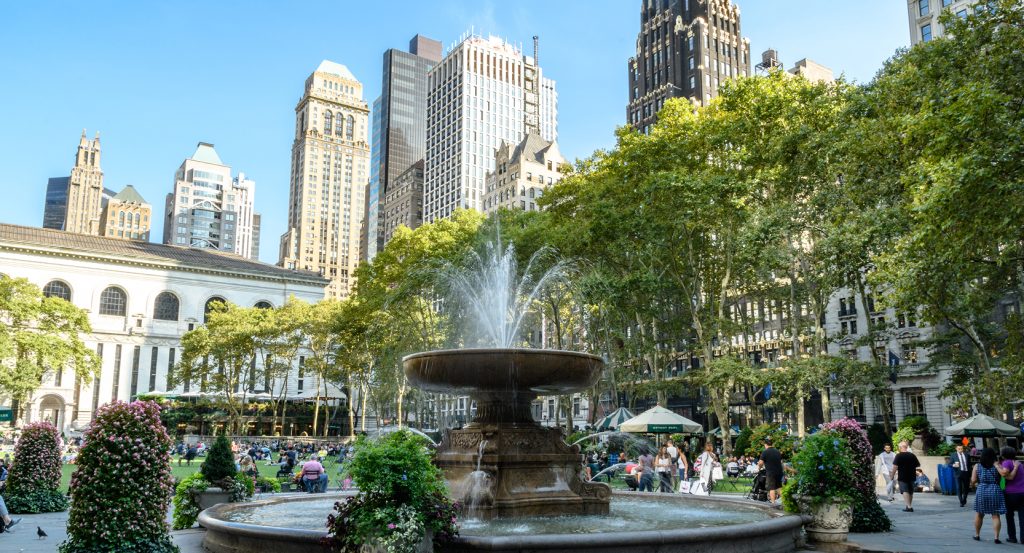
Set along Bryant Park's northern edge near 6th Avenue and just steps from the Grace Building, the Reading Room occupies a shaded section beside the 42nd Street plaza beneath the park's mature London plane trees. Yellow umbrellas, movable chairs and compact shelving carts create a recognizable outdoor enclave without enclosing it from the surrounding lawn, paths and tree-lined promenade. Books for adults and children share the site with newspapers and magazines, allowing printed matter to move directly from the carts to tables scattered beneath the canopy. The absence of permanent walls keeps the Reading Room physically integrated with Bryant Park as office towers rise beyond the trees and the central lawn opens immediately to the south. The result is a deliberately modest literary setting whose umbrellas, mobile shelves, tree cover and loose furniture turn a small section of Midtown parkland into an outdoor counterpart to the great research library immediately beyond the park.
What defines Bryant Park Reading Room.
Bryant Park Reading Room is best known for reviving an outdoor library created by The New York Public Library in 1935 as a free resource for unemployed New Yorkers during the Great Depression. The original Bryant Park Open-Air Reading Room operated without requiring money, a home address, a library card or personal identification, removing barriers that unemployed patrons faced when seeking places to spend the day. Five librarians employed through the Works Progress Administration staffed an arrangement of bookstalls, magazine racks and outdoor tables, with the equipment wheeled into position each morning. Contemporary photographs preserved by The New York Public Library show the outdoor operation in Bryant Park during its inaugural year, placing rows of readers among freestanding shelves and park seating. The second summer drew 64,624 patrons, demonstrating substantial demand for a service conceived amid mass unemployment. Period commentary characterized its users as a cross-section of Midtown life and noted that questions arising outdoors sometimes sent readers onward to specialized divisions inside the adjacent library. The program continued through the Depression and early wartime years before staffing pressures and the return of unemployed patrons to the workforce brought the original run to an end during World War II. Its first incarnation joined New Deal employment, public librarianship and an unusually informal model of intellectual access within one of Manhattan's busiest districts.
Bryant Park Corporation revived the Reading Room in 2003 after an absence of nearly six decades, restoring the outdoor-library concept with support from HSBC Bank USA. The reopened operation began with 700 books and 300 periodicals, and Daniel Biederman, executive director of the Bryant Park Restoration Corporation, framed its return as a renewed opportunity for free reading during another period of economic uncertainty. Children's books and literary programming expanded the revived format, turning the site into both a reading collection and a recurring venue for writers, poets and public discussion. Oxford University Press joined its summer literary programming in 2008 and developed a classics book club pairing contemporary authors with titles from the Oxford World's Classics series. Poetry programming has brought established and emerging writers into the park through partnerships including the Academy of American Poets and the Whiting Foundation Poetry Awards. The 2026 calendar extends across author conversations, nonfiction programs, poetry, film discussions, writing workshops, book clubs, children's programming and a crossword tournament hosted by The Wall Street Journal puzzle editor Mike Shenk and Puzzability co-founder Amy Goldstein. Quiet Reading joined the program in 2026 through sessions pairing an hour devoted to independent reading with a second hour of conversation among participants. The revived Reading Room has developed the original free-access principle into a sustained literary program spanning publishing, poetry, criticism, writing and communal reading across the summer season.
How Bryant Park Reading Room fits.
Bryant Park Reading Room works as the anchor for a Midtown outing connecting artisan education, Gilded Age maritime patronage and one of New York's great private collections transformed into a public cultural institution.
Begin at General Society of Mechanics and Tradesmen, founded on November 17, 1785 when 22 craftsmen representing trades including blacksmithing, carpentry, masonry, tailoring and silversmithing gathered at Walter Heyer's tavern on King Street. The organization created the Apprentices' Library in 1820, which grew into one of nineteenth-century New York's major free circulating libraries, and its school became the Mechanics Institute in 1858. The Society's present West 44th Street home contains a three-story reading room beneath a skylight and the John M. Mossman Lock Collection, comprising more than 370 locks, keys and related tools extending across millennia of lockmaking history. Continue to New York Yacht Club, whose Midtown clubhouse originated when Commodore J. Pierpont Morgan purchased and donated three West 44th Street lots for the organization's first permanent headquarters. Warren & Wetmore designed the building, completed in 1901, with an elaborate maritime architectural program centered on a facade whose projecting bays resemble the sterns of sailing vessels. The commission helped establish the reputation of Whitney Warren's firm years before Warren & Wetmore worked on Grand Central Terminal, and the clubhouse became the institutional home of a club that held the America's Cup from 1851 until 1983. Conclude at The Morgan Library & Museum, which began with Pierpont Morgan's private library designed by Charles Follen McKim and constructed between 1902 and 1906 beside Morgan's Madison Avenue residence. J. P. Morgan Jr. converted the collection into a public institution in 1924, followed by a 1928 Annex and the later incorporation of his own nineteenth-century brownstone into the campus. Renzo Piano Building Workshop undertook the institution's largest expansion a century after McKim's library was completed, joining three historic buildings with three steel-and-glass pavilions and a central court. The $106 million project reopened in 2006 with double the previous exhibition area and marked Piano's first completed New York commission. The progression moves from an eighteenth-century craftsmen's association and its educational library through Morgan's patronage of a maritime clubhouse and culminates in the financier's own collection evolving from McKim's private library into a public institution expanded by Renzo Piano.
Where your story begins.
Foresyte Travel reveals places that feel extraordinary long before you arrive.
Enjoy editorial crafted for luxury travelers.
Foresyte may earn a commission when you book.