
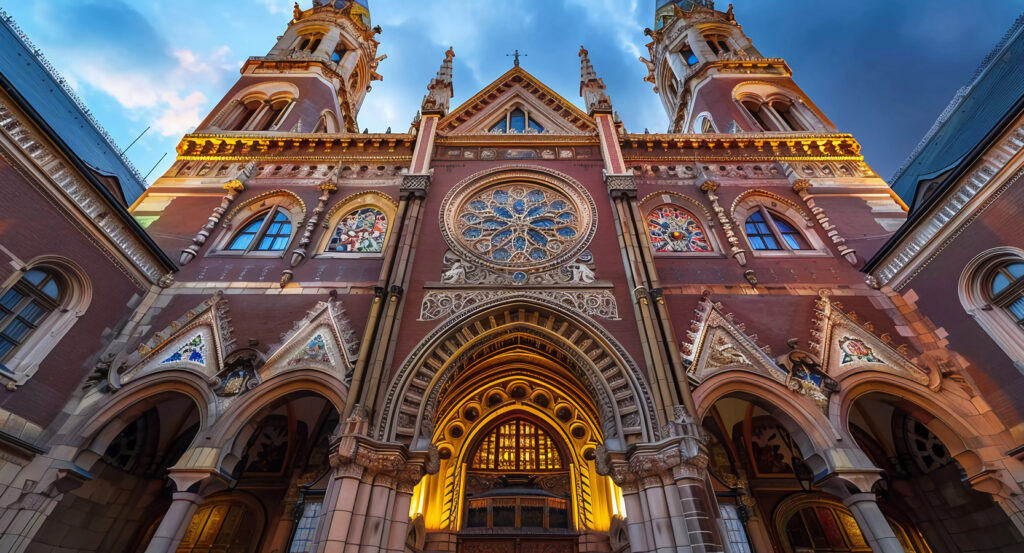
Why you should experience Holocaust Tree of Life Memorial in Budapest, Hungary.
Holocaust Tree of Life Memorial at Dohány Street Synagogue in Budapest stands as one of Europe's most haunting symbols of remembrance, a weeping willow of steel, shimmering with the names of the dead.
Tucked in the courtyard behind Dohány Street Synagogue, the tree glints in the sunlight like frozen tears, each delicate metal leaf engraved with the name of a Hungarian Jew lost during the Holocaust. At first glance, it seems im beautiful, its silver branches reflecting light across the stone courtyard, but step closer and the weight of it hits you. The stillness here is profound. Beneath its branches, sorrow feels physical, a quiet that presses gently against the chest. Yet within that sorrow is something transcendent, a whisper of resilience, a shimmer of grace. Designed by Hungarian sculptor Imre Varga in 1989, the tree turns grief into a sacred geometry of remembrance. It is both memorial and prayer, a reminder that memory, when tended to, can become light.
What you should know about Holocaust Tree of Life Memorial.
The tree was commissioned as part of the Raoul Wallenberg Memorial Park, built to honor those who risked everything to save Jewish lives during the Holocaust.
Its placement behind Dohány Street Synagogue is deliberate, this courtyard once served as a mass grave during the winter of 1944-45, when the surrounding ghetto overflowed with victims of starvation and violence. Today, the memorial transforms that space of death into one of enduring life. Each of the willow's thousands of leaves bears a name, an act of restoration in a history that sought erasure. The sculpture's design echoes the natural form of mourning: the willow, long a symbol of sorrow, here remade in metal so that it will never wither. Beneath its roots lie stone tablets engraved with the names of the Righteous Among the Nations, diplomats, priests, and ordinary citizens who defied fascism to shelter the persecuted. Imre Varga's vision was not just to commemorate tragedy, but to transmute it, to create beauty from loss, permanence from fragility. Few realize that the memorial was funded in part by actor Tony Curtis, whose Hungarian-Jewish parents fled Budapest, his contribution ensuring that memory here would never fade with time.
How to fold Holocaust Tree of Life Memorial into your trip.
Enter Dohány Street Synagogue complex with reverence, allowing time to reach the courtyard beyond the main sanctuary.
The tree is not hidden, yet it reveals itself gradually, its metallic shimmer glimpsed between the arches of the synagogue as you step outside. Approach slowly; this is not a place for photographs first, but reflection. Trace your fingers lightly along the steel leaves, each etched name representing a life once lived, a story interrupted. Nearby, plaques and stones bear the names of foreign diplomats, Raoul Wallenberg, Carl Lutz, Giorgio Perlasca, whose courage saved tens of thousands. Visit in the early morning or at dusk, when the sun's angle sets the sculpture ablaze in gold and silver light. Sit for a moment on the surrounding benches and let the silence fill you; even the air feels deliberate here. When you leave, look back once more, the tree's form shifts depending on the light, sometimes soft and spectral, sometimes radiant and rebellious. Holocaust Tree of Life Memorial at Dohány Street Synagogue is not just a monument, it is the city's conscience made visible, proof that remembrance, when held with love, can outshine even the darkest shadow.
Where your story begins.
Foresyte Travel reveals places that feel extraordinary long before you arrive.
Experience premium editorial crafted for luxury travelers.





































































































