
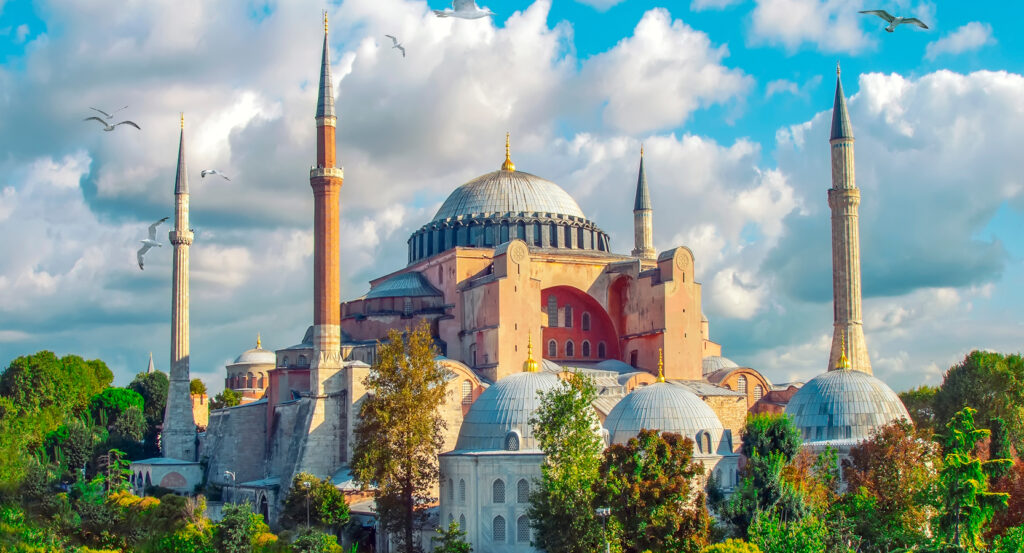
Why you should experience The Courtyard of Hagia Sophia in Istanbul, Turkey.
The Courtyard of Hagia Sophia is the building's breath, a tranquil pause between the pulse of the city and the majesty of the dome within.
Here, beneath the open sky, marble arcades and ancient fountains tell quieter stories than the grand mosaics inside, yet no less profound. The air carries the scent of stone, earth, and time, the same air that emperors, sultans, and pilgrims once inhaled before stepping into the heart of the sacred. Once the atrium of Justinian's great basilica, the courtyard evolved into a serene Ottoman forecourt lined with slender columns and ablution fountains, where worshippers would wash and prepare for prayer. To stand here is to feel history settle around you like dust and light, a space that has remained a threshold for reverence across seventeen centuries.
What you should know about The Courtyard of Hagia Sophia.
The courtyard of Hagia Sophia was not designed merely as a prelude, it was a world of ritual and rhythm in its own right.
In the Byzantine era, it formed part of a vast atrium known as the Augusteum, enclosed by colonnades and filled with fountains where pilgrims gathered before entering the basilica. After the Ottoman conquest, this open space was reshaped into the mosque's avlu, complete with a central şadırvan (ablution fountain) for purification before prayer. The surrounding marble porticoes provided shelter for study and rest, while the outer walls incorporated tombs of sultans, including those of Selim II, Murad III, and Mehmed III, turning the courtyard into both sanctuary and sepulcher. The ornate fountain at its center, commissioned by Sultan Mahmud I in the 18th century, remains one of Istanbul's finest examples of Ottoman rococo. Its rippling marble carvings and Quranic inscriptions transform function into devotion, a sculpted expression of purity. Few realize that beneath parts of the courtyard lie remnants of the original Byzantine pavement, still visible in fragments, where stone meets centuries of prayer.
How to fold The Courtyard of Hagia Sophia into your trip.
Begin your visit here, not inside, to understand Hagia Sophia as both monument and living organism.
Enter through the outer gate and let your pace slow as the din of Istanbul softens behind you. Visit in the early morning, when the light is gentle and the sound of trickling water echoes beneath the arches. Walk along the perimeter arcades, tracing the shift from Byzantine foundation to Ottoman ornament. Pause by the fountain, where reflections of the great dome ripple on the water's surface. If you look carefully, you'll see swallows weaving through the sunlight, descendants of those that once nested in the marble cornices above. Before entering the main hall, sit for a moment on the stone benches under the plane trees and listen: the courtyard breathes with centuries of footsteps, each one carrying hope, awe, and belonging. The Courtyard of Hagia Sophia is not simply an entrance, it is the city's heartbeat in open air, reminding you that every act of faith begins with stillness.
Where your story begins.
Foresyte Travel reveals places that feel extraordinary long before you arrive.
Experience premium editorial crafted for luxury travelers.





































































































