
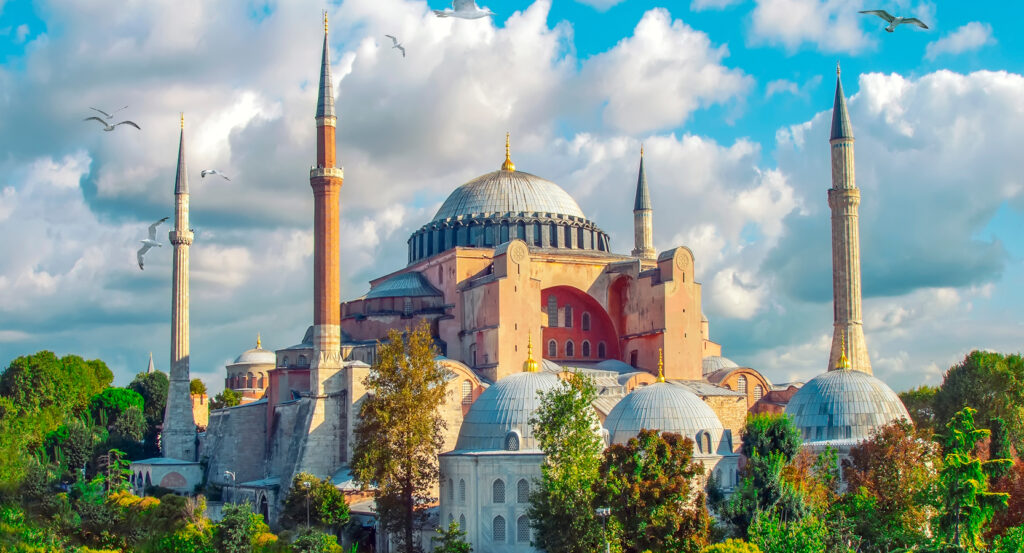
Why you should experience Mihrab and Minbar at Hagia Sophia Grand Mosque in Istanbul, Türkiye.
Mihrab and Minbar at Hagia Sophia Grand Mosque embody the moment when one civilization's masterpiece became the sacred heart of another, a seamless discussion between faiths written in marble, gold, and devotion.
Set against the apse once crowned by the Virgin and Child, the mihrab now points faithfully toward Mecca, bathed in the same light that once fell on Byzantine mosaics. Nearby stands the minbar, the preacher's pulpit, rising in carved elegance of white marble, its geometry refined yet serene. Together, they anchor the building's spiritual transformation. Standing before them, you feel the layered soul of Istanbul itself: Christian and Muslim, Eastern and Western, eternal and ever-changing. The symmetry of the mihrab beneath the vast dome symbolizes not replacement but continuation, a place where prayers have never ceased, only changed their language.
What you should know about Mihrab and Minbar at Hagia Sophia Grand Mosque.
When Hagia Sophia was converted into a mosque in 1453, Sultan Mehmed II ordered that its sanctity be preserved, only redirected toward a new qibla.
The mihrab, slightly off-center from the original apse to align with Mecca, was fashioned from finely veined marble and inset with gilded calligraphy quoting the Qur'an. Above it, delicate stained glass from the reign of Sultan Abdülmecid catches sunlight like jewels in air, illuminating verses that shimmer across the apse wall. The minbar, completed under Sultan Murad III in the late 16th century, exemplifies Ottoman refinement, an architectural poem in stone, crowned by a slender spire echoing the domes above. Its stairway, traditionally reserved for the Friday sermon, mirrors the rhythm of ascent found in Islamic art: a physical and spiritual elevation. Few realize that these additions were designed in harmony with the Byzantine structure, never piercing or defacing its older layers. The Ottomans revered Hagia Sophia as a divine inheritance, calling it Ayasofya-i Kebir Camii Şerifi, “The Great Holy Mosque of Divine Wisdom.”
How to fold Mihrab and Minbar at Hagia Sophia Grand Mosque into your trip.
When you visit Hagia Sophia, save this space for last, it's the quiet culmination of everything the building has become.
Approach the mihrab from the central nave and stand directly before it, allowing your gaze to follow the line of the marble arch upward to the dome's distant light. Visit mid-afternoon, when sunlight strikes through the southern windows and turns the gilded inscriptions to molten gold. From that position, look right to find the minbar: its sculpted panels patterned with arabesques that seem to move as shadows drift across them. Step closer and notice how the craftsmanship connects with the Byzantine marble beneath, one tradition flowing into another. Sit along the edge of the nave and let the sounds of whispered prayers and shuffling footsteps fill the vastness around you. In this union of stone and silence, Hagia Sophia's true miracle reveals itself: not that it has changed hands, but that it has never stopped being holy.
Where your story begins.
Foresyte Travel reveals places that feel extraordinary long before you arrive.
Experience premium editorial crafted for luxury travelers.





































































































